
Key facts
- Between 2012 and mid-2026, astronomers recorded 27 outbursts from AT 2016blu on a roughly 113-day cycle, and the star survived each eruption.
- Peter Conti coined the term luminous blue variable in 1984, and fewer than 20 confirmed LBVs are known in the Milky Way.
- During the outburst, AT 2016blu's X-ray brightness jumped more than 100-fold to log L_X ≈ 38.64 ± 0.11 erg per second, about 100 trillion times the Sun's X-ray output alone.
- Infalling matter forms a hot rotating disk spiraling inward, radiating visible light, then ultraviolet, then X-rays at about 10 million degrees Celsius, producing a flare visible across millions of light-years.
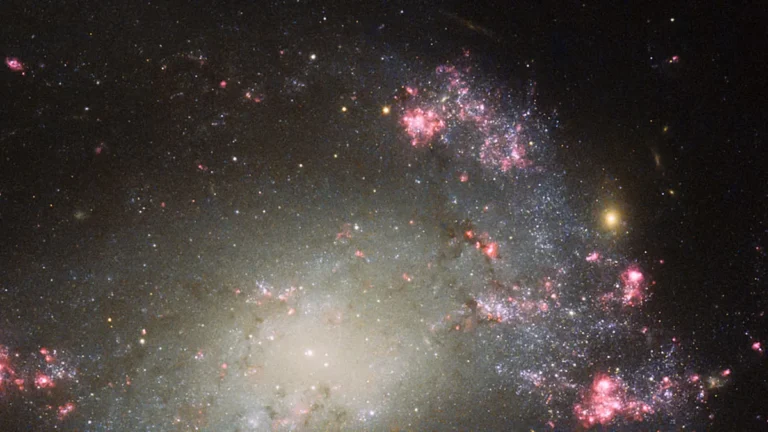
The research team led by Mojgan Aghakhanloo of the University of Virginia reported in The Astrophysical Journal on November 9, 2026, that AT 2016blu, a luminous blue variable, orbits a black hole or neutron star in NGC 4559, a galaxy some 30 million light-years away. The work ends a 14- to 15-year puzzle about an unstable massive star that brightens repeatedly like a supernova without destroying itself. Co-authors on the study include Núria Torres-Albà and Nathan Smith.
Such an object is a massive star that flares so brightly it looks like a supernova from Earth, yet it survives after briefly going above its luminosity limit and blowing off material in a giant eruption. That sets impostors apart from true supernovae, which destroy the star, and makes AT 2016blu’s survival through repeated blasts the heart of the mystery. These stars weigh 20 to more than 100 times the Sun and erupt semi-regularly when radiation pressure and gravity pull against each other in an unstable zone of the temperature-luminosity diagram. These eruptions put out far more energy than a typical stellar wind, setting them apart from ordinary stellar behavior.
Peter Conti created the term luminous blue variable in 1984, and astronomers know of fewer than 20 confirmed examples in the Milky Way. Eta Carinae, the best-known galactic case, erupted in the 1840s and briefly ranked as the second-brightest star in the sky. Observers logged 27 eruptions from AT 2016blu between 2012 and mid-2026 on a cycle of roughly 113 days, and the star lived through each one. Fifteen years of regular brightening and fading formed the core of the mystery that the Chandra observation cleared up.
Each of the 27 eruptions lines up with one close approach in the binary orbit. Mojgan Aghakhanloo of the University of Virginia said astronomers observed the star brightening and fading on a steady schedule for 15 years without understanding why. Núria Torres-Albà said the star behaves like a supernova yet cannot be one, since it lives through roughly three eruptions per year.
Amateur astronomers working through the American Association of Variable Star Observers assembled a decade-long record of brightness measurements that fixed the 113-day orbital period, with more than 30 amateurs following the star’s brightness according to NASA reporting. Ground-based telescopes and robotic survey cameras also tracked the brightness, providing the long-term record needed to predict outbursts for the Chandra trigger.
Tech Times reports that thousands of amateur astronomers working through the association tracked the star’s repeated outbursts starting in 2012, calling the steady rhythm on a roughly 113-day cycle unusual even among supernova impostors. In March 2026, the team used a Chandra Target of Opportunity observation set to match the star’s predicted outburst maximum to show that a compact companion drives the eruptions. The Chandra Target of Opportunity program run by NASA lets astronomers pause scheduled observations for urgent, time-sensitive events.
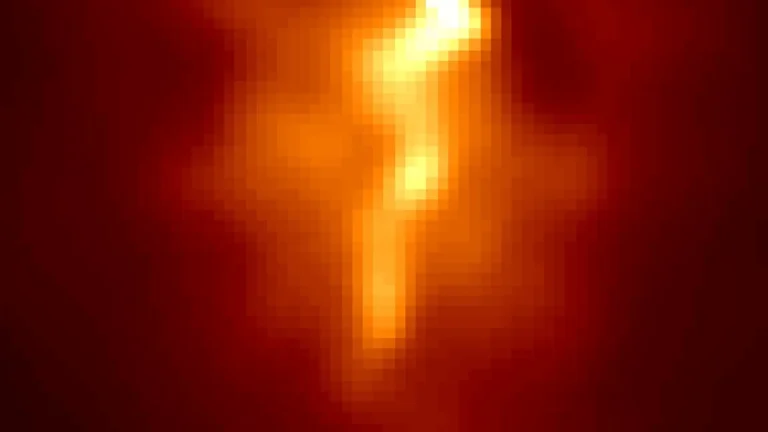
Nathan Smith of the University of Arizona said the team had to schedule Chandra observations to coincide with an optical outburst, which made the Target of Opportunity trigger essential for catching the X-ray flare at the correct orbital phase. The known ultraluminous X-ray source NGC 4559 X7 shines far more brightly than AT 2016blu during outburst and sits about 10 arcseconds away, close enough to merge with it in any other X-ray telescope. Chandra’s mirror assembly, 24 years old, produces the sharpest X-ray images ever, separating sources only fractions of an arcsecond apart in a way no other space instrument matches. That resolution let astronomers assign the X-rays to AT 2016blu instead of to the brighter nearby source.
In outburst, the star’s X-ray brightness rose more than 100-fold to log L_X ≈ 38.64 ± 0.11 erg per second, roughly 100 trillion times the Sun’s own X-ray output. Chandra observations from 2001 to 2002, before the eruptions started, show the star was at least 100 times fainter in X-rays then than during outburst, a baseline indicating the flare appeared with the eruptive activity instead of staying constant. The implied accretion rate onto the companion comes to at least 8 × 10⁻⁸ solar masses per year, a rate consistent with a neutron star or stellar-mass black hole fed by the massive star’s wind. That rate supports the view that material captured from the star’s strong stellar wind powers the compact object.
Material falling inward forms a hot rotating disk that spirals inward and emits visible light, then ultraviolet, then X-rays at roughly 10 million degrees Celsius, creating a flare visible across millions of light-years. That process connects the star’s optical outburst, which looks like a supernova, to the X-ray signature of matter accreting onto a compact object. Falling gas can heat to 10 million to 100 million degrees Celsius, or 18 million to 180 million degrees Fahrenheit. At those temperatures, the gas gives off most of its energy as X-rays, making X-ray telescopes like Chandra the right tools for studying these accretion-driven systems, including AT 2016blu.
When matter strikes a neutron star or black hole, gravitational potential energy converts to kinetic energy and then to heat with remarkable efficiency. Captured material whips around at nearly light speed and grows hot enough to radiate bright X-rays. Nathan Smith of the University of Arizona said X-rays heat the dense gas surrounding the system, causing it to shine in visible light.
AT 2016blu and its compact companion travel an elliptical orbit, reaching periastron, the orbit’s closest approach, every 113 days when the compact object’s gravity pulls in a surge of material from the star’s wind. After periastron, the accretion rate drops, X-ray output fades, and the binary returns to relative quiet until the next close pass. Random stellar outbursts would not hold to a fixed schedule, so the star’s steady rhythm pointed to an orbital period set by a gravitational companion instead of random instability.
Astronomers put AT 2016blu’s mass at no less than 33 times the mass of the Sun. The study confirms a compact object is the companion but cannot yet say whether the remnant is a neutron star or a black hole. Telling them apart would call for X-ray pulsations, a thermonuclear flash on a neutron star’s surface, or a precise spectroscopic mass measurement, none of which is possible for AT 2016blu yet. The X-ray luminosity and inferred accretion rate match either a neutron star or a black hole companion.
A 2025 study by Pintore et al. found pulsations in the nearby ultraluminous X-ray source NGC 4559 X7 that suggest a neutron star, meaning NGC 4559 may hold two separate compact-object binaries of different types. AT 2016blu shines brightly enough in X-rays to qualify as a candidate ultra-luminous X-ray source, hinting at a connection between ULXs and violent stellar eruptions. Since many ULXs vary sharply in X-ray brightness, the finding links the erupting impostor to a rare and poorly understood class of objects.
When AT 2016blu eventually blows up as a true supernova, possibly within tens of thousands of years, it will leave behind a second compact object, creating a double compact object binary. Gravitational-wave emission will tighten the double compact object binary’s orbit over millions of years until the two remnants merge. These mergers match events seen by the LIGO-Virgo network since 2015, though how they form remains an open question.
The LBV phase lasts only tens of thousands of years, compared with millions for a full stellar lifetime, so a compact object orbiting an LBV offers a rare chance to observe. That brevity makes AT 2016blu a unique window into how massive-star binaries evolve. The team won more Chandra time to study AT 2016blu and to hunt for other LBV systems with hidden compact companions.
The Vera C. Rubin Observatory’s Legacy Survey of Space and Time starts full operations in 2026 and will repeatedly scan the southern sky for ten years, potentially turning up more LBV-plus-compact-object binaries. Upcoming surveys hope to repeat this discovery on a much larger scale using multi-year records of variability. NASA’s Marshall Space Flight Center manages Chandra, while the Smithsonian Astrophysical Observatory’s Chandra X-ray Center runs science operations from Cambridge, Massachusetts.
Proposed NASA budget cuts threaten to sharply reduce or end Chandra’s operations within the next few years, even though AT 2016blu demonstrates science that cannot be done without it. The discovery’s reliance on Chandra’s unique angular resolution shows what would be lost if the 24-year-old observatory’s operations are cut back. Around Prague reports that NASA called the discovery the first X-ray detection of this kind of erupting star and the first such object with a black hole or neutron star companion. The discovery may help explain brightness changes before a supernova, because astronomers suspect much of that behavior comes from massive stars orbiting compact objects or other massive stars.



Join the discussion