Key facts
- ExoColumn matched other radiative-convective equilibrium models to within a small number of kelvin through the troposphere after calibration to present-day conditions.
- Benchmarks at the line-by-line level found the ExoRT and Clima radiation cores match outgoing longwave flux within a few percentage points.
- Using the same inverse climate modeling method as earlier studies, the work sets the inner edge limit for a moist greenhouse at 0.970 au.
- The work sets an inner-edge runaway-greenhouse limit at 0.966 au.
Researchers Jacob Haqq-Misra, Eric T. Wolf, and Ravi K. Kopparapu published a study in The Astrophysical Journal in 2026 that validates the Clima habitable-zone boundaries used to select exoplanet targets and introduces a new one-dimensional climate model called ExoColumn, providing the first independent check on the long-standing limits using a comparable model.
The Clima one-dimensional radiative-convective equilibrium climate model has served as a standard reference for choosing exoplanet targets. Its published habitable-zone boundaries had never undergone independent validation using a comparable model before this study, making the new comparison the first independent check on the long-standing limits. The habitable zone covers the span between orbits hot enough to boil surface water and orbits cold enough to freeze it, with water described as a key ingredient for life.
The zone represents a balance between sunlight and atmospheric warming. Greenhouse gases such as carbon dioxide and water vapor keep Earth warm enough for liquid water and life. Without atmospheric warming, Earth’s average surface temperature would fall to about 0°F (-18°C), below the freezing point of water.
Mars sits just beyond the habitable zone’s outer edge and displays clear evidence of ancient rivers and lakes, illustrating that Earth’s rocky neighbors inform the zone but that it is not a perfect predictor of habitability. Venus sits too near the sun to lie within the habitable zone, though some evidence suggests it may have had water in the past, with the amount and duration uncertain.
The habitable zone offers astronomers a starting point for identifying planets that could host liquid water without requiring full knowledge of a planet’s atmosphere or history. The source calls this a powerful idea that directs astronomers where they might expect to find liquid water.
The new work centers on ExoColumn, a one-dimensional radiative-convective equilibrium model that combines an independently developed atmospheric column physics package with the ExoRT correlated-k radiative transfer core. The same ExoRT core also powers the three-dimensional ExoCAM model, linking the new one-dimensional work to an existing framework.
To establish baseline credibility, the researchers calibrated ExoColumn to present-day conditions. Following that calibration, ExoColumn matched other radiative-convective equilibrium models through the troposphere to within a small number of kelvin, a step taken before the study compared ExoColumn boundaries against the published Clima limits.
Line-by-line benchmarks found that the ExoRT and Clima radiation cores match outgoing longwave flux within a few percentage points, establishing a direct radiation-core comparison. The source traces the remaining differences to the distinct spectral line databases used by the two radiation cores, which account for the small flux discrepancies between the models.
Applying the same inverse climate modeling method used in earlier studies, the research sets the inner edge limit for a moist greenhouse at 0.970 au. This boundary is one of three habitable-zone distances derived by applying that established method. The research also establishes an inner-edge runaway-greenhouse boundary at 0.966 au, which sits just inside the moist-greenhouse boundary at 0.970 au, placing the two inner-edge limits close together.
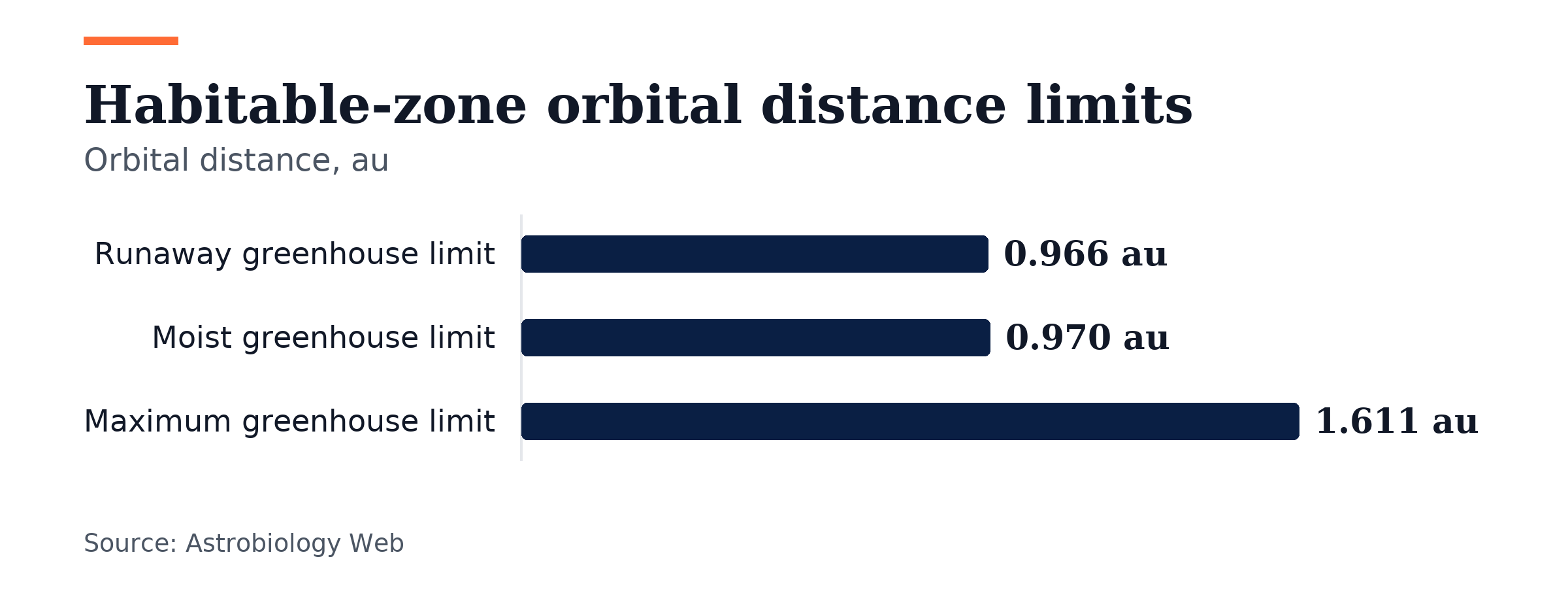
For the outer edge, the research establishes a maximum-greenhouse boundary at 1.611 au at a carbon dioxide partial pressure of 8.7 bar, with the pressure specified as part of the maximum-greenhouse calculation for the outer edge. This marks the distant orbital boundary where a planet can still retain enough greenhouse warming for surface water to remain liquid under a thick carbon dioxide atmosphere.
The research team extended the calculations to 12 host stars, with temperatures spanning 2000 K to 7200 K, covering stars cooler and hotter than the sun and broadening where researchers can apply the boundaries. They also modeled worlds of 0.1, 1, and 5 Earth mass, representing sub-Earth, Earth-like, and super-Earth cases alongside the stellar temperature range, so the results span a variety of planetary sizes.
ExoColumn limits sit systematically nearer to the host star than Clima limits, yet the agreement between the two models stays within a few percent in orbital distance. Despite the inward shift, this close match supports the robustness of the published Clima habitable-zone boundaries. The close match between two independent models means the older Clima limits remain trustworthy for selecting exoplanet targets, even as the newer model shifts the boundaries slightly inward.
The research team supplied updated habitable-zone boundary coefficients for use by the research community.
The study appeared in The Astrophysical Journal in 2026 as volume 1011, article 253. The study’s authors are Jacob Haqq-Misra, Eric T. Wolf, and Ravi K. Kopparapu, and the work carries a dedication to Jim Kasting according to the source’s comments section, where the dedication appears in the comments field of the source document.
The arXiv preprint 2611.09475 was submitted on Fri, 6 Nov 2026 at 13:55:59 UTC and is 1,025 KB.
NASA is planning the Habitable Worlds Observatory, which the source describes as the first space telescope intended to search for signs of habitability and life on planets orbiting other stars. The observatory represents a dedicated facility for assessing whether planets around other stars could support life and habitability, filling a role no current space telescope has been specifically designed to perform.
The observatory will directly image Earth-sized planets orbiting sun-like stars to examine their atmospheres in detail. Observatory instruments will study starlight passing through planetary atmospheres to detect gases such as carbon dioxide, methane, water vapor and oxygen.
Development of the Habitable Worlds Observatory continues in science and engineering, with a possible launch targeted for the 2040s. Combined with current telescopes, the observatory may help scientists determine whether Earth’s climate-regulating processes are common across the galaxy or unique to Earth.


Join the discussion