Key facts
- Anduril's oven-sized satellite, named Anduril-216, launched in July on a SpaceX rideshare mission carrying technology-demonstration payloads.
- Gokul Subramanian, Anduril's senior vice president of engineering, said the sensor captures long-wave infrared imagery with a huge dynamic range and very low solar exclusion, allowing it to see objects in full dark.
- Subramanian said Anduril is focused on selling space-domain-awareness data to the US military rather than complete satellites or sensors, and is not currently offering the system as a merchant supplier.
- Anduril-216 is Anduril's first satellite on orbit.
Anduril Industries announced on Nov. 10, 2026, that its first satellite on orbit, Anduril-216, successfully demonstrated a sensor built to follow spacecraft that maneuver while hidden by Earth’s shadow. Anduril said on Tuesday that the satellite’s purpose is to demonstrate space domain awareness missions, and the company reported the success of its technology demonstration mission that day.
Anduril paid for the sensor project with internal capital instead of an external development contract. The company said internal capital covered the work rather than an outside deal.
The oven-sized satellite is Anduril’s first on orbit, and it launched in July 2026 on a SpaceX rideshare flight carrying technology-demonstration equipment. It flies about 590 kilometers (366 miles) above Earth and spends roughly one-third of each orbit in darkness, placing it in low Earth orbit and giving the infrared imager regular viewing opportunities during orbital darkness.
The satellite carries an edge-compute processor, a computer that processes data on the satellite itself, plus an adaptable power-management system and a long-wave infrared space sensor for detecting objects in orbit. The technology-demonstration package aboard the small satellite included those three items. Long-wave infrared is heat-sensing light beyond visible wavelengths. The sensor detects spacecraft by their heat signatures, including during eclipses when optical tracking loses sight of them, and heat-signature detection works even when no sunlight illuminates the target, unlike traditional optical sensors.
Optical tracking loses sight of satellites when they pass through Earth’s shadow, so a spacecraft that maneuvers during orbital night could temporarily disappear from monitors. A satellite entering the planet’s shadow can disappear from visible-light sensors, leaving a brief blind spot during maneuvers. Adam Thurn, Anduril’s vice president and general manager of orbital systems, said the sensor closes the gap because visible sensors cannot see unlit satellites during eclipse periods. He added that the US lacks ground sensors in adversary nations, creating a visibility problem when sunlight does not illuminate spacecraft during eclipse periods.
Gokul Subramanian, Anduril’s senior vice president of engineering, said the sensor takes long-wave infrared pictures with a huge dynamic range and very low solar exclusion, allowing it to see objects in full dark. He said the Sun rarely blocks the sensor because of its low solar exclusion, making full-dark observation possible. “we’re blocked by the Sun very rarely, and we can see things in full dark.”
Subramanian said the long-wave infrared sensor is less affected when pointed toward the sun, which lets it detect adversary spacecraft that might otherwise hide. That feature helps the instrument locate adversary spacecraft attempting to stay hidden by operating outside sunlight. During a reporter briefing on Monday, he also said space is a warfighting domain and that fighting there is impossible without the ability to see. The comment came during a briefing about Anduril’s first on-orbit satellite and its relevance to government space domain awareness needs.
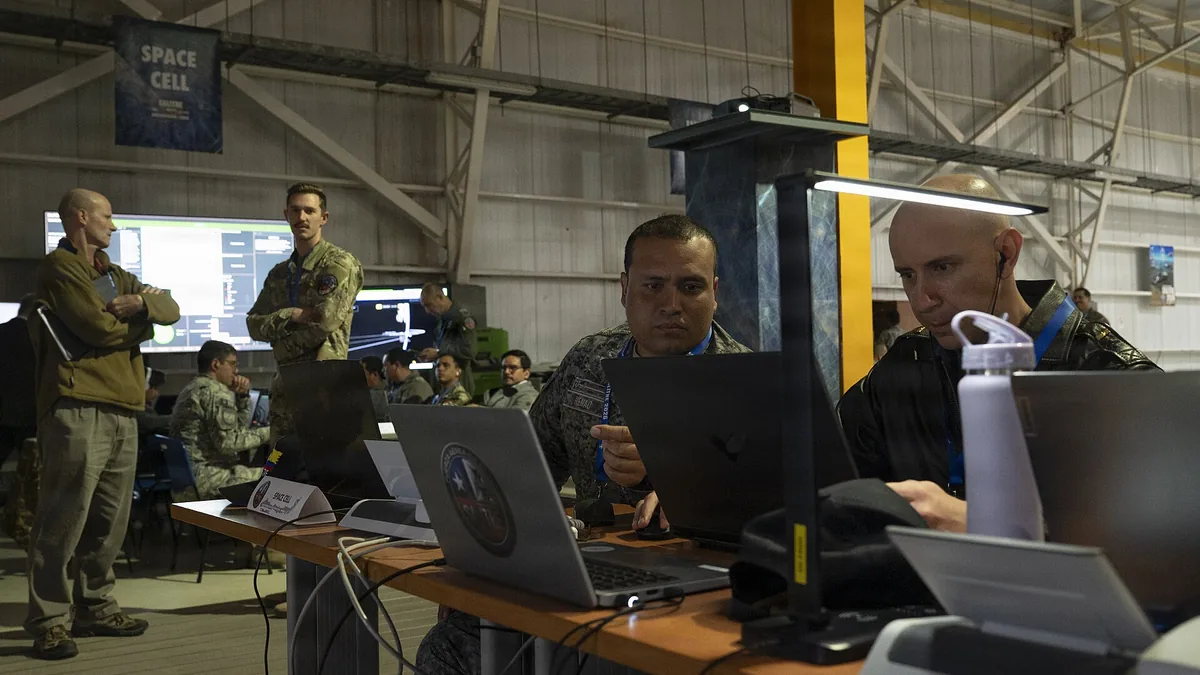
The US military and commercial data providers use ground-based and space-based radars and optical sensors to monitor satellite traffic, and the existing monitoring network combines radar and optical systems on the ground and in space. The US Space Force tracks satellites to spot potentially threatening adversary movements and to send collision-risk alerts to satellite operators around the world; these two missions cover threat awareness and space traffic safety. Anduril bought commercial satellite-tracking company ExoAnalytic Solutions earlier in 2026, adding a commercial tracking company to its portfolio.
Thurn said an Anduril-216 image showing the Moon in infrared above Earth’s horizon was only a glimpse of the instrument’s capabilities. The image served as an early example of what the sensor can capture from orbit. Thurn said the sensor can make both unresolved and resolved images and could inspect other satellites if it gets close enough, a capability that could allow close-up examination of other spacecraft during proximity operations.
Anduril-216 carries a long-wave infrared sensor developed by Anduril along with two third-party electro-optical sensors. The satellite’s compute module merges data from infrared and visible-light imagers to create tracking solutions without help from the ground, and onboard sensor fusion aims to cut reliance on ground stations for processing and tracking calculations.
Anduril is optimizing the sensor for low-Earth orbit, although it could work in other orbits and eventually near the Moon in cislunar space. Cislunar space is the region between Earth and the Moon. The company sees potential uses beyond low-Earth orbit, including around the Moon, though the current focus is the lower orbit regime.
Apex Space, a satellite-manufacturing startup, built the spacecraft platform for Anduril-216, and the company used an outside builder for the bus instead of making it in-house. Subramanian said Anduril does not plan to start its own satellite production line and will buy third-party platforms to integrate with sensor and computing modules; it plans to buy existing platforms and add its own sensor and computing packages for different missions.
Subramanian said Anduril plans to sell space-domain-awareness data to the US military instead of complete satellites or sensors, and is not currently offering the system as a merchant supplier. He said military data sales are the current business model, though Anduril could become a merchant supplier later.





Join the discussion