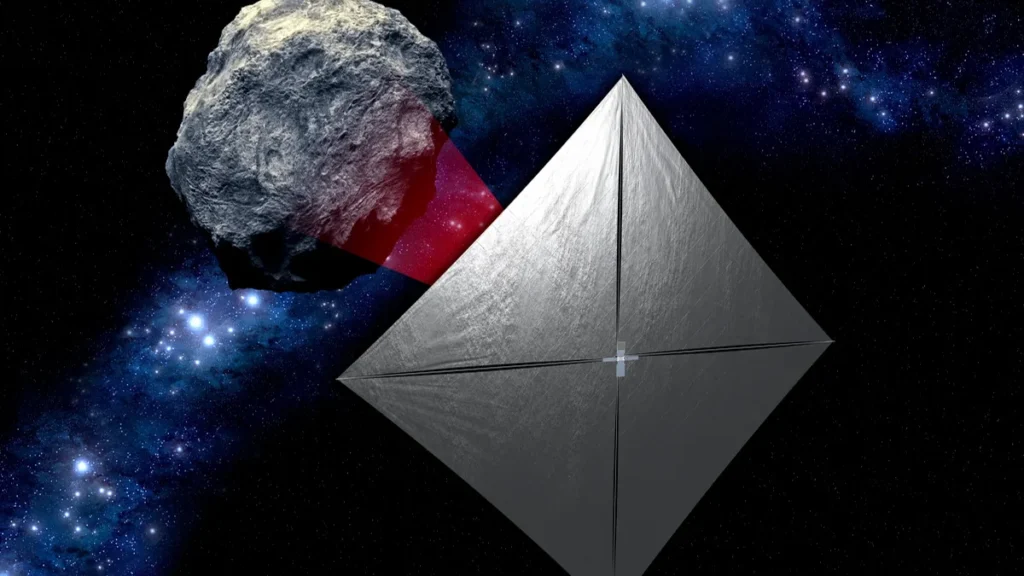
Key facts
- The object measures about 7.5 miles (12 km) across, making it larger than 99% of asteroids, and its path around the sun takes it farther out than the paths of most known active asteroids.
- A team led by researchers at Northern Arizona University and other institutions found the activity in Zwicky Transient Facility data and released a study on arXiv on October 22, 2026 that remains without peer review.
- Archival Zwicky Transient Facility images from June 25, 2026, showed a thin, linear tail stretching at least 32 arcseconds past the asteroid's primary body.
- A collision with another space rock may have ejected dust from the asteroid's surface, and the particles might slowly spread outward, producing a tail that fades over time.
A team led by researchers at Northern Arizona University found the activity in Zwicky Transient Facility data and released a study on arXiv on October 22, 2026, reporting that asteroid 1995 BJ4, also designated 6993, has been shedding material and growing a comet-like tail in the main asteroid belt between Mars and Jupiter. The activity was first noted in summer 2026, and a machine-learning model within the Solar System Notification Alert Processing System flagged an image of the asteroid with 99.9% confidence on August 5, 2026.
Archival Zwicky Transient Facility images from June 25, 2026, showed a thin, linear tail stretching at least 32 arcseconds past the primary body, indicating the activity began before the automated detection. The team checked archival observations after the automated alert and determined the tail had existed since late June. Scientists had prepared the algorithm to spot the fuzzy look of active asteroids, and the detection prompted the review of earlier imagery. The study’s preprint status means the results have not yet undergone formal peer review.
The team explained that most asteroids are static rocky bodies in the main belt between Mars and Jupiter, but active asteroids like 1995 BJ4 occasionally release dust and gas to form a fuzzy cloud or visible tail while remaining in that region. Researchers have found about 20 main-belt comets so far. The newly observed object measures about 7.5 miles (12 km) across, larger than 99% of asteroids, and its orbit takes it farther out than most known active asteroids. This makes 1995 BJ4 a large and distant example of this category.
Researchers ruled out rotational breakup after evaluating whether the asteroid’s spin could be ejecting dust and finding that the measured rotation period of 3.9 hours was too slow to throw material into space. Two other mechanisms remain viable: a collision with another space rock that may have ejected dust from the asteroid’s surface, and sublimation, where sunlight warms buried ice until it vaporizes and streams away.
The particles from a collision might slowly spread outward, producing a tail that fades over time, while sublimation is the process behind cometary comas and tails. Both collision and sublimation remain viable explanations for the asteroid’s activity. The team will watch for changes as the asteroid nears perihelion, the point in its orbit closest to the sun, in January 2027; an increase in activity would suggest ice is turning to gas, while a fading tail would support the collision scenario.

The team noted that if sublimation proves responsible, 1995 BJ4 would rank as the largest-known main-belt comet and travel farther from the sun than other known main-belt comets, reaching perihelion at roughly 2.85 times Earth’s distance from the sun. The asteroid‘s perihelion distance places it beyond the range of known main-belt comets, strengthening its potential record-setting status if cometary activity is confirmed.
The team reported that the object’s colors and reflectivity do not align cleanly with established categories, leaving doubt about its surface contents. Scientists hope data will clarify the asteroid’s makeup as part of figuring out its true nature, highlighting how the boundary between asteroids and comets is blurring as objects like 1995 BJ4 show cometary features while orbiting among asteroids.
The team emphasized that ongoing observations matter for identifying what drives the activity as 1995 BJ4 nears perihelion in January 2027. An increase in activity near perihelion would suggest ice is turning to gas, whereas a fading tail would back the collision scenario. Researchers want data on what the object consists of, since its colors and reflectivity do not align cleanly with established categories.



Join the discussion