Key facts
- A Yale- and Columbia-led study finds that the majority of Earth's carbon came from the outer solar system late in the planet's development.
- The work delivers the first direct measurement of carbon isotope ratios in Earth's core, according to Damanveer Grewal, a Yale assistant professor of Earth and planetary sciences and study co-author.
- Researchers under Yves Moussallam at Columbia's Lamont-Doherty Earth Observatory created a technique to detect core carbon by studying Hawaiian lavas drawn from different parts of a volcanic plume.
- Grewal, who led that research strand, said outer-solar-system carbonaceous chondrites could enter the core permanently only in Earth's final main assembly stage.
A study led by researchers at Yale and Columbia and published in 2026 in Proceedings of the National Academy of Sciences found that most of Earth’s carbon arrived from the outer solar system late in the planet’s development. The paper is Isotopically heavy carbon in the core by Yves Moussallam et al., published in Proceedings of the National Academy of Sciences in 2026 with DOI 10.1073/pnas.2610912123. The study tackles a long-running question about where Earth’s carbon came from and how volatiles reached the planet.
Earth’s core carbon matched carbonaceous chondrites exactly, while being too heavy to match the rocky, carbon-poor inner-solar-system material that built most of the planet. Grewal, who led that research strand, said outer-solar-system carbonaceous chondrites could enter the core permanently only during Earth’s final main assembly stage, because later collisions would have lost an earlier arrival to space and a later arrival would have found the core already closed. The sources present this as the single window of opportunity for outer-solar-system carbon to become part of the core.
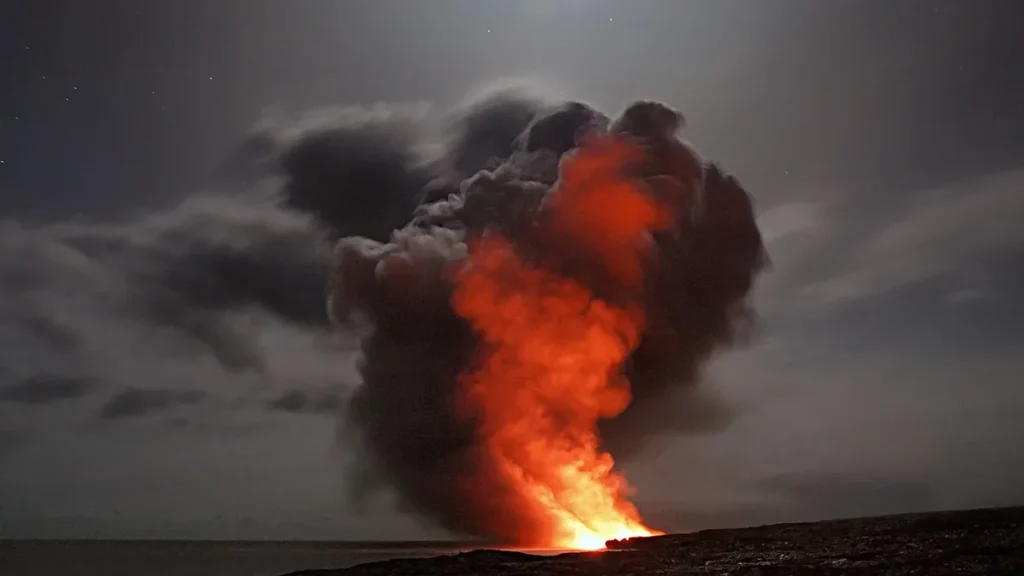
Yves Moussallam of Columbia’s Lamont-Doherty Earth Observatory led researchers in creating a technique to detect core carbon by studying Hawaiian lavas drawn from different parts of a volcanic plume, which is a heated column of melted rock and gas released during an eruption. Sampling plume sections let the team look for material from the boundary between Earth’s core and mantle. The team studied magma droplets called melt inclusions, bits of molten rock trapped inside crystals that form in magma, with each droplet capturing a picture of the magma from deep inside the planet. The droplets come from different sections of the volcanic plume, and the samples came from historic Hawaiian eruptions, including Keanakākoʻi from 1500 to 1840 and Kīlauea Iki in 1959.
The researchers found a uniquely heavy signature from carbon-13, a heavy isotope of carbon, in magma believed to come from plume sections at the boundary between Earth’s core and mantle, and the mantle is Earth’s rocky upper layer. Grewal said the team reads this as carbon escaping from the core. “We interpret this as carbon leaking from the core,” Grewal said.
Damanveer Grewal, a Yale assistant professor of Earth and planetary sciences and study co-author, said the work delivers the first direct measurement of carbon isotope ratios in Earth’s core, and researchers had considered it impossible to observe core carbon or measure its isotopic composition. The sources say this assumption existed before the Yale and Columbia team devised a way to detect core carbon using Hawaiian lavas. “This is the first observational estimate of the isotopic composition of carbon in Earth’s core,” Grewal said.
The research may affect understanding of core carbon’s role during episodes of intense volcanic activity, the researchers said. This comes on top of answering a long-running question about where Earth’s carbon came from.
Six other institutions contributed researchers: the Institut des Sciences de la Terre d’Orléans in France, the U.S. Geological Survey, the University of Oregon, the University of Hawaiʻi at Mānoa, Brown University, and the University of California-Santa Barbara. The U.S. National Science Foundation provided part of the funding for the research.



Join the discussion