Key facts
- The CLPS 2 companies are Blue Origin, Firefly Aerospace, Intuitive Machines, ispace-US, Lockheed Martin Space, Northrop Grumman Space Systems, SpaceX, and Voyager Technologies.
- NASA increased the existing CLPS 1.0 contract ceiling from $2.6 billion to $4.2 billion to support Phase One Moon Base objectives.
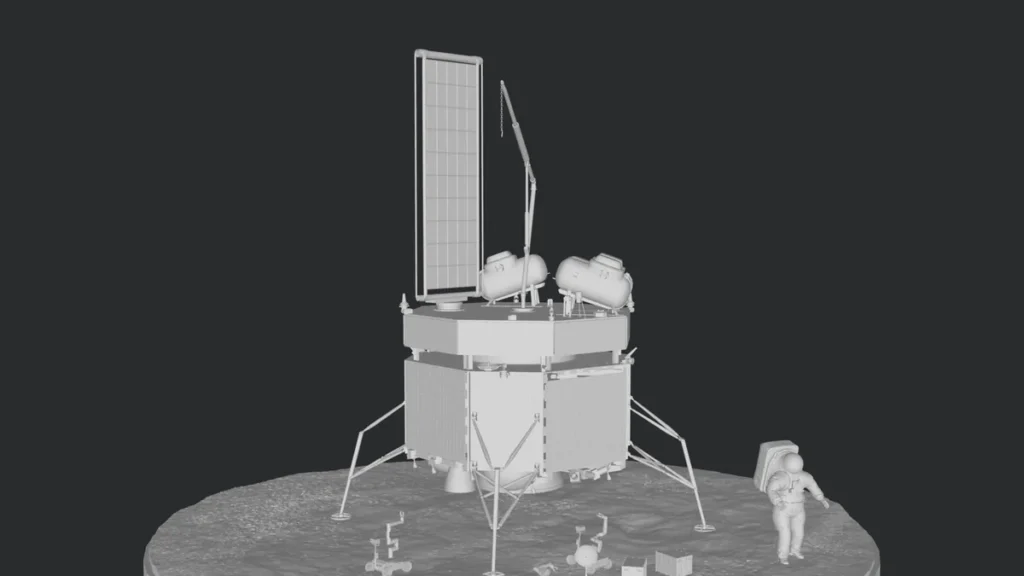
- NASA awarded Blue Origin a $94 million base contract plus a $140 million option to land PROMISE on the Moon's South Pole with a Mark 1 lander.
- The VADR task orders went to Arrow Science and Technology, Blue Origin, and Impulse Space.
NASA awarded billions of dollars in lunar infrastructure contracts on Saturday, Nov. 7, 2026, at Kennedy Space Center during the agency’s first-ever aerospace technology expo, MAX POWER.
The agency selected eight companies to compete for CLPS 2, a lunar delivery contract vehicle spanning 10 years and worth up to $10 billion. The companies are Blue Origin, Firefly Aerospace, Intuitive Machines, ispace-US, Lockheed Martin Space, Northrop Grumman Space Systems, SpaceX, and Voyager Technologies.
The $10 billion is a combined maximum value, not missions awarded immediately. NASA also lifted the existing Commercial Lunar Payload Services 1.0 ceiling to $4.2 billion from $2.6 billion for Phase One Moon Base objectives.
CLPS 2 expands on CLPS 1.0 to create cargo landers and vehicles that will continuously ferry supplies and crew between Earth and the lunar surface. The goal is to deliver materials ahead of time, so humans can begin building the base immediately upon arrival. Voyager Technologies recently acquired Astrobotic. “We are building the Moon Base mission by mission,” Isaacman said.
Four CLPS landers have launched so far. Astrobotic’s did not reach the Moon. The two Intuitive Machines vehicles landed but then tipped over. Firefly’s Blue Ghost Mission-1 was a complete success.
The Commercial Lunar Payload Services program began in 2018, under which NASA purchases delivery services from companies that design, build and launch their own landers. NASA plans additional South Pole landers and rovers before astronauts arrive to gather data on regolith, lighting, and thermal conditions.
Three CLPS missions planned for 2026 have moved to 2027. The agency also shifted a planned cadence of 10 CLPS missions in 2027 to 2028. As of May, NASA had expected three CLPS missions to launch in 2026, but none will launch this year because of schedule slips and ongoing engine testing. The three Moon Base missions designated for 2026 are Blue Origin‘s Blue Moon MK1 cargo lander Endurance, Astrobotic’s Griffin, and Intuitive Machines’ IM-3 Trinity, and none will launch this year.
García-Galán said Griffin will not launch before January at the earliest, citing limited lunar launch windows and ongoing engine testing; Endurance and Trinity have already slipped. Lori Glaze said at a MEPAG meeting that the agency expects only four CLPS missions in 2027: Endurance, Trinity, and one Firefly mission.
The agency awarded six task orders totaling about $1.3 billion under the $5 billion Venture-Class Acquisition of Dedicated and Rideshare contract. Arrow Science and Technology, Blue Origin, and Impulse Space received the task orders. The work includes cargo transport from Earth to lunar orbit, communications and navigation testing, MoonFall drone deliveries to the surface, and Orbital Transfer Vehicle demonstrations. The agency likened Orbital Transfer Vehicles to long-distance freight trucks that carry cargo landers to the Moon and deploy them safely.
In-space transportation will be handled by Blue Origin, Firefly Aerospace, Impulse Space, and Quantum Space.
Some missions will launch on Blue Origin’s New Glenn, Relativity Space’s Terran R, and SpaceX’s Falcon 9 rockets. Arrow Science and Technology said its award totals $185 million and pairs a Falcon 9 rocket with a Quantum Space Orbital Transfer Vehicle. Impulse Space said it holds two task orders, one using a Falcon 9 and Mira OTV and another planned on Terran R with a Helios kick stage and lunar lander vehicle. Blue Origin’s New Glenn vehicle suffered an explosion in May.
Blue Origin received a $94 million base contract plus a $140 million option to deliver PROMISE to the Moon’s South Pole on a Mark 1 lander. JPL is building the rover. Its payload includes a drill that reaches 1 meter below the surface, spectrometers, temperature and radiation sensors, visible-light cameras, radiation-tolerant computing, and advanced autonomy sensors and algorithms. A Radioisotope Thermal Generator, a nuclear power source that keeps hardware warm, will let PROMISE operate through two-week lunar nights and in permanently shadowed regions to analyze regolith, hunt for ice, and conduct general exploration.
NASA plans additional South Pole landers and rovers before astronauts arrive to gather data on regolith, lighting, and thermal conditions.
NASA plans to launch PROMISE in 2028 for an 18-month mission on the lunar surface, with investigations at the lunar south pole beginning in late 2028. JPL has committed $400 million to modify the PROMISE engineering test article for lunar operations, a cost separate from the Blue Origin delivery contract. Some Mars scientists worry the test article will no longer be available to help troubleshoot Curiosity, but Fox said a review team of subject matter experts concluded the Mars rover can continue with low risk. Isaacman said in June that he was considering using a JPL engineering test model, typically used to address problems with Curiosity or Perseverance on Mars, for a lunar mission.
SpaceX is set to fly communications satellites on Starship in 2028 under an existing lunar logistics contract for the Cislunar Communications Deployment Demonstration. The spacecraft resemble Starlink vehicles and will help build a future lunar communications network.
The agency will buy commercial components rather than an integrated system for a Mini-Communications and Solar Tower to provide surface power and communications. The agency expects a solicitation for a fully integrated system next year. Assembly of the equipment will take place at Marshall Space Flight Center in Huntsville, Alabama. Honeybee Robotics received an award for miniCAST energy storage, Redwire for power generation, and Yank Technologies for wireless power transfer.
The awards lay groundwork for surface infrastructure supporting long-term habitability for astronauts.
Artemis II flew around the Moon in April, and NASA aims to send American astronauts to the lunar surface in 2028. The Artemis program’s third mission will take place in 2027, with a return of people to the Moon planned for 2028. Artemis missions serve as precursors to the Moon Base, NASA said.
Phase One of the Moon Base strategy runs through 2029 and focuses on robotic exploration, infrastructure demonstrations, and commercial deliveries. Phase Two runs from 2029 to 2032, and the base becomes operational during Phase Three. The Ignition initiative aims to put a base on the Moon by 2032. At the March Ignition event, Isaacman laid out a long-term vision for a South Pole Moon Base starting with commercial robotic landers, rovers, communications, and solar and nuclear power.
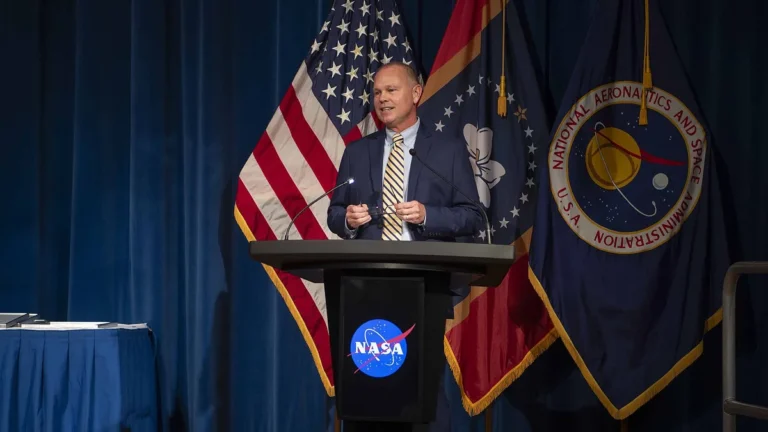
Following a Saturday skydive, Isaacman joined Moon Base Program Manager Carlos García-Galán, Science Mission Directorate head Nicky Fox, and acting Moon Base Utility and Infrastructure Office director Dayna Ise at a press conference to announce task order and contract awards. The MAX POWER event included Thunderbirds flyovers, Isaacman at the controls of an F-5 and a MiG-29, NASA T-38 trainers, and skydives by Isaacman and the U.S. Army Golden Knights.
The agency also unveiled a Moon Base Student Challenge offering $1 million in prizes for winning student ideas about lunar base problems. NASA also said applications are open for the next class of astronauts. Isaacman said during the Saturday press conference that the current CLPS contract works as all or nothing for one or two missions per year, but scaling up requires the flexibility to move pieces around. “Under the current CLPS contract, it’s all all or nothing,” he said.
“We are inviting students from across the country to help solve some of the problems,” Isaacman said. NASA has previously asked students to help with problems such as lunar dust clouds and human-capable landers.



Join the discussion