Key facts
- NASA's twin ESCAPADE probes each carried out a powered Earth flyby, pairing Earth's gravity with a sustained engine burn to slingshot toward Mars, and are headed for the Red Planet in September 2027.
- NASA's Heliophysics Division funds ESCAPADE as part of the SIMPLEx (Small Innovative Missions for Planetary Exploration) program, which backs innovative solar system missions with smaller budgets.
- Skyler Kleinschmidt, ESCAPADE program executive at NASA Headquarters, said the mission carries on the scientific legacy of past Mars missions with a team driving new innovations for the trip to and at the Red Planet.
- ESCAPADE's cameras took unique visible and thermal-infrared photos of Earth and the moon on July 3, 2026, from 363,250 miles away from Earth and 115,600 miles away from the moon.
NASA’s twin ESCAPADE spacecraft completed powered Earth flybys on Nov. 7 and Nov. 9, 2026, pairing Earth’s gravity with a sustained engine burn to slingshot the probes toward Mars, with arrival at the Red Planet expected in September 2027.
The first spacecraft finished its close approach to Earth and a roughly nine-minute trans-Mars injection burn (an engine firing that sends the spacecraft toward Mars) at 5 a.m. EST on Nov. 7, 2026, about 1,000 miles above the surface. The second completed its close approach and burn at 6 a.m. EST on Nov. 9, 2026, about 650 miles above the surface. The flybys concluded that day after the spacecraft spent months in a loiter orbit around Lagrange point 2 waiting for Earth and Mars to align favorably.
Asal Naseri, acting associate flight director for NASA’s Heliophysics Division, said the maneuver marked the first time NASA used a powered Earth flyby to propel a spacecraft toward Mars, and the agency performed it twice without flaw in two days. “This is the first time NASA has used a powered Earth flyby to propel a spacecraft toward Mars,” Naseri said.
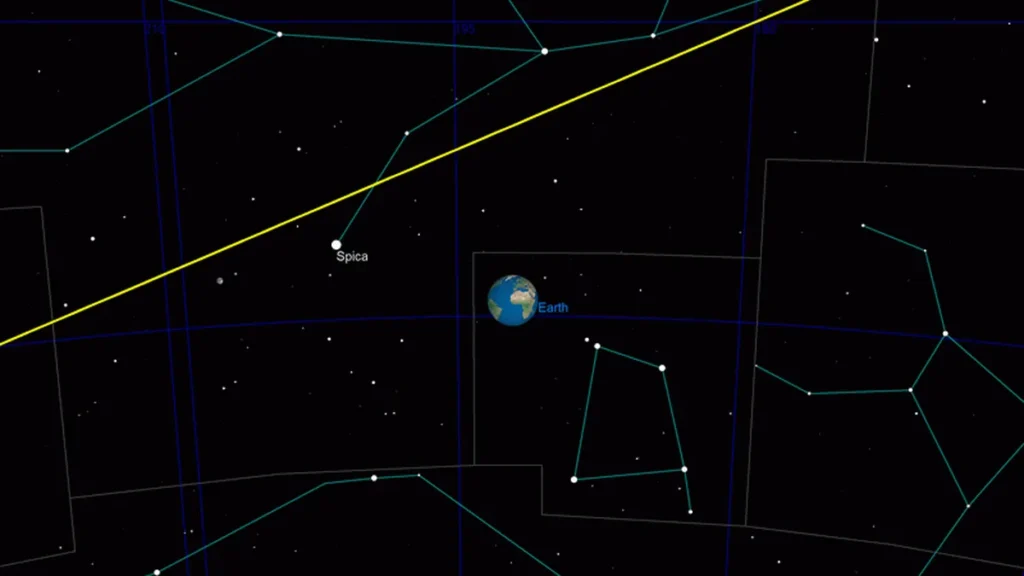
The journey began Nov. 13, 2025, when the spacecraft left Cape Canaveral Space Force Station in Florida as Earth and Mars sat on opposite sides of the Sun. Rather than flying straight to Mars, they entered a loiter orbit around Lagrange point 2, about a million miles from Earth, tracing a kidney-bean-shaped path until the planets aligned for the trip.
Jeff Parker of Advanced Space, the lead mission designer, said the loiter orbit and Earth flyby pioneer a new strategy for reaching Mars: launching almost anytime and using Earth’s gravity for a boost instead of waiting every two years for a direct launch when planetary alignment permits. Most other Mars missions travel directly to the Red Planet only during those two-year windows.
The spacecraft face a 10-month cruise to Mars, with trajectory correction maneuvers along the way to keep them on course for a September 2027 rendezvous. Upon reaching Mars two days apart, each will fire its engine for roughly 11 minutes to slow down and enter orbit, with insertion burns planned for Sept. 7 and Sept. 9, 2027.
At Mars, the twin probes will fly in formation to study how the solar wind, a million-mile-per-hour stream from the Sun, interacts with the Martian environment and drives atmospheric loss. During the cruise they will also study solar wind dynamics between Earth and Mars, adding to magnetotail observations gathered during the loiter phase.
Science operations are expected to start in June 2028, after months of moving into the first science formation, in which the spacecraft follow each other in the same orbit. Six months later, the pair will split into separate orbits — one farther from Mars to watch the incoming solar wind, the other closer to study the planet’s response in real time — during a campaign planned for five months.

Rob Lillis, ESCAPADE’s principal investigator at the University of California, Berkeley, said the mission will be the first science effort to choreograph two orbiters around Mars and permit coordinated observations of the Martian environment from two places simultaneously.
Michele Cash, ESCAPADE program scientist at NASA Headquarters, said understanding how the solar wind affects the Martian environment could help plan and prepare for future human exploration of the Red Planet. She linked the atmospheric science to the agency’s broader goal of preparing to send humans to the Red Planet.
NASA’s Heliophysics Division funds ESCAPADE through SIMPLEx, the Small Innovative Missions for Planetary Exploration program, which backs innovative solar system missions with smaller budgets. The University of California, Berkeley’s Space Sciences Laboratory leads the mission with Rocket Lab, NASA’s Goddard Space Flight Center in Greenbelt, Maryland, Embry-Riddle Aeronautical University, Advanced Space, and Blue Origin. Skyler Kleinschmidt, ESCAPADE program executive at NASA Headquarters, said the mission carries on the scientific legacy of past Mars missions with a team driving new innovations for the trip to and at the Red Planet.
On July 3, 2026, ESCAPADE’s cameras took visible and thermal-infrared photos of Earth and the moon from 363,250 miles from Earth and 115,600 miles from the moon, eight months after the November 2025 launch. The visible view showed Earth and the moon as crescents, about 8% sunlit on each face, while the thermal view showed Earth’s nightside at -10°F to 44°F (-23°C to 7°C) and the moon’s nightside at -280°F (-173°C), with Antarctica and part of Africa visible. The images served as a calibration check as the craft moved toward its loiter orbit about 1 million miles from Earth.
Faculty and students at NAU designed and built the camera systems with support from the University of California, Berkeley, and Rocket Lab, with Christopher Edwards, Chris Haberle, Michael Shafer, and David Trilling leading the students’ work. Edwards said the last unique view of Earth and the moon came when Artemis II astronauts flew by. “The last time we got a unique view of Earth and the moon was when the Artemis II astronauts flew by,” Edwards said.
At Mars, the NAU cameras could return true-color views from unseen angles and infrared data on polar cap changes, and the team plans to recruit students with backgrounds in computing, data analysis, and science to help operate the instrument and analyze returned images.


Join the discussion