Key facts
- The research team was headed by José María Palencia from the Institute of Physics of Cantabria.
- Astronomy & Astrophysics published the paper on Sept. 30.
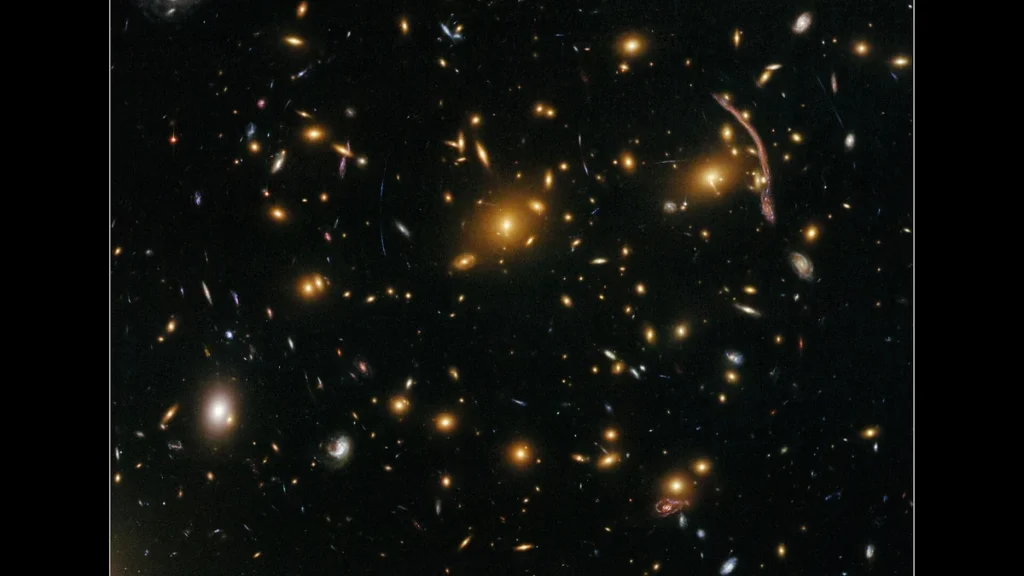
- The Dragon galaxy sits at redshift 0.725 while Abell 370, a massive galaxy cluster, stretches and magnifies its light.
- Along caustic lines, gravitational lensing focuses light so strongly that stellar brightness can climb to hundreds or thousands of times normal levels.
A team led by José María Palencia of the Institute of Physics of Cantabria identified 104 magnified stellar events in the Dragon galaxy, roughly 6.5 billion light-years away, using JWST images gathered from 2022 to 2024. The haul more than doubles the old mark of 44 detections in that galaxy.
The journal Astronomy & Astrophysics published the study on Sept. 30. It carries DOI 10.1051/0004-6361/202660640. The study used JWST images gathered across three observing cycles between 2022 and 2024 and a time-domain method that watches for brightness changes tied to caustic crossings, brief flares when the cluster’s gravity focuses a star’s light. Researchers compared pictures of the same arc and region taken at different times because these brightening events are temporary.
The Dragon galaxy lies at redshift 0.725 behind Abell 370, a massive galaxy cluster whose gravity stretches and magnifies the galaxy’s light; redshift measures how much the universe’s expansion has stretched that light. Gravitational lensing, the bending of light by a massive object’s gravity, draws part of the galaxy into a long feature called the Dragon arc. Abell 370’s gravity bends light unevenly because the cluster is not an even distribution of mass. Along caustics, a star’s brightness can climb by hundreds of times the normal level, or by thousands in the strongest cases.
Stars in the Dragon galaxy move across microcaustics, tiny focusing lines made by the cluster’s own stars and possibly by dark matter. At a crossing, two images of a star merge and the star reaches peak brightness; it fades back over days to weeks while the images disappear. Repeated imaging lets researchers spot these short-lived brightening events.
The team processed images collected from 2022 to 2024, correcting for slightly different viewing angles and taking out bright unrelated objects and the galaxy’s bright core, along with other contaminants. They measured normal background noise from a separate JWST image taken far from the critical curve, the boundary of highest magnification where microlensing does not occur. Merging repeat detections across filters with later observations left the team with its catalog of unique stellar events, which the team describes as the biggest set of highly magnified star candidates found in one galaxy.
Only the brightest stars are detectable through these events, so the caught stars are almost always blue or red supergiants. Blue supergiants are hot stars that shine mainly at short wavelengths; red supergiants are cool stars that emit mainly in the near-infrared. Younger, metal-poor populations tend to produce more blue supergiants, while older, more metal-rich populations evolve toward the red type. The color split came out about even, a ratio of 1, which the team says fits a relatively evolved galaxy still forming stars.
Event counts were equal on both sides of the critical curve far from it, but close to the curve the count fell on one side while holding steady on the other. That pattern agrees with the fuzzy dark matter model, which posits very light particles that behave like waves, though the team warns that an incorrect critical curve location could also explain it.
From the events’ spatial distribution, the researchers constrained the high end of the stellar luminosity function, which describes how common stars are at each brightness, at β=2.18, with uncertainty margins of +0.20 and −0.30. With the slope held fixed, the team also constrained the surface mass density of microlenses from intracluster stars, stars between the cluster’s galaxies. The researchers say this asymmetry can help probe wave dark matter and trace Abell 370’s critical curves.
The authors note that only a few dozen such stars had been reported before this work, and say the current tally is still not large enough to realize these objects’ full scientific potential. The Dragon’s relatively low redshift makes its biggest stars easier for JWST to detect. The researchers say using this approach on other strongly lensed galaxies could help study stars and dark matter in those massive clusters, particularly with better lens models.
The authors say these magnified stars let researchers study early-universe stellar populations, test dark matter ideas, map small-scale cluster structure, and improve lens models. The paper presents these uses as the scientific motivations behind the detection effort.
The researchers say frequent repeat observations and improved lens models could extend the approach to other galaxies with strong lensing. That would build a wider census of lensed stars and let teams study dark matter in more massive galaxy clusters.



Join the discussion