Key facts
- Simulations show that aiming an X-ray burst at different sides of the same irregular asteroid can change deflection effectiveness by nearly fivefold.
- The paper appeared in Icarus in 2026 as article 117364 with DOI 10.1016/j.icarus.2026.117364.
- Sandia's Laboratory Directed Research and Development program funded the research.
- The model combines the ALEGRA code for fast high-energy experiments with the SPARTA direct simulation Monte Carlo code for weak slowly evolving forces.
Sandia National Laboratories physicist Nathan Moore led a team whose asteroid-deflection study appeared in Icarus in 2026 as article 117364, finding that aiming an X-ray burst at different sides of the same irregular asteroid can change how effectively the object is pushed off course by nearly fivefold. The paper carries the DOI 10.1016/j.icarus.2026.117364.
The simulations produced different results depending on the angle of irradiation. One model asteroid changed speed by 3.9 millimeters per second when struck from one direction, compared with 0.8 millimeters per second from another, while a different simulated asteroid saw its spin rate vary by a factor of 17 based on where the X-rays hit. The researchers say real asteroids have uneven surfaces unlike the smooth spheres used in earlier models, making aim a critical variable.
Moore said researchers expected aim to matter. “Pick the right side and you win. Guess wrong and it could be a bad day.” Moore also said the scale of the effect surprised the team.
Real asteroids are irregular, not smooth spheres like those used in older models. Moore said researchers often chose spheres to simplify the math, though no real asteroid is spherical. Combining both complex shape and detailed physics required more computing power than was practical, so many older simulations used spheres because the math was simpler, but that approach ignores real irregular shapes.
The new algorithm runs more than 1,600 times faster than previous asteroid deflection models, allowing the team to simulate actual rocky bodies rather than idealized shapes. Moore said the speed increase was critical because older computers could not handle realistic asteroid shapes combined with high-fidelity physics, and the new system preserves precision while modeling irregular geometries. The laboratory publicly released details of the study in early November 2026.
The model merges two computing approaches. It pairs the ALEGRA code for fast high-energy experiments with the SPARTA direct simulation Monte Carlo code for weak slowly evolving forces. Moore explained that ALEGRA handles fast, high-energy experiments such as wire implosions on Sandia‘s Z machine, while SPARTA handles weak, slowly evolving forces like satellite drag from the solar wind.
Researchers simulated deflection of three real asteroids with different shapes: Bennu, Itokawa, and Golevka, using near field and far field irradiations. Older studies mostly used spherical asteroid shapes because irregular forms proved hard to model. The faster algorithm made it possible to simulate these actual rocky bodies.
For Bennu, Itokawa, and Golevka, the strongest response could reach nearly two times, four times, and five times each body’s weakest response, depending on how the object is oriented at intercept.
Coverage by The Debrief described a fivefold difference in rotational speed between two blast locations in some cases. Other Sandia sources report a factor of 17 variation in rotational speed for a different simulated asteroid.
Researchers can reconstruct an asteroid using detailed 3D images captured during spacecraft flybys and then simulate an X-ray burst. It calculates how much material would vaporize across different parts of the surface and shows the results as a heat map, from which the program estimates the resulting push, changes in rotation, and extent of surface damage.
The ideal outcome is to push the asteroid without breaking it into smaller dangerous pieces, but the model has limits. It only considers breakup of rocks on the surface and cannot yet predict breakup of the entire asteroid body accurately.
Planners might also lack the shape data they need. The software requires reasonably accurate shape data from every direction, which might not be available if an asteroid is discovered on a collision course, and putting a nuclear device at the exact spot needed beside a fast-moving asteroid would demand extraordinary precision.
The physics of a nuclear burst in space differs from familiar explosions. In space, a nuclear detonation produces no atmospheric shock wave, only a powerful radiation pulse, and a stand-off burst sends X-rays across space without a shock wave. Striking one side vaporizes surface material and produces most of the pushing force, while a shock wave moves through the asteroid’s interior.
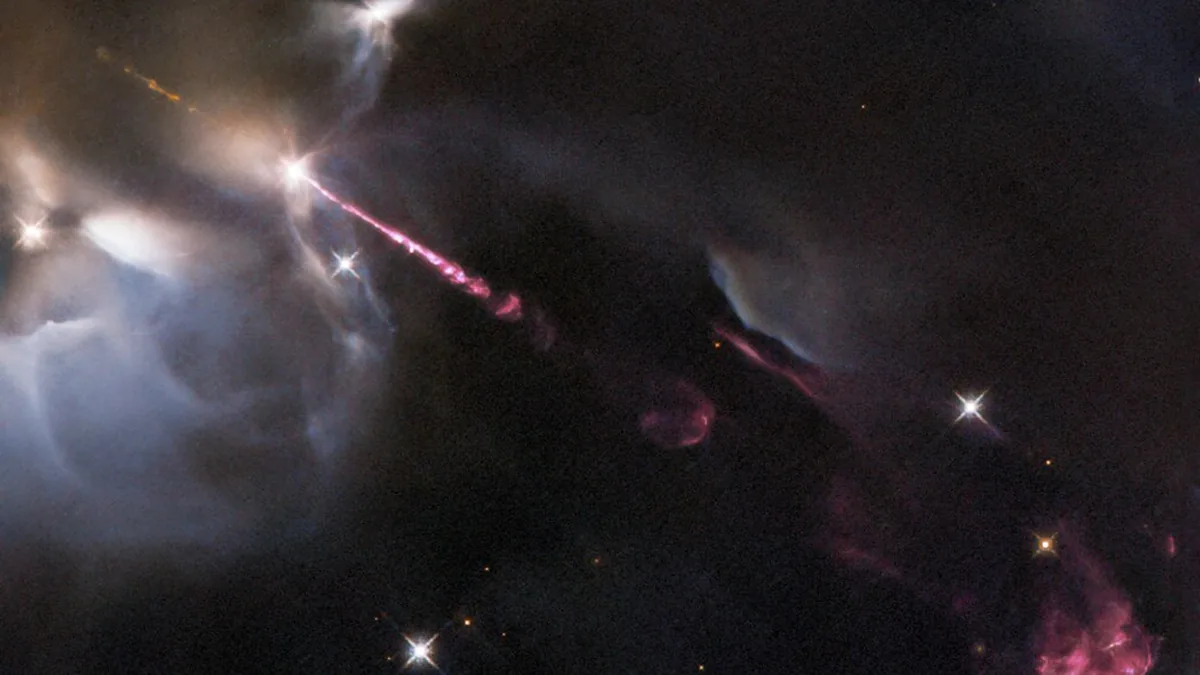
In a near detonation, an X-ray pulse strikes one side, vaporizing the surface to generate most thrust, while an internal shock wave fractures the body and may blow chunks off the opposite surface and sides. The authors wrote that a burst at a distance could deflect an asteroid with less structural disruption than an explosion on its surface, permitting more controlled steering.
The work builds on earlier laboratory experiments. An experiment at Sandia’s Z machine first demonstrated that X-rays could deflect a small piece of asteroid material, motivating Moore to wonder how to scale up the calculation to predict deflection of a full-scale asteroid.
In the chamber tests, X-ray radiation heated the surfaces of small free-falling asteroid stand-ins, and the resulting vapor plumes pushed the objects away. A 6.6-nanosecond blast from the world’s most powerful X-ray generator sent a blueberry-sized quartz stand-in into free fall; the vapor expanding from its surface acted like rocket exhaust, pushing on the quartz and driving the mineral off at roughly 250 kilometers per hour away from the X-ray source. Fused silica produced comparable results in the same chamber runs.
A nuclear blast a couple kilometers away could send X-rays that deflect an asteroid of similar composition up to 4 kilometers wide, according to simulations that followed the lab experiments. Moore said X-rays may be the only option for the largest asteroids or smaller ones with short warning time, potentially as little as a year.
NASA used a spacecraft to strike asteroid Dimorphos two years before the 2024 report, changing the object’s orbit around a larger asteroid. The result demonstrated that impact deflection works only for small bodies with enough warning time to change their path. Researchers explored X-rays because impacts cannot handle larger asteroids or short warnings.
Moore said asteroids consist of many mineral types. Researchers hope to run similar X-ray tests on iron and other minerals found in asteroids. Moore said that in those situations, only X-rays from a nuclear device would work.
Science News reported that the planetary defense community views nuclear X-rays as the only option when warning time is short. But no real-life scenario has required an actual nuclear missile to deflect an asteroid.
The researchers write that measuring how well pulsed radiation deflects asteroids is hard to pin down because it depends on surface topography, which is often unknown. This matters because the shape of an incoming object may not be known, and its orientation when intercepted may be uncontrolled. This uncertainty about shape and orientation underlies the study’s warning that aiming errors could turn a successful deflection into failure.
Interior structures of asteroids vary and remain beyond the model’s current capabilities, Moore said, and the model cannot yet predict how an asteroid will react after it is broken into several pieces. Disrupting an asteroid’s original structure could multiply the hazard to Earth by creating a swarm of debris, some of which could still strike the planet.
Detailed topographic mapping of an incoming object by spacecraft could make the deflection model more accurate. The new simulation tools could help mission planners determine the best explosive strength, distance, and direction for deflecting a threatening asteroid. Planners could input detailed shape data and calculate the best blast setup to push the object away from Earth. Despite remaining limitations, the improved simulation gives planners a tool to maximize the chances of a successful deflection.
Sandia’s Laboratory Directed Research and Development program funded the research. Ten authors are listed on the paper: Nathan W. Moore, Michael A. Gallis, D. Gregory Tipton, Zakari S. Eckert, Timothy P. Koehler, Kevin N. Long, Joel T. Clemmer, Kyle R. Cochrane, Brian C. Franke, and Mekiel Olguin.
The work focuses on deflecting a near Earth object or comet found too late for a kinetic impactor to be effective. Researchers describe a complete calculation of what would occur in a planetary defense scenario as incredibly complicated. An intense X-ray burst triggers numerous physical effects on an asteroid, and some of those effects influence one another, making it extremely hard to forecast an asteroid’s real behavior during a deflection attempt.


Join the discussion