SES reported 4.2% year-over-year third-quarter revenue growth during an investor presentation on Thursday, Nov. 5, 2026, driven by expansion in aviation and government defense connectivity.
The company’s Networks division revenue rose 6% on a like-for-like basis in the third quarter of 2026. Its Government and Defense business unit generated €216 million ($242 million) in Q3 revenue, a 4.2% like-for-like increase, CEO Adel Al-Saleh said. Fixed Data revenue declined more than 12% like-for-like year-over-year to 105 million euro ($118 million), while Media was essentially stable like-for-like at 304 million euro ($341 million).
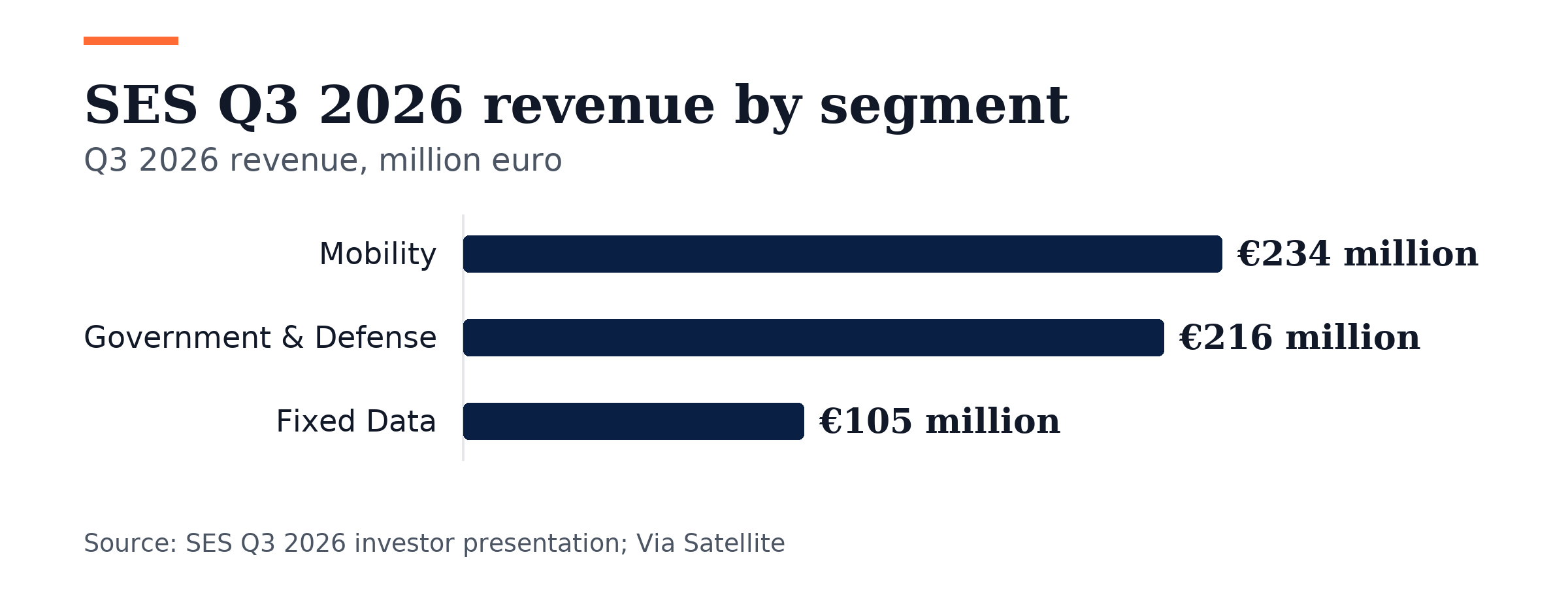
SES’s Mobility segment revenue grew 19% year-over-year like-for-like in Q3 2026 to 234 million euro ($263 million), led by the aviation business. Installations of electronically steered antennas picked up during the quarter. Year-to-date, SES had installed and activated more than 230 ESA-equipped aircraft, with an installed base of roughly 650 aircraft.
ESA program commitments stand at more than 1,330 aircraft, and SES won deals for more than 250 planes in 2026, including recent awards from Finnair and Air Astana, CEO Adel Al-Saleh said. The aviation business negotiated favorable contract restructurings in the first and third quarters, including a 54 million euro ($61 million) restructuring with an unnamed customer cited by CFO Lisa Pataki.
The company’s Networks backlog reached 7 billion euro ($8 billion), up from 3.5 billion euro ($4 billion) at the end of the previous quarter, driven by aviation and Government & Defense growth. The increase reflects mobility growth and defense contract momentum during the quarter.
SES secured commercial launch contracts for 53 operational satellites scheduled to enter orbit by 2030 without publicly naming its contracted launch service providers. The GEO tranche includes seven geostationary satellites engineered to reinforce high-throughput video and fixed enterprise networks. The meoSphere constellation adds 28 high-power MEO satellites built by K2 Space to supply software-defined beam capacity, and the sovereign MEO tier includes 18 IRIS2 satellites with bus platforms from Germany’s OHB SE.
SES’s IRIS2 spacecraft will integrate proprietary software-defined communications payloads designed and built directly by SES at a dedicated Luxembourg payload manufacturing facility reaching full operational capability by 2028. Owning payload development, manufacturing and final assembly gives SES intellectual property, value-chain control and a significant double-digit percentage reduction in overall constellation cost, CEO Adel Al-Saleh said.
As a public-private partnership, IRIS2 lets SES commercialize 90% of MEO capacity, 830 gigabits to 1.2 terabits of sellable commercial capacity, supporting revenue generation until end of life around roughly 2040. CEO Adel Al-Saleh said SES’s Government & Defense business remains healthy with MEO renewals on track and GEO capacity sales continuing to stabilize, with business fundamentals steadily improving since 2025. He noted the rate of decline seen between 2023 and 2025 continues to moderate.

Join the discussion