Key facts
- In June 2026, Vasily Kokorev at the University of Texas at Austin published a spectrum of little red dot GLIMPSE-17775, finding more than 40 spectral lines consistent with a black hole cocoon model.
- The Rinaldi team plans to search JWST archival data for more intermediate-redshift galaxies with little-red-dot-like nuclei to build a census of their environments and evolution.
- Researchers first flagged little red dots in 2022, the debate took off in 2023, and by 2025 more than 300 had appeared in Webb observations discussed in recent studies.
- Data from the RUBIES and MOM observing programs showed unusual V-shaped spectral features and high-speed hydrogen gas, with roughly 70 to 80 percent of objects fitting black holes in compact dusty systems.
A team from Johns Hopkins tested whether QSO1, a little red dot, could contain a primordial black hole using James Webb Space Telescope data; Physical Review Letters published the work on November 5, 2026.
QSO1 dates to just 700 million years after the Big Bang. Its composition is nearly all hydrogen and helium, without heavier elements formed later, which sets it apart from other little red dots.
Primordial black holes are theoretical objects tied to early-universe physics, and they predate the first stars. They formed during exponential expansion by other mechanisms than astrophysical black holes. Ordinary black holes form from collapsing stars. Co-author Valerio De Luca, a Johns Hopkins postdoctoral researcher, said: “They come from the physics of the early universe that predates the first stars, when the universe was expanding exponentially in time and space.”
Since Stephen Hawking proposed the idea in the 1970s, researchers have sought evidence that could confirm their existence.
The team ran three scenarios to check whether a primordial black hole could reach QSO1’s size while assembling a surrounding disk of material under special circumstances. The leading scenario has a smaller primordial black hole drawing in and consuming nearby gas and energy until it reaches QSO1’s size. Del Grosso said observations restrict the total number of primordial black holes and how many can live in a single cluster. The group wanted to know whether one such black hole could develop into a little red dot matching QSO1’s size.
Johns Hopkins plans to check how many of those 100 observed dots could be primordial black holes. Physical Review Letters published the paper, titled Primordial-Black-Hole-Based Pathways to Little Red Dots by Valerio De Luca et al. (2026), under DOI 10.1103/6y1w-87pd.
Little red dots are faint red objects in Webb data, and they do not match known theoretical models or object classes. Researchers first flagged them in 2022, debate picked up in 2023, and over 300 had appeared in Webb observations by 2025. A team including Ivo Labbé of Swinburne University of Technology in Australia identified 13 bright red blobs, with Webb data captured on June 21, 2022. Nature published the discovery in February 2023, after other teams had located red blobs in greater detail.
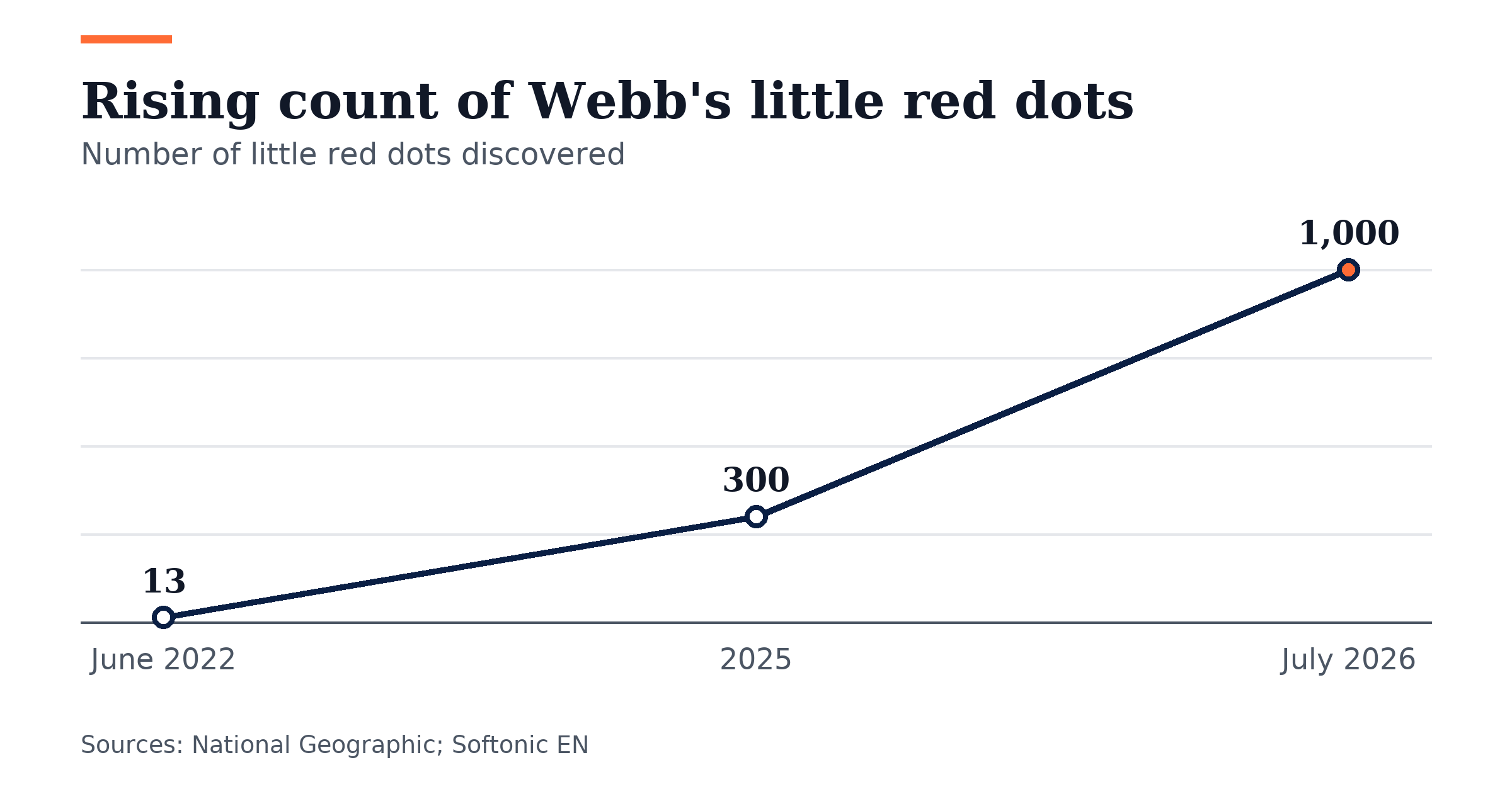
By July 2026 researchers had found about 1,000 little red dots, including a couple dozen closer than 2 billion light-years in the modern universe, and researchers had written more than 700 papers about them. Ideas have shifted as new data arrived, although the answer still has not been found, and researchers can study nearby dots in much better physical detail. JWST launched on Dec. 25, 2021, to reveal the earliest galaxies.
Spectroscopy revealed broadened hydrogen lines from gas moving at thousands of kilometers per second in both directions, signaling something massive with gas in orbit around it. The RUBIES and MOM observing programs produced data showing V-shaped spectral features plus fast-moving hydrogen gas, with roughly 70 to 80 percent of objects consistent with black holes inside compact dusty systems.
In X-ray light, only a single one of these dots appears. The objects barely change brightness at all. Ordinary active black holes flicker as hot spots, instabilities, and flares move through accreting material, so these dots’ steadiness is unusual. Jorryt Matthee of the Institute of Science and Technology Austria said the steadiness indicates these were not normal black holes.
A massive galaxy cluster produces several images of one little red dot, with the light paths spanning 130 years and brightness varying by about a factor of two. Gravity from the cluster warps space-time and bends the light, sending separate images along different paths that take different amounts of time. Xiaohui Fan of the University of Arizona said the time delays let researchers watch the dot brighten and dim across time.
Fan said little red dots are not necessarily one single class of objects. Viewing angle matters, and clumpy surrounding gas, rather than a shell, can change how the object looks depending on the line of sight.
Roberto Maiolino of the University of Cambridge said the dots look different if their gas is clumpy instead of a shell, which changes with viewing angle. Papers from 2025-2026 suggest ideas ranging from active black holes consuming too much material to rare quasi-stars or black hole stars, with some objects tied to Population III stars, the first generation of stars. A spectral drop followed by a sudden jump leads researchers to propose a massive active black hole, or a star of ten thousand solar masses inside a dense gas cocoon, as the engine powering little red dots.
Researchers led by Rusakov reported in Nature in January 2026 that black holes within little red dots are probably far lighter than earlier estimates, at roughly 100 times less massive. Vasily Kokorev at the University of Texas at Austin studied little red dot GLIMPSE-17775 in June 2026 and published a spectrum showing more than 40 spectral lines that fit a black hole cocoon model.
Early claims that JWST broke cosmology rested on calculations implying far more supermassive black holes, and far more massive ones, than standard models predicted. Matthee and colleagues documented that calculation in a landmark 2024 study. Later work showed researchers had overestimated the masses instead, and the dots’ disappearance resulted from distance dimming, an observational artifact.
Work led by Pierluigi Rinaldi, published July 29, 2026, in The Astrophysical Journal, concludes that these dots are rapidly feeding supermassive black holes hidden in thick dust, not exotic objects requiring new physics. In that framework, the dots represent an early, intense phase of black hole activity, later settling into dormant black holes in modern galaxies.
Catalogued as WISEA J123635.56+621424.2, the Saguaro galaxy sits at redshift 2, or roughly 10.4 billion years ago, about 3.3 billion years after the Big Bang; its compact luminous red nucleus matches every known little red dot characteristic. Its relative closeness let JWST and Hubble resolve the full spiral structure, so researchers could separate light from the nucleus, from the star-forming arms, and from the extended disk. Its nucleus alone shows the defining V-shaped spectral profile, with more ultraviolet and infrared light than visible light.
The Saguaro’s core shows faint X-ray emission in Chandra’s data. Carys Gilbert, a co-author, described it as both obscured and X-ray weak. Gilbert studies at the University of Cape Town as a master’s student. She said the obscured yet X-ray-weak profile could explain why other dots show little X-ray emission, fitting the broader puzzle.
The team mathematically relocated the Saguaro to distant, high-redshift positions — redshift is the stretch of light caused by the universe’s expansion — leaving only its compact luminous nucleus visible, indistinguishable from 341 catalogued little red dots. In the simulation at 13 billion light-years, the spiral arms and star-forming regions faded below detection along with the extended disk, leaving only the bright core. This creates an observational bias, Rinaldi said, because the surroundings are too faint for even Webb to observe.
For extended objects, dimming follows the fourth power of (1+z): a galaxy disk at redshift 7 looks roughly 4,096 times fainter than at redshift zero. Point sources fade more slowly, scaling as roughly (1+z)^2 together with ordinary luminosity distance effects. That dimming is why distant little red dots look like bare points of light rather than resolved galaxies.
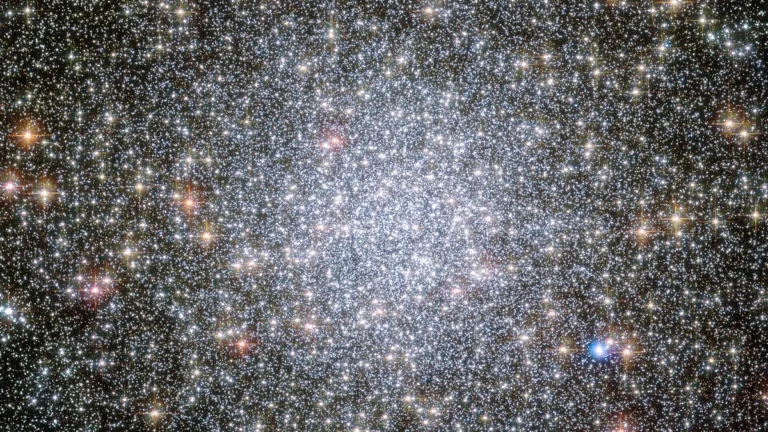
Simulations from 2026 suggested little red dots could be a normal stage evolving into compact red galactic cores such as the Saguaro or possibly globular clusters. This links the distant dots to lower-redshift structures, suggesting they are not exotic one-off objects. Ideas in recent papers span active black holes consuming too much material to rare quasi-stars.
Taken together, the two lines of work place little red dots in the first billion years of cosmic history. The Johns Hopkins work asks whether at least some dots could be primordial black holes formed before the first stars, while the Saguaro-based research casts them as an early active phase of black holes that later quiets into dormant black holes in modern galaxies.
Johns Hopkins plans to check how many of those 100 observed dots could be primordial black holes. The Rinaldi team plans to look through JWST archival data for more intermediate-redshift galaxies that have nuclei resembling little red dots, building a census of where they live and how they change.


Join the discussion