Key facts
- The isotope ratio indicates that the comet's ices probably originated in a cold, remote, metal-poor setting instead of a warmer, metal-rich one.
- Astronomers using NASA's James Webb Space Telescope detected the highest methane deuterium-to-hydrogen ratio ever measured in the Solar System on interstellar comet 3I/ATLAS, at about 3.33 percent.
- Because direct measurements of methane deuterium-to-hydrogen outside the Solar System are essentially absent, the authors used deuteration in the hydrocarbon cyclopropenylidene as a proxy for interstellar values.
- 3I/ATLAS is only the third interstellar object ever identified and the second known to display a clear coma while passing through the inner Solar System.
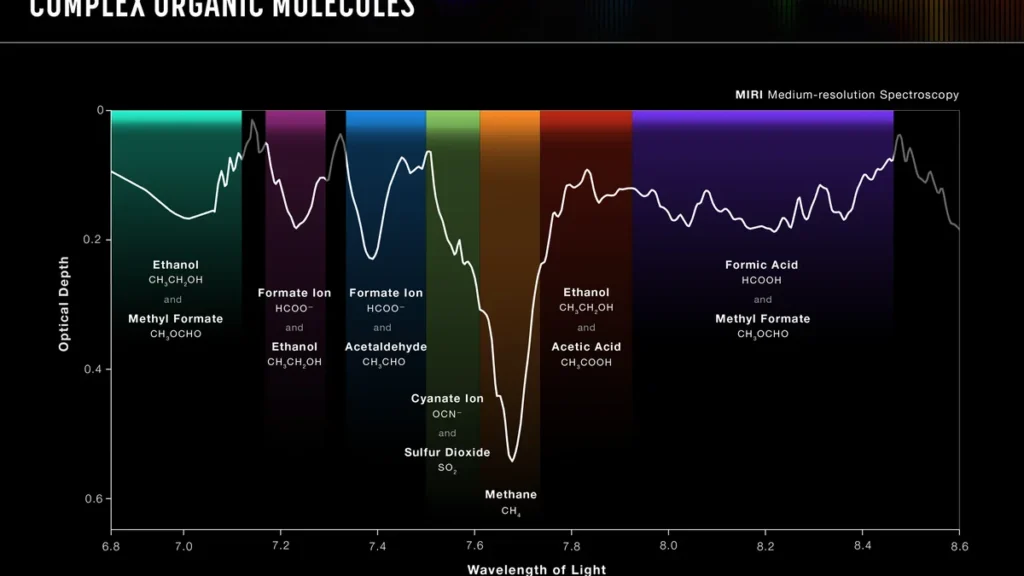
Astronomers using NASA’s James Webb Space Telescope detected the highest methane deuterium-to-hydrogen ratio, a measure of heavy hydrogen relative to ordinary hydrogen, ever measured in the Solar System on interstellar comet 3I/ATLAS, at about 3.33 percent, in findings published Oct. 23, 2026.
Webb’s NIRSpec Integral Field Unit observed the comet’s coma on Dec. 22 and 23, 2025, when 3I/ATLAS was about 2.4 astronomical units from the Sun. The same instrument also recorded other gases in the coma during those visits.
The 3I/ATLAS value is at least 1.4 times higher than any other direct measurement of organic molecules in the Solar System. The nearest match is organic material in the Orgueil carbonaceous chondrite at a deuterium-to-hydrogen ratio of 1.5 percent. Researchers compared the comet against values for Venus, the giant planets, Titan, dwarf planets Eris and Makemake, organics in interplanetary dust, carbonaceous meteorites, and Antarctic micrometeorites; none of those Solar System values approaches the 3I/ATLAS methane ratio.
The isotope ratio indicates that the comet’s ices probably originated in a cold, remote, metal-poor setting instead of a warmer, metal-rich one. Deuterium enrichment acts as a sensitive tracer of formation conditions because cold conditions favor deuterium retention in molecules. The authors also noted that interstellar or protostellar deuterium-to-hydrogen ratios could tentatively match the comet’s value.
Earlier dynamical studies pointed toward the same conclusion before the Webb measurement. Research using Galactic dynamics and chemistry models said 3I/ATLAS originated in a metal-poor star system more than 3 billion years ago, based on the direction of its radiant point and its fast heliocentric speed. Separating thick-disk from thin-disk origins was difficult.
The findings appeared Oct. 23, 2026, in Nature Astronomy as An enriched methane D/H ratio in the interstellar object 3I/ATLAS by N.X. Roth et al., with doi 10.1038/s41550-026-03002-5. Dr. Nathan Roth and colleagues at NASA’s Goddard Space Flight Center said interstellar objects like 2I/Borisov and 3I/ATLAS bring material that reveals how planets form around other stars. “Dynamical and compositional studies of these enigmatic objects may provide clues to their origins,” they wrote.
The researchers said it is uncertain whether star-formation or disk-chemistry models can reproduce the 3I/ATLAS methane ratio, and they called for new chemical models. Because direct measurements of methane deuterium-to-hydrogen outside the Solar System are essentially absent, they used deuteration in the hydrocarbon cyclopropenylidene, a ring-shaped molecule, as a proxy for interstellar values.
3I/ATLAS is only the third interstellar object ever identified and the second known to display a clear coma while passing through the inner Solar System. The coma releases gas and dust as sunlight heats the icy body, making 3I/ATLAS unusually accessible for spectroscopic study.
Alongside methane and deuterated methane, Webb detected methanol, ethane, formaldehyde, water and carbon monoxide in the coma. Carbon monoxide was the most abundant, with a production rate roughly 3.6 times that of water.
Webb observed the comet’s ice grains on Aug. 6, 2025, Dec. 22, 2025, and Apr. 1, 2026. The grains are dusty water-ice particles about a micron across, with a strong 3-micron absorption band and weak or missing 1.5- and 2.0-micron bands. “The grains of 3I/ATLAS are about the same size as those in our own comets,” Silvia Protopapa said.
The ice grains are about the same size as those in Solar System comets but contain much more dust mixed into the ice. They resemble distant icy bodies beyond Neptune that show carbon dioxide ice and organics. In April 2026, as the comet moved away from the Sun, Webb detected a faint feature consistent with crystalline ice, though the team could not determine whether solar heating or surface erosion caused the change.
Separate observations with ALMA and MDM Observatory on Nov. 4, 2025 found water deuterium at least 30 times the level in any Solar System comet and roughly 40 times Earth’s ocean value. The measurement used HDO, a form of water containing deuterium, and methanol lines when the comet was 1.37 astronomical units from the Sun and 2.24 astronomical units from Earth. This was the first isotopic analysis of this kind performed on an interstellar object, and it points to a colder natal environment than the Sun’s birth cloud.
The comet’s precise age is not settled. One study says its ice formed 10 to 12 billion years ago, more than twice the age of the Sun; another gives a kinematic age of 3 to 11 billion years; a third suggests formation more than 7 billion years before the Sun ignited. All sources agree the object is extremely old relative to the Solar System. Its estimated kinematic age potentially makes it the oldest known interstellar object.
Low carbon-13 content in 3I/ATLAS hints it originated in a young universe before stellar generations had seeded space with heavier elements. Isotope ratios also suggest heavy cosmic-ray exposure in a cold prestellar core, a dense, super-cold region in the earliest stages of star formation that is shielded from starlight.
Teresa Paneque-Carreño commented on the need to confirm what the data suggest. “That may sound obvious, but it’s one of those things that you need to prove.”


Join the discussion