
Key facts
- Chris Van Hollen of Maryland would take over the Senate Commerce, Justice, Science subcommittee from Kansas Republican Jerry Moran, who loses both gavels.
- Rosa DeLauro of Connecticut is poised to retake the House Appropriations chair from Oklahoma Republican Tom Cole; New York Democrat Grace Meng would succeed Kentucky Republican Hal Rogers on the House CJS subcommittee.
- House Democrats plan to investigate restrictions on SpaceX's Starlink and Starshield in Ukraine; Silicon Valley House Democrats demanded an October letter investigation to White House chief of staff Susie Wiles.
- The Canadian Space Agency is redirecting investment in Canadarm3, the MDA Space robotic arm for the paused Lunar Gateway, to support lunar surface operations.
Democrats won majorities in the Senate and House in the U.S. midterm elections held Tuesday, giving their party control of the committees that write NASA’s budget, set Space Force policy, and can compel chief executives such as Elon Musk to testify. CBS News projected Democrats would hold at least 54 Senate seats with two races unresolved and pass the 218 seats needed for a House majority, potentially finishing with more than 250. The new Congress sits on Jan. 3.
James Talarico, a 37-year-old state legislator, won the Texas Senate seat John Cornyn holds until January, beating state attorney general Ken Paxton and becoming the first Democrat to win a Texas Senate race since 1988. Cornyn lost the Republican primary runoff to Paxton. Vicente Gonzalez held the South Texas district that includes SpaceX‘s Starbase, beating Republican Eric Flores. Gina Hinojosa beat Greg Abbott 53 per cent to 46 per cent with over 95 per cent of votes counted, becoming the first Democrat elected Texas governor since Ann Richards in 1990.
During the 2026 midterm elections, Elon Musk poured at least $474 million into the race, with $224 million of that total directed at Texas contests, making him the largest single-cycle donor in modern U.S. political history as he backed Republican candidates and conservative groups. Musk said in an X post, “Guess my election-interfering space lasers didn’t work this time,” responding to the Democratic sweep. The X post came from Musk, a Trump ally who had spent more than any other individual during the 2026 midterm elections, as the results showed a Democratic wave building on Nov. 4, 2026. SpaceX shares fell almost 7 per cent premarket Wednesday but recovered most by late morning per Quartz, and Kathleen Brooks of XTB told the Wall Street Journal Congress cannot stop a SpaceX-Tesla merger but could slow it with extra scrutiny.
In the House, Zoe Lofgren of California is in line to chair the Science, Space, and Technology Committee, replacing Texas Republican Brian Babin; both won re-election. Valerie Foushee of North Carolina is next in line to chair the House space and aeronautics subcommittee after winning re-election. Florida Republican Mike Haridopolos keeps the chair, and he represents the Space Coast.
George Whitesides of California, a former NASA chief of staff and Virgin Galactic chief executive, won a second term and sits on the committee’s space subcommittee and the House Armed Services Strategic Forces subcommittee, which oversees military space. Whitesides is the committee’s vice ranking member, the Democrats’ No. 2 post. A gavel may open because Haley Stevens of Michigan lost a Senate primary in August and is leaving the House.
In the Senate, Maria Cantwell of Washington is in line to reclaim the Commerce, Science, and Transportation Committee, which she chaired from 2021 to 2025. Texas Republican Ted Cruz moves to the minority. Chris Van Hollen of Maryland would take over the Commerce, Justice, Science subcommittee from Kansas Republican Jerry Moran, who loses both gavels.
Rosa DeLauro of Connecticut is poised to retake the House Appropriations chair from Oklahoma Republican Tom Cole. New York Democrat Grace Meng would succeed Kentucky Republican Hal Rogers on the House CJS subcommittee. DeLauro was declared re-elected by the Associated Press on Wednesday. Meng won a contested primary in June.
Jack Reed of Rhode Island is in line to replace Mississippi Republican Roger Wicker as Senate Armed Services chair. Washington Democrat Adam Smith would take House Armed Services from Alabama Republican Mike Rogers. Reed chaired Senate Armed Services from 2021 to 2025. The Democratic seat on the House Strategic Forces subcommittee opens because Seth Moulton of Massachusetts lost the September primary for the Senate.
Byron Donalds won Florida’s governor’s race, Senator Ashley Moody kept her seat against Democrat Angie Nixon, and Alabama Republican Dale Strong returns in the district that takes in Huntsville and NASA’s Marshall Space Flight Center. Republicans held Florida.
Louisiana’s Senate race saw Julia Letlow edge out Jamie Davis by roughly two points – about 25,000 votes – for the seat vacated when Bill Cassidy lost his party’s spring primary. Davis had not conceded Tuesday night and hinted at a recount. Letlow strongly backs Starbase Louisiana, the $100 billion Starship launch site announced in August for Vermilion Parish. Local residents sought the release of the state’s SpaceX agreement, but officials replied that the document would remain sealed until December, according to the Globe and Mail.
In an election-eve call to Louisiana voters, former President Donald Trump said he recommended Vermilion Parish to Musk as a potential site for the new launch facility. SpaceX plans construction in 2027 and launch from Starbase Louisiana in 2029. Governor Jeff Landry announced the Starbase Louisiana deal and faces voters next year. Davis used his election-night speech to put Landry on notice.
Before any votes were cast, the Planetary Society tallied at least 90 fresh faces set to join the next Congress, a wave of turnover fueled by the highest rate of incumbents retiring since at least 2012. This turnover comes before a single vote is cast in the next Congress.
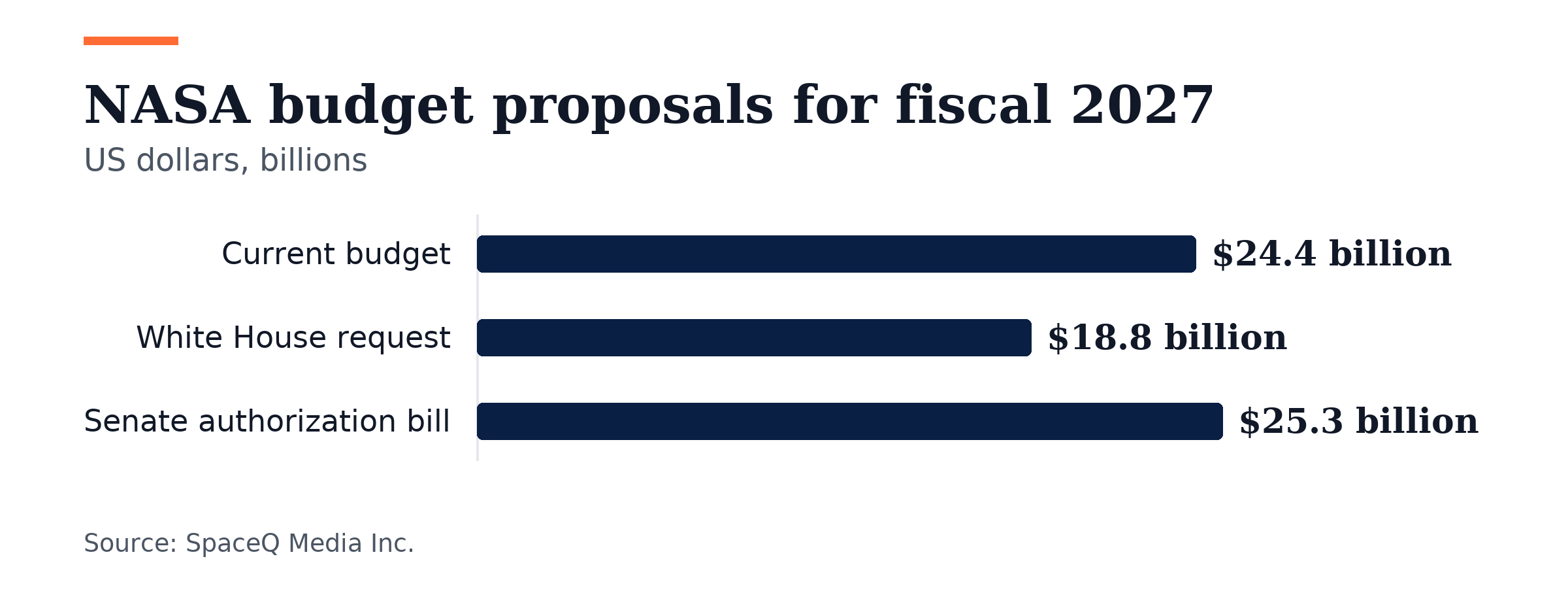
Congress faces a midnight Dec. 11 deadline to pass a budget or extend the stopgap holding NASA at $24.4 billion for 2026. The White House requested $18.8 billion for fiscal 2027. All figures are in U.S. dollars.
A House spending bill that stalled before reaching the floor would have slashed NASA science funding by roughly 18 per cent while steering additional resources toward human spaceflight. The bill was still pending after the late-September recess. Both the House and Senate advanced NASA authorization bills without a single dissenting vote in committee, yet neither measure reached the floor for a final tally before the session ended. Any bill not passing by January must start over in the new Congress.
The Senate’s NASA authorization bill, crafted by Cruz and Cantwell, would provide $25.3 billion for 2027 and mandate that NASA establish a permanent lunar base. Cantwell will chair and Cruz will lead the other side next year.
The White House requested $4.4 billion for NOAA in 2027, $1.6 billion less than this year, and Congress rejected similar cuts for 2026. The Commerce Department moved the Office of Space Commerce out of NOAA into the commerce secretary’s office last year. The 2027 request gives it $11 million, down from $52.5 million this year.
The detailed budget proposed halting TraCSS collision-warning work while working out a financial structure that may include user fees per SpaceNews. Appropriators reversed similar cuts in 2026 bills, and the House Appropriations Committee’s May-approved 2027 bill puts $50 million back for the office and backs TraCSS per SpaceNews. Gabe Amo of Rhode Island, senior Democrat on the environment subcommittee, would be in line to chair it.
Golden Dome received about $25 billion through last year’s budget reconciliation law. Of the Golden Dome program’s 2027 funding request, only a sliver – less than $400 million – is tucked into the regular defense budget.
In late May, the Space Force handed SpaceX a pair of contracts: $2.29 billion for a military communications network linked to Golden Dome, followed three days later by $4.16 billion for missile-tracking satellites. NASA buys crew flights, cargo runs and a Starship Moon lander from SpaceX. Democratic appropriators have spent two years fighting White House NASA cuts. Democratic appropriators could slow Golden Dome money.
House Democrats plan to investigate restrictions on SpaceX’s Starlink and Starshield in Ukraine. Silicon Valley House Democrats demanded an October letter investigation to White House chief of staff Susie Wiles. Robert Garcia’s office told Politico in October that the House Oversight Committee plans to investigate Musk’s role at the Department of Government Efficiency (DOGE).
The FAA is reviewing SpaceX’s plan for up to 456 Starship launches a year from Starbase, with public comments open until Nov. 30. From January it answers to Democratic committees. Starbase, now its own city, finished annexing more than 7,100 acres in September, including much of the state park per the Texas Tribune.
A bipartisan pair of senators, Kirsten Gillibrand and Peter Welch, introduced legislation to eliminate 50 per cent tariffs on certain Canadian imports, though a presidential veto and the difficulty of assembling a two-thirds override cast doubt on its passage. Dominic LeBlanc said the results will not change Canada’s trade approach per the Globe and Mail. Mark Carney said Tuesday the White House was asking less and offering more before results, and Scott Matthews told CTV News Canada may have lost advocate Susan Collins.
Mark Carney said in February that Canada would be willing participants in Golden Dome if it serves Canada’s interests. Kepler Communications, Telesat and MDA Space positioned technology for the missile shield. The Canadian Space Agency is redirecting investment in Canadarm3, the MDA Space robotic arm for the paused Lunar Gateway, to support lunar surface operations.
U.S. stock futures initially declined overnight on tighter regulation concerns for AI, cryptocurrency and data centers, then recovered after Trump said he would accept the results. Deborah Cunningham of Federated Hermes said the political split could create a “blockade against new legislation.” Divided government is historically viewed favorably by markets. Some investors saw benefits in divided government with Democrats in Congress and Republicans in the White House, and Cunningham said stability limits major policy changes.
Election results raised concerns about restrictions on AI infrastructure investment, especially power-intensive data centers, and greater scrutiny of their electricity and water demands. Brad Gerstner of Altimeter Capital estimated 10 to 15 gigawatts of expected AI capacity could be affected by additional regulations delaying projects. Gerstner said concerns about a broad halt were exaggerated. Continental CFO Roland Welzbacher said companies need stability and a reliable economic framework per Reuters.



Join the discussion