Key facts
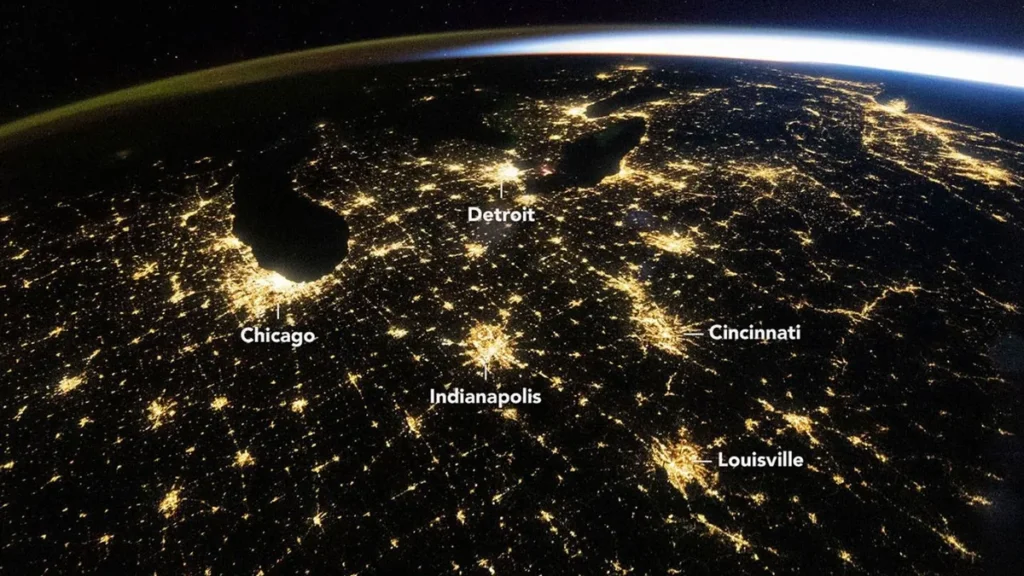
- A diffuse band of green and orange airglow appears along the left horizon, created when sunlight strikes upper-atmosphere atoms and molecules, which then eject photons.
- Astronaut imagery and other remote sensing views of nighttime lights help researchers track changes in the built environment.
- Chicago's lightscape appears as a uniform pale yellow in the broad view, although closer images reveal multiple colors produced by different lighting types.
- Researchers built a pixel-level method using NASA's Gateway to Astronaut Photography of Earth archive to separate different lighting types in nighttime images.
NASA Earth Observatory published a nighttime photograph of the Midwest on November 4, 2026, after an astronaut aboard the International Space Station captured it at 4:54 a.m. Central Daylight Time, or 09:54 Universal Time, on October 18, 2026.
Mid-sized cities including Indianapolis, Indiana; Cincinnati, Ohio; and Louisville, Kentucky shine brightly in the astronaut’s photograph, along with the highways connecting them. Green and orange airglow forms a diffuse band along the left horizon. Sunlight hitting upper-atmosphere atoms and molecules causes them to eject photons, producing the glow.
Chicago, Illinois, and Detroit, Michigan stand out as some of the brightest features in the image. The wide-angle image taken by the astronaut shows illuminated cities large and small spread across the darkened landscape. Skies were clear across much of the eastern United States before dawn on October 18, 2026. The image carries the identifier ISS075-E-226709 and was shot using a Nikon Z9 digital camera with a 14-millimeter focal length by a member of the Expedition 75 crew.
Because the station passed over the heartland before local sunrise, city lights dominated the darkened surface below. Light from the sun reached across the horizon to the right, with sunrise about one hour away on the East Coast and about two hours away in Chicago.
Astronaut and remote-sensing views of nighttime lights help researchers observe changes in built environments. Systematic measurement of urban lights’ brightness, color, and extent can reveal how cities grow and change over time. In the broad view, Chicago’s lightscape looks like a uniform pale yellow, while closer images show colors from different lighting types.
A pixel-level method developed by researchers uses NASA’s Gateway to Astronaut Photography of Earth archive to distinguish different lighting types in nighttime images. NASA’s Black Marble product suite uses satellite data to produce science-quality global nighttime light records at daily, monthly, and yearly intervals. Scientists in the eastern United States have used Black Marble data to monitor storm-related power outages and restoration, infrastructure-related lighting changes, and the shift to LED lighting.
The ISS Crew Earth Observations Facility and the Earth Science and Remote Sensing Unit at NASA Johnson Space Center supplied the images. Members of the Expedition 70 crew took a detailed comparison photograph, ISS070-E-105097, on March 1, 2024, with a Nikon D5 digital camera at a 400-millimeter focal length. Editors cropped and enhanced the images to improve contrast and removed lens artifacts.
NASA’s International Space Station Program supports the laboratory through the ISS National Lab to help crew photography of Earth for researchers and the public and to publish the images online at no cost. The NASA/JSC Gateway to Astronaut Photography of Earth lets viewers see images taken by astronauts and cosmonauts. Lindsey Doermann wrote the story. Satellite sensors track changes in lighting across Earth.


Join the discussion