Key facts
- The source for S2 is the University of California, Los Angeles.
- Grace Telford, assistant professor at the University of Utah and lead author, said Webb opened up new questions about the evolution of early galaxies, calling them weird, and that this motivates TEMPOS.
- Massive stars in more oxygen-rich galaxies show much stronger iron UV absorption than stars in oxygen-poor galaxies, and the TEMPOS dataset spans a wide range of iron abundances across six galaxies.
- The TEMPOS survey published on Sept. 21, 2026, in The Astrophysical Journal Supplement Series, with DOI 10.3847/1538-4365/ae95f6.
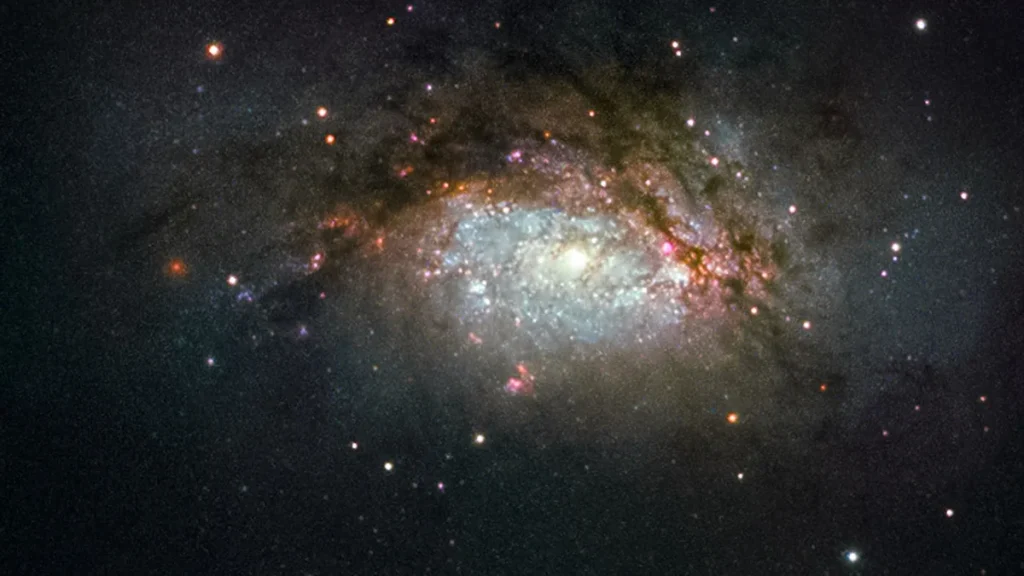
Research led by Claire Williams, a doctoral student at the University of California, Los Angeles, proposes that collisions among stars in crowded early-universe clusters built enormous stars, seeded black holes, and accounted for the compact red objects called little red dots. The Astrophysical Journal published the work Oct. 26, 2026. Sources: Sci.News: Breaking Science News
Knowridge reports the UCLA-led study as a possible explanation for how some black holes became incredibly massive so soon after the Big Bang, since their early appearance leaves less time for gradual growth than scientists once expected. Sources: Knowridge Science Report
Using a radially resolved analytic approach, the authors modeled how stars collide inside dense systems at high redshift. Instead of starting from observations, the team drew initial conditions from high-resolution cosmological simulations, then checked its predictions against Monte Carlo simulations and found good agreement across key regimes. Sources: Sci.News: Breaking Science News
The team applied its collision model to the forerunners of globular clusters, to nuclear star clusters such as the one surrounding the Milky Way’s central black hole, and to compact reddish little red dots. In systems that lack a black hole, stellar encounters usually merge gently rather than destroying the stars involved. Merger products sink toward the center through dynamical friction, a process in which heavier objects lose orbital energy and spiral inward, where repeated collisions can build a very massive star. Sources: Sci.News: Breaking Science News
At densities above roughly 100,000 solar masses per cubic parsec, almost every low-mass system in the tests produced a very massive star exceeding 200 suns. In the densest simulations, the star surpassed 100,000 solar masses and might collapse into an intermediate-mass or supermassive black hole. Sources: Sci.News: Breaking Science News
The team considered little red dots, compact red points in early-universe observations, and raised the possibility that some are dense star clusters where collisions are building giant stars. Sources: Sci.News: Breaking Science News, Knowridge Science Report
Williams noted that one place in the nearby Universe where collisions between stars are common is the Galactic center. The model says that once very massive stars turn into intermediate-mass black holes, the system resembles the Milky Way’s galactic center, a black hole surrounded by a dense star cluster. Sources: Sci.News: Breaking Science News
Most of those lensed clusters form only modest very massive stars, but the most compact could reach 1,000 to 10,000 solar masses. Sources: Sci.News: Breaking Science News
Around our solar system, stars are so far apart that direct collisions are rare, but in packed clusters encounters are more likely and their outcome depends partly on how fast the stars are moving. The model suggests slower collisions can merge stars while faster impacts can destroy them, and if a merged star encounters others the process may repeat to produce a single giant star. Sources: Knowridge Science Report
Such destructive collisions can quickly accumulate extremely dense gas around the black hole, reaching densities that match or exceed those estimated for little red dots. That gas could be a ready fuel supply and help explain why little red dots look the way they do. The research compares the scenario to the Milky Way’s center, where a massive black hole sits inside a dense star cluster, and suggests comparable conditions could assemble in the early universe. Sources: Sci.News: Breaking Science News, Knowridge Science Report
The team said destructive collisions happening often could quickly create extremely dense gas around massive black holes, offering a possible match for the observed little red dots. Sources: Sci.News: Breaking Science News
Knowridge reports that the research is available as an arXiv preprint, that the team based the proposed sequence on models rather than direct observation of individual ancient collisions, and that testing it requires further observations and research. The source for Knowridge’s coverage is the University of California, Los Angeles. Sources: Knowridge Science Report
TEMPOS, a University of Utah-led survey, uses Hubble’s Cosmic Origins Spectrograph to gather ultraviolet observations of massive stars in nearby galaxies, treating them as analogs for stars in the early universe. TEMPOS surveyed 29 massive stars across six local dwarf galaxies, all with metallicities below one-fifth of that of the sun. Massive stars, defined as those more than 10 times the sun’s mass, are uncommon yet potent drivers of galactic change, generating intense radiation, losing material through stellar winds, and ending as supernovae. Sources: EurekAlert!, Newswise
Grace Telford, assistant professor at the University of Utah and lead author, said Webb opened up new questions about the evolution of early galaxies, calling them weird, and that this motivates TEMPOS. As metallicity decreases, the maximum speed of stellar winds decreases, but at the lowest metallicities below about 10% of the sun’s, wind speeds decline much more sharply than expected from higher-metallicity trends. Sources: EurekAlert!, Newswise
Iron plays a key role in launching stellar winds, determining stellar evolution, and triggering supernovae, but iron abundance is hard to measure in metal-poor environments. Massive stars in more oxygen-rich galaxies show much stronger iron UV absorption than stars in oxygen-poor galaxies, and the TEMPOS dataset spans a wide range of iron abundances across six galaxies. Sources: EurekAlert!, Newswise
TEMPOS combined new observations of 12 stars with previously collected data into a larger uniform dataset, and each star outside the Milky Way costs up to 35 hours of Hubble time to observe. The TEMPOS survey published on Sept. 21, 2026, in The Astrophysical Journal Supplement Series, with DOI 10.3847/1538-4365/ae95f6. The team will make the TEMPOS science-ready UV spectra publicly available through the Mikulski Archive for Space Telescopes. Sources: EurekAlert!, Newswise
The work used observations with the NASA/ESA Hubble Space Telescope, and NASA grant numbers GO-16767, GO-16920, and GO-17491 supported it. Sci.News reports that the UCLA-led collision model offers one unified channel for supermassive stars, black-hole seeds, and little red dots, while EurekAlert! and Newswise report that TEMPOS supplies low-metallicity massive-star physics needed to interpret early-universe JWST observations. Sources: Sci.News: Breaking Science News, EurekAlert!, Newswise
“Little red dots are a hot topic in astronomy.” Sources: Sci.News: Breaking Science News


Join the discussion