Key facts
- NASA's Perseverance rover measured fine and ultrafine Martian dust clinging to spacesuit-material samples over 1,645 Martian days.
- PIXL detected fine particles below 2.5 micrometers and ultrafine particles around 100 nanometers, below the roughly 3-micrometer limit of earlier Mars dust measurements.
- Dust particle sizes on PIXL's basaltic glass target and SHERLOC's Teflon swatch ranged down to about 100 to 300 nanometers.
- Suitports, dual-chamber airlocks, and filtration for particles smaller than a micrometer could reduce how much dust enters astronauts' living quarters.
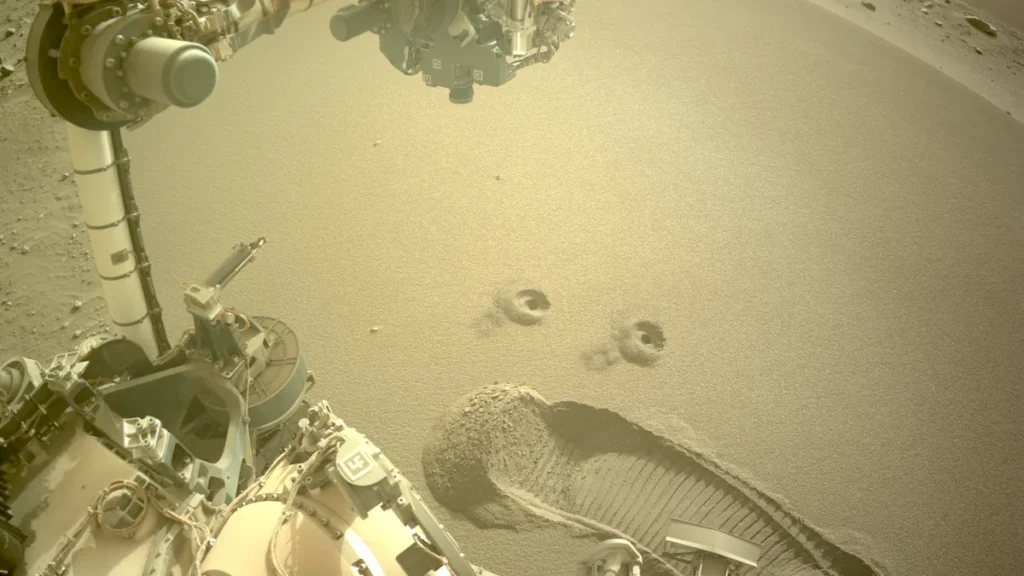
NASA’s Perseverance rover measured fine and ultrafine Martian dust clinging to spacesuit-material samples over 1,645 Martian days, reported Oct. 27, 2026. The particles include grains below 2.5 micrometers and ultrafine particles around 100 nanometers, smaller than the roughly 3-micrometer limit of earlier Mars dust measurements.
The rover’s PIXL instrument detected the fine particles on its basaltic glass target and on SHERLOC’s Teflon swatch, with sizes down to about 100 to 300 nanometers. On PIXL’s Teflon target and SHERLOC’s Vectran swatch, particles averaged about 2 micrometers, showing a size split across surfaces.
ZME Science reported dust on one glass target averaged about 140 nanometers, the Teflon spacesuit patch about 300 nanometers, and Vectran fabric about two micrometers. Teflon concentrated smaller and ultrafine particles into the sub-100 nm range, while Vectran attracted larger fine-spectrum particles averaging around 2 micrometers.
Electrostatic charging determines which particle sizes stick to which surface; grains charge through collisions, different materials attract different sizes, and the finest particles stayed attached through years of driving and drilling. Tech Times explains the mechanism as triboelectric charging during grain-on-grain impacts in dust storms and dust devils, with surface potential governing which size class each material attracts.
Ultrafine particles below 100 nanometers can travel from the nasal cavity to the brain along the olfactory nerve, bypassing the blood-brain barrier, while fine particles below 2.5 micrometers penetrate deep into the lungs and enter the bloodstream. NASA and Tech Times tie these size thresholds to Earth-based air-quality research; Tech Times adds that no occupational standard yet exists for Martian dust chemistry or the olfactory-nerve pathway.
Martian dust is predominantly silicate minerals and carries chemically reactive compounds including perchlorates that disrupt thyroid function and reactive iron that induces cellular damage; health risks depend on quantity and duration of exposure. ZME Science adds that the fine dust was unusually rich in phosphorus, and researchers could not determine how harmful exposure would be in practice, noting toxicity depends on dose and duration per Scott VanBommel.
Because Teflon contains no elements PIXL can directly detect, elemental signals from the Teflon sample come from dust resting on it, allowing the team to separate the chemical signature of Martian dust from the material underneath by comparing pre-flight Earth measurements with new dusty readings.
Not all fabrics trap dust equally, and those variations could shape decisions about coatings and materials for future spacesuits and habitats. Static electricity and fabric texture help grains stick despite years of rover movement.
Suitports, dual-chamber airlocks, and filtration for particles smaller than a micrometer could reduce how much dust enters astronauts’ living quarters. NASA is testing dust-mitigation technology, including an Electrodynamic Dust Shield that cleared lunar regolith from glass and radiator surfaces in March 2025 aboard Firefly Aerospace’s Blue Ghost Mission 1.

In February 2026, NASA’s Martian Dust Limit Working Group recommended a 24-hour time-weighted average exposure limit of 0.1 mg/m3 for Martian dust particles under 10 micrometers for missions up to 30 days, derived from the 0.4 mg/m3 lunar limit with a threefold uncertainty factor. NASA is incorporating the limit into Volume 2 of NASA-STD-3001, with separate spacecraft maximum allowable concentrations for chemicals such as perchlorate and manganese as crosschecks.
NASA based its existing indoor dust limits partly on lunar dust experiments, and scientists say they need more testing with actual Martian dust to determine safe exposure levels. ZME Science cites a 2025 medical review warning Mars dust could threaten respiratory health and a 2016 study establishing its unusual sulfur- and chlorine-rich chemistry.
The rover study did not directly measure health effects in people exposed to Martian dust, and establishing safe conditions will require work beyond measuring grains on rover surfaces. Both sources say particle size matters for health and that risk depends on composition, amount inhaled, and exposure duration.
Shaunna Morrison, a Rutgers mineralogist who contributed to NASA’s dust working group, described Mars dust as an unusual challenge because of its extreme fineness and tendency to electrostatically cling to surfaces. Morrison said identifying crystal structure remains essential and that scientists ultimately need Martian samples in Earth laboratories. “We really need to characterize this dust so that we know what the hazards are,” Brian Hynek said. “This is bonus science,” VanBommel told Chemical & Engineering News.
Perseverance landed in Jezero Crater in 2021 to search for ancient microbial life, and the mission also prepares for human explorers through MOXIE, Ingenuity, and spacesuit samples. Katie Stack Morgan, Perseverance’s project scientist at JPL, described the human-exploration preparation as part of the mission’s design.
Apollo lunar dust scratched visors, degraded spacesuit layers, damaged seals, and caused hay-fever-like symptoms, while wind rounds Martian dust, making it less abrasive but chemically reactive. After 1,645 Martian days, the test materials showed little visible wear, an encouraging difference from the sharp, abrasive lunar dust Apollo astronauts encountered. ZME Science says Martian dust is smoother because winds wore down rough edges over billions of years, though its chemical hazards remain a concern.
A 2025 GeoHealth study estimated average Martian grain size at roughly 3 micrometers and identified perchlorates, silicates, iron oxides, arsenic, and beryllium in Martian dust composition. The study confirmed a substantial fraction already falls below the PM10 threshold, Tech Times says, and quotes Brian Hynek calling for dust hazard characterization.
The closest human analog is Apollo 17 astronaut Harrison Schmitt, who had runny eyes and persistent throat irritation after lunar dust contaminated his suit and habitat.


Join the discussion