Key facts
- Using computer modeling, the researchers determined that comets move too fast and arrive at steep angles, so fragile organic molecules would almost certainly vaporize during atmospheric entry or on surface impact.
- Comet strikes on Earth became much rarer in the planet's first 500 million years, leaving only a few chances for hydrogen cyanide (HCN) to arrive on a comet.
- For nearly a century, researchers have proposed that comets brought carbon- and nitrogen-bearing molecules to early Earth.
- Asteroid strikes were much more common than comet impacts and could produce organic building blocks from atmospheric and surface compounds using localized energy and shock chemistry.
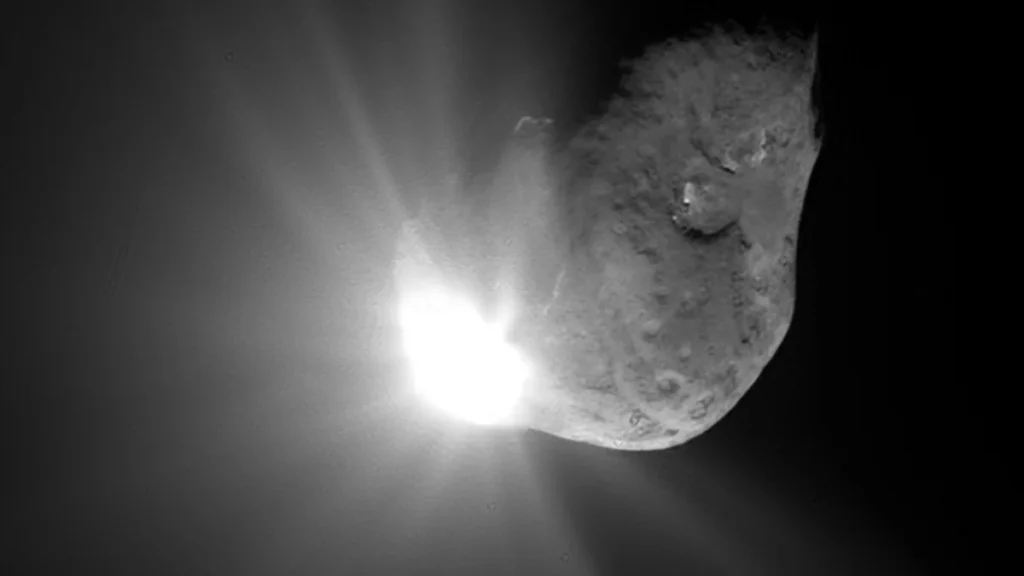
A team led by the University of Cambridge’s Institute of Astronomy concluded on October 28, 2026, that cometary delivery of prebiotic molecules to Earth would be at best a one-off fluke and an exceedingly rare event, according to a peer-reviewed study published that day in Scientific Reports by Dr Richard Anslow.
The study appeared in Scientific Reports on October 28, 2026, under the DOI 10.1038/s41598-026-74214-y. The University of Cambridge announced the research on the same date. The work was peer-reviewed before publication.
Dr Richard Anslow from Cambridge’s Institute of Astronomy is the lead author of the study. Anslow is affiliated with the University of Cambridge’s Institute of Astronomy.
The researchers used computer modeling to test whether comets could bring hydrogen cyanide (HCN), an important prebiotic molecule regularly found on Solar System comets, to early Earth. The simulations examined whether fragile organic molecules could survive atmospheric entry and surface impact.
The simulations showed that comets move too fast and arrive at steep angles, so fragile organic molecules would almost certainly vaporize during atmospheric entry or on surface impact. Comet strikes on Earth became much rarer in the planet’s first 500 million years, leaving only a few chances for HCN to arrive on a comet.
Anslow said successful delivery would have to be a one-in-a-million event, needing the right impact speed and angle and rapid chemistry afterward, and that while not impossible it seems unlikely and at best a one-off fluke. “We can’t rule out for certain that it happened that way.” – Richard Anslow.
For nearly a century, researchers have proposed that comets brought carbon- and nitrogen-bearing molecules to early Earth. “It’s kind of a romantic idea, but our results suggest it’s highly unlikely.” – Dr Richard Anslow.
Asteroid strikes were much more common than comet impacts and could produce organic building blocks from atmospheric and surface compounds using localized energy and shock chemistry. Asteroids carry many of the same molecular building blocks as comets, and impacts following asteroid strikes are one possibility for where the molecular seeds of life came from.
Scientists say Earth’s own processes, like deep-sea hydrothermal vents or lightning in the atmosphere, might have created prebiotic chemicals without help from space.

Mars might be a somewhat better candidate for cometary delivery because it is smaller than Earth with weaker gravity and a much thinner atmosphere, though cometary arrival there is still highly unlikely and an internal or asteroid-driven origin seems more plausible for both worlds. The researchers evaluated Mars as a potential destination for cometary organics.
In 2023, Anslow and co-authors proposed that comets in tightly packed planetary systems might slow by bouncing between worlds and dropping off organic molecules. The new study checked whether this could occur in our Solar System and concluded it would be uncommon. EarthSky reported in 2023 on the idea of comets bouncing between planets to deliver organic molecules as part of the background to the new study’s investigation.
Funding came in part from the Royal Society, the Leverhulme Centre for Life in the Universe, and the Science and Technology Facilities Council, part of UK Research and Innovation. This funding information appears in the University of Cambridge’s announcement of the study.
The researchers say their results could aid the search for life in other systems once successors to the James Webb Space Telescope (JWST), such as the proposed Habitable Worlds Observatory, are operational. Spotting systems with bouncing comets could help astronomers narrow their search, a forward-looking application beyond Earth’s origin of life.
EarthSky reported the study on November 1, 2026, noting that scientists have for about a century believed comets brought prebiotic molecules to Earth and that any delivered molecules likely arrived in a one-off event rather than an ongoing rain. EarthSky’s article was published on November 1, 2026.
Researchers have considered both asteroids and comets as carriers of prebiotic molecules to Earth. The new study focuses on comets specifically.



Join the discussion