
Key facts
- During the May 2024 storm, solar wind gusts reached 1,200 kilometers per second, compressing Earth's magnetic field and causing the most intense geomagnetic disturbance since the Halloween storm of 2003.
- Japan's Arase satellite, also named the Exploration of energization and Radiation in Geospace or ERG mission, has flown through Earth's magnetosphere since 2017.
- Researchers used electron phase space density, a mathematical method tracking electron distribution by energy and motion, to interpret the Arase measurements.
- The May 2024 storm crushed the plasmasphere, the shroud of charged gas normally covering the inner radiation belt, back toward Earth and created a void.
A research team led by Yoshizumi Miyoshi of Nagoya University found in a Geophysical Research Letters study that the May 2024 solar storm drove electrons to relativistic speeds within Earth’s radiation shield using chorus-wave interactions.
The May 2024 storm drove solar wind gusts to 1,200 kilometers per second. That flow compressed Earth’s magnetic field and caused the strongest magnetic disturbance since the Halloween storm of 2003. The compression preceded the electron acceleration later measured by Arase.
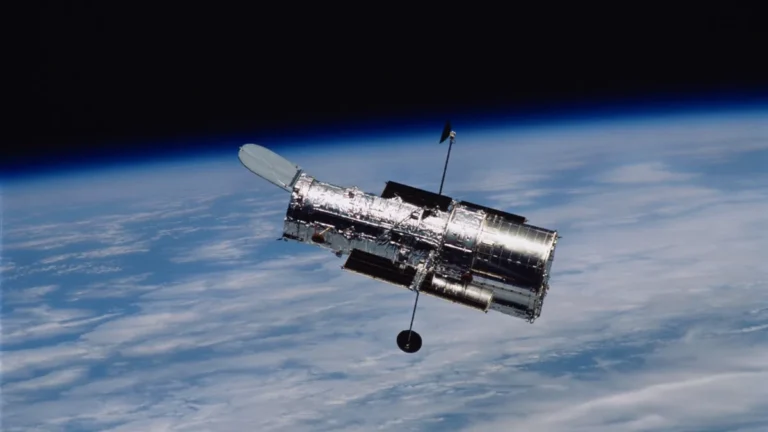
Japan’s Arase satellite, also named the Exploration of energization and Radiation in Geospace or ERG mission, has traveled through Earth’s magnetosphere since 2017. The spacecraft observed Earth’s radiation belts before the May 2024 event. Its instruments tracked the belts as they behaved normally for years. Arase provided the continuous measurements that made the storm’s effect visible.
Before May 2024, Arase observed high energy electrons kept away during its mission until that point. That stable pattern represented the normal behavior that changed when the storm arrived. The spacecraft had seen the barrier hold steady against the most energetic particles. No similar influx had appeared in the data from earlier in the mission.
When the storm peaked, Arase instruments detected ultra-relativistic electrons at levels 5,000 times above normal background levels. The study’s authors call this spike a key measurement that older spacecraft could not explain. It marked a sharp departure from the quiet conditions Arase had observed. The increase drew attention to the acceleration mechanism operating inside the magnetosphere.
Researchers interpreted the Arase measurements using electron phase space density, a mathematical approach that maps electrons by energy and movement. This metric reveals whether electrons arrived from outside or local processes accelerated them. Applying it to the May 2024 data helped the team determine where the particles gained their energy. The method distinguishes between transported and locally generated particle populations.
Arase found a clear electron peak where the barrier used to be, rather than a decline arriving from outside. That peak indicates local acceleration where the particles were observed. The study’s authors describe the peak as a smoking gun for acceleration inside the barrier. The signature contradicts a model in which particles simply drift inward from the outer belt.
Earth’s radiation shield refers to the Van Allen belts, first detected during the early Space Age by Explorer 1. The belts serve as Earth’s primary defense against high-energy electrons and ions from the Sun. Scientists have studied the structure since the earliest days of spaceflight. The discovery established the existence of trapped radiation around the planet.
Researchers sort the Van Allen belts into two groups: an inner belt made mostly of protons and an outer belt filled with high-energy electrons. This two-belt structure forms the standard model of the near-space radiation environment. The inner region sits closer to the planet than the outer region. Each population behaves differently during geomagnetic disturbances.
In 2014, NASA’s Van Allen Probe mission found a boundary where killer electrons moving near light speed seemed to strike a barrier at roughly 11,500 kilometers above Earth’s surface. The shield protects the inner region near the planet from the most dangerous radiation. The barrier kept the most energetic particles away from lower altitudes.
Gizmodo reported in 2014 that the probes found a barrier blocking electrons at relativistic energies of five megaelectronvolts or higher. The outlet described the edge as a barrier the fastest electrons cannot cross, with a sharp drop-off near 7,200 miles, or 11,580 kilometers, above the planet. That report helped frame the belt boundary as a filter-like feature. It also noted the barrier helps explain harm to satellite equipment and risk to astronauts while leaving Earth’s surface unaffected.
The plasmasphere, a zone of electrically charged cold gas starting around 600 miles, or 965 kilometers, above the surface, causes outer belt particles to scatter, taking them out of the belt. Researchers ruled out ground radio signals and magnetic fields before crediting the plasmasphere. The charged gas acts as a natural drain for energetic particles. Its presence shapes the structure of the outer belt.
Charged gas in the plasmasphere normally takes in high-frequency electromagnetic waves and reduces their strength. Van Allen Probes data indicate the most energetic electrons move toward Earth slowly over months, too weakly to beat plasmasphere scattering. That slow inward drift helps maintain the barrier at the inner edge of the outer Van Allen belt. The balance between drift and scattering sets the barrier’s location.
The May 2024 storm crushed the plasmasphere, the layer of charged gas normally over the inner radiation belt, back toward Earth and left a void. The crushed plasmasphere and a negative ionospheric storm created a depleted environment that enabled chorus waves. Without its usual gas shield, the inner belt region became exposed to wave activity. The loss of the plasmasphere removed a protective layer.
A negative ionospheric storm accompanied the May 2024 event and sharply reduced local plasma densities. That depletion worked with the crushed plasmasphere to allow efficient energy transfer from chorus waves. The result was a near-Earth environment stripped of its usual charged gas. The double depletion removed the normal barriers to wave-particle interaction.
Chorus waves are low-frequency electromagnetic waves. Lower-energy particles generate them during magnetic storms. They make a whistling sound when turned into audio, and charged gas normally soaks them up. In the May 2024 event, the depleted environment let these waves act on electrons without the normal damping.
In that setting, chorus waves lifted low energy electrons from below one million electron volts into multi-MeV ranges. The waves transferred energy efficiently through the plasma-depleted region. The process accelerated particles that had previously remained at lower energies. Multi-MeV electrons reach relativistic speeds and pose risks to spacecraft systems.
The fresh high-energy electron radiation moved in both directions from Earth and stayed for months. Arase could still observe the effects as the radiation lingered in the near-space environment. The enhancement lasted well beyond the storm’s peak. It created a persistent population of energetic particles in the inner magnetosphere.
A solar storm followed in October 2024. That later storm came five months after the May event. The later storm changed conditions in the magnetic field, so the spacecraft could no longer observe the effect. The October storm marked the end of the observation window for the radiation enhancement.
The study describes a new space weather hazard in which localized radiation results from Earth’s protective plasma sheath pulling back instead of a massive solar explosion. This mechanism differs from storms driven by solar eruptions. The finding points to a risk that can emerge from within Earth’s own near-space environment.
The authors say protecting electronic and biological cargo may call for extra shielding. Gizmodo reports that the 2014 barrier helps explain harm to satellite equipment and risk to astronauts while leaving Earth’s surface unaffected. The retreat of the plasma sheath adds a new dimension to that risk.
Extreme solar wind or coronal mass ejection conditions push outer belt electrons into the normally empty slot region between the belts. Strong solar events push clouds of material into near-Earth space. The slot region normally separates the two belt populations. Strong events can temporarily erase that separation.
The result challenges older ideas about how electrons move through the inner magnetosphere. Arase measurements show local acceleration can produce relativistic electrons inside the barrier during severe storms. That observation differs from assumptions that particles only enter from outside. The study’s authors present the spike as evidence that older spacecraft could not explain.

Join the discussion