Key facts
- Carl Couch said defense money is budgeted for five years but may be reduced, halted or shortened at any time.
- Space Development Agency Director GP Sandhoo said at the MilSat Symposium opening that the first Tranche 1 tracking satellites, previously expected this year, are now projected for early next spring.
- GP Sandhoo said Tranche 2 requires 190 transport satellites and 54 tracking satellites.
- Melanie Preisser said York Space Systems operates 55 satellites in orbit spread across five missions.
York Space Systems, Terran Orbital and CesiumAstro have expanded satellite-building capacity for U.S. government demand, but stop-start contract funding is undermining steady high-rate production, satnews.com reported Oct. 29, 2026.
Melanie Preisser, general manager and executive vice president of York Space Systems, said on a Wednesday panel at Silicon Valley Space Week that changing demand signals, incremental contract funding, and slowed contracts make it hard for industry to keep a steady pace of high-volume satellite production and delivery when contracts and money are delayed. She spoke during a discussion of satellite buses versus vertical integration in the proliferated era, as industry responds to Pentagon pressure for high-rate satellite output. “the changing demand signal, the tendency to incrementally fund contracts, slow contracts down,” Preisser said.
Carl Couch of Terran Orbital agreed with Preisser while describing how unpredictable defense appropriations disrupt long-term planning for suppliers and manufacturers. He said defense money is budgeted for five years but may be reduced, halted or shortened at any time. His comments came during the same Wednesday panel at Silicon Valley Space Week.
Preisser said York Space Systems operates 55 satellites in orbit spread across five missions, offering the satellite count as evidence that manufacturing capacity is already in place despite funding uncertainty. She also said many companies invested corporate capital to scale production and assure supply chains. She spoke on Wednesday during a panel at Silicon Valley Space Week, where she addressed industry investment in response to Pentagon requests.
Preisser said a stable demand signal would be the most useful support. She made the comment after explaining that throttled timelines and funding make steady high-rate delivery difficult.
Space Development Agency Director GP Sandhoo said at the MilSat Symposium opening that the first Tranche 1 tracking satellites, expected in 2026, are now projected for early 2027. Sandhoo made the remarks about an hour after the Silicon Valley Space Week panel comments.
In the same MilSat Symposium remarks, Sandhoo said Tranche 2 requires 190 transport satellites and 54 tracking satellites. He provided the Tranche 2 satellite counts where he discussed the Tranche 1 schedule slip.
Couch said Terran Orbital produces roughly six spacecraft per month and reports roughly 85% vertical integration. He gave the production and integration figures while describing Terran Orbital’s position as a Lockheed Martin subsidiary that also serves merchant customers.
Couch said Terran Orbital operates as a Lockheed Martin subsidiary while retaining merchant-supplier sales, and Lockheed’s backlog shields it from much new-space turbulence. He said Lockheed’s backlog buffers Terran Orbital against the volatility affecting other new-space companies.
Couch said suppliers are instructed to get ready for material purchases and increased production rates, though funding could stop, dry up, restart and start again. He described the start-stop funding cycle as a challenge for suppliers who must commit to materials and manufacturing based on contracts that may not be fully funded.
Shey Sabripour said CesiumAstro is building infrastructure even though current demand is limited, because it expects future demand. He said CesiumAstro is moving forward with construction without waiting for government demand to materialize.
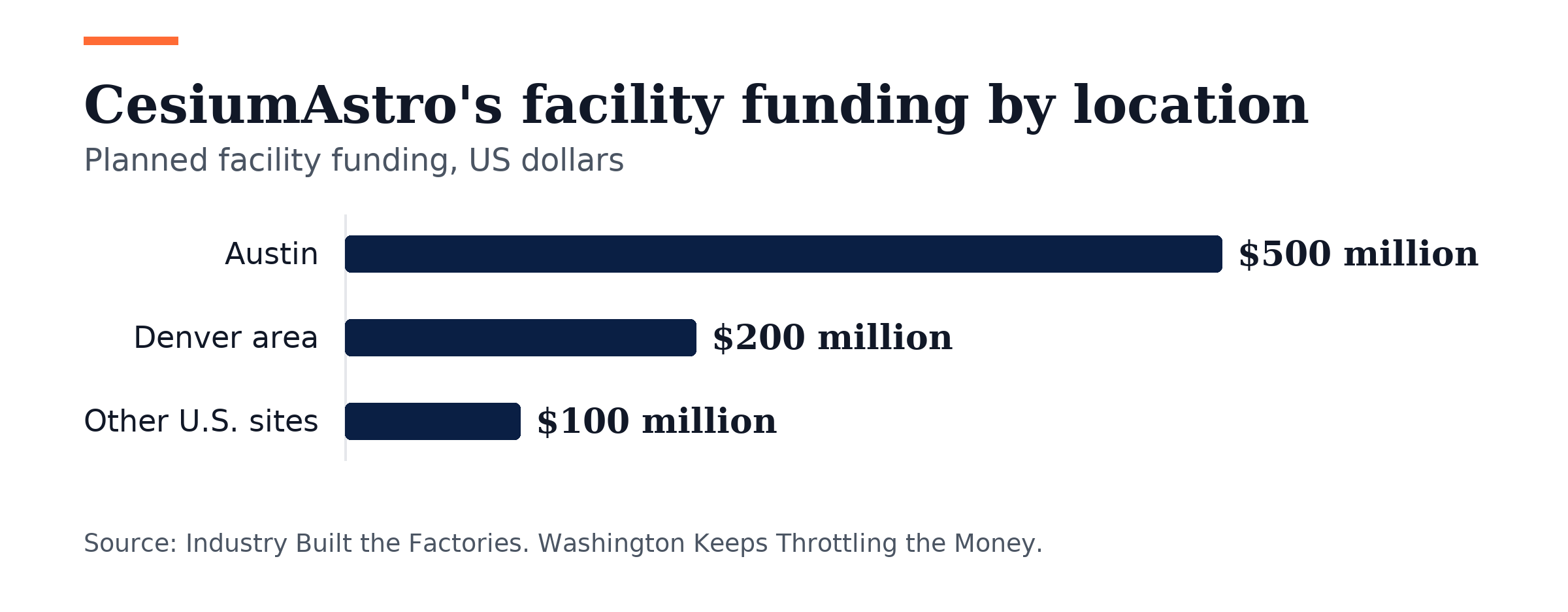
Sabripour said CesiumAstro is funding about $500 million in Austin, $200 million in the Denver area and $100 million at other U.S. sites for facilities that produce components through full mission assemblies. The spending covers sites in Austin, the Denver area and other U.S. locations and supports facilities producing items from chips to complete missions.



Join the discussion