Key facts
- According to Asenjo, Einstein's equations hold constraints on space-time evolution that are not immediately obvious.
- The rules governing gravitational fields closely resemble those that govern magnetic fields in plasmas.
- If the conditions fail, gravitational sheets can split and join in completely new layouts, moving energy tied to heavily warped space-time.
- The new findings appear in "Reconnection of Gravitational Fields" by Luca Comisso and Felipe A. Asenjo in Physical Review D (2026), DOI 10.1103/lmqy-pf9k.
Physicists Luca Comisso of Columbia University and Felipe A. Asenjo of Universidad Adolfo Ibáñez proposed in October 2026 that gravitational field structures can break and reconnect, moving energy from the gravitational field into matter. {Sources: Phys.org, Tech Explorist}
The researchers call the process gravitational reconnection and present it as a theoretical idea rather than an observed phenomenon. It reinterprets Einstein’s field equations by drawing an analogy with magnetic reconnection in plasmas, where field lines break and reconnect to power explosive events such as solar flares. {Sources: Phys.org, Tech Explorist}
Comisso defined magnetic reconnection for Phys.org with these words: “Magnetic reconnection is when these field lines, in some specific configuration, break and reattach in a different configuration,” he said. Plasma drags magnetic field lines around, stretches them, and twists them until the stress becomes too great. Moving plasma in the Sun stretches and twists magnetic fields that stay attached, and only when the frozen-in state breaks down can the fields reconnect and release energy such as in solar flares. {Sources: Phys.org, Tech Explorist}
Magnetic reconnection powers solar flares, takes energy from the magnetic field, gives it to particles in plasma, and produces explosions. The process ranks among the most important energy-release mechanisms in astrophysics. {Sources: Phys.org}
The rules governing gravitational fields closely resemble those that govern magnetic fields in plasmas, according to the researchers. A new formulation of Einstein’s equations has been developed that remains mathematically equivalent to the originals while using different variables. Written in those variables, the equations of gravity resemble the equations governing plasmas such as those in the sun, fusion experiments, and interstellar space. {Sources: Phys.org}
The Brighter Side of News describes the recasting as making Einstein’s equations look like equations from nonlinear electrodynamics and magnetohydrodynamics. The Brighter Side of News presents the Maxwell-like framing as a complementary route to supercomputer simulations, meant to find organizing rules beneath the chaos of space-time evolution. {Sources: The Brighter Side of News}
Comisso’s career has focused on plasmas, leading him and his colleagues to apply plasma physics methods to gravity after recognizing the resemblance. The research idea traces to a talk by Kip Thorne at Columbia University on parallels between gravity and fluid motion, which strongly influenced the team to ask whether rules preserving structure in an electrically conducting fluid could apply to gravity. {Sources: Phys.org, The Brighter Side of News}
Space-time blends four dimensions of space and time and bends, stretches, and shifts when matter and energy move through it. In four-dimensional space-time, gravity uses field sheets instead of field lines because adding a dimension to a line gives a plane, which can be pictured as many lines forming a sheet. Gravitational field connections consist of two-dimensional surfaces paired with field lines that keep their connections intact while space-time changes, and gravitational sheets in four-dimensional space-time differ from three-dimensional magnetic field lines and are harder to reduce to one-dimensional lines. {Sources: Phys.org, Tech Explorist, The Brighter Side of News}
Gravitational field sheets are mathematical structures rather than physical objects, yet their reconnection transfers energy from the gravitational field into matter. Space-time includes gravitational two-surfaces together with field lines that can keep their connections over time. {Sources: Phys.org, The Brighter Side of News}
When gravity meets the frozen-in condition, gravitational magnetic flux stays constant as space-time evolves, leaving some features of the field unchanged. Gravitational magnetic flux conservation limits how gravitational fields change over time and is a property of gravity despite its magnetic-sounding name. Asenjo said, “We show that analogous gravitational field structures also remain frozen into the dynamics when an ideal Ohm-type condition is fulfilled.” {Sources: Tech Explorist, The Brighter Side of News}
Gravitational helicity measures the way field lines wrap around themselves, loop through space, and connect to each other, giving a new way to describe gravitational-field organization. It remains fixed under the ideal condition, according to both Tech Explorist and The Brighter Side of News. {Sources: Tech Explorist, The Brighter Side of News}
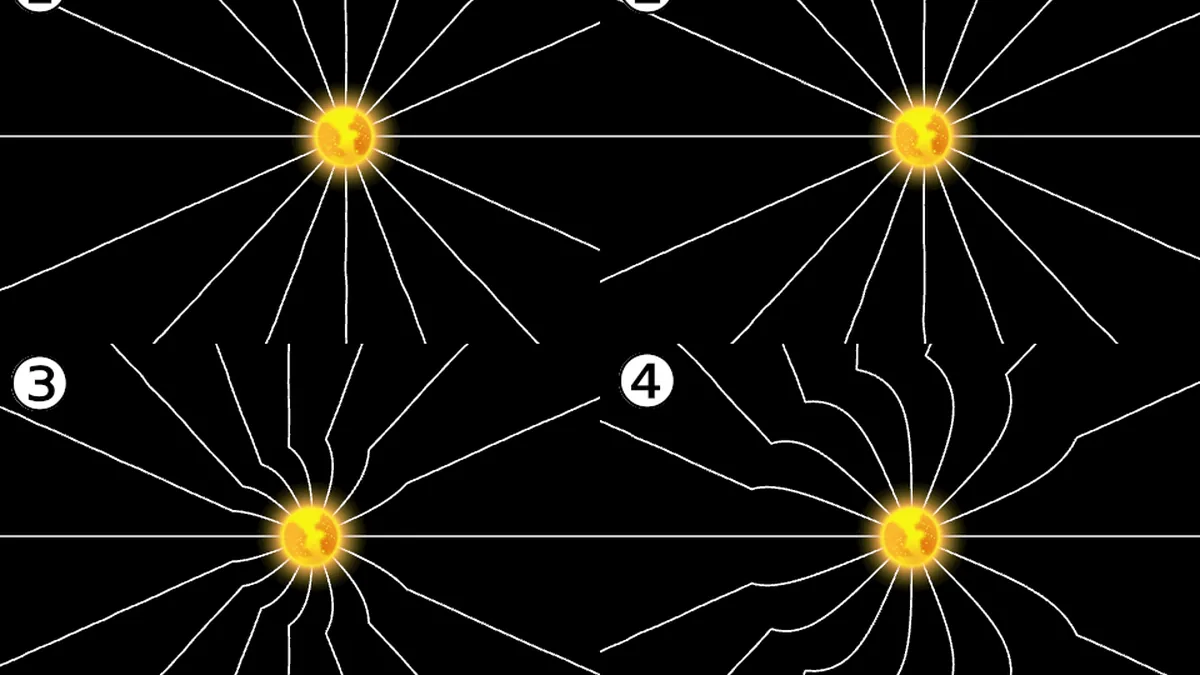
The answer is affirmative, at least in mathematics and when an ideal Ohm-type condition is part of the framework, Tech Explorist and The Brighter Side of News state. The conclusions hold only under that condition, and the authors do not say every case of gravitational evolution keeps these structures. If the conditions fail, gravitational sheets can split and join in new layouts, moving energy tied to heavily warped space-time. {Sources: Tech Explorist, The Brighter Side of News}
Certain gravitational structures can remain linked as space-time changes, according to the earlier research. When conditions hold, space-time does not evolve freely in every way, and certain shifts between topological setups are barred. The framework highlights cases where topological constraints might break down, potentially uncovering new physics in strongly dynamic gravitational systems. {Sources: The Brighter Side of News, Tech Explorist}
Comisso said some implications hide in the equations and are not straightforward to capture just by looking at them, so researchers must rewrite the equations differently to exploit the behavior. Asenjo noted that Einstein’s equations hold constraints on space-time evolution that are not immediately clear. {Sources: Phys.org}
The earlier Physical Review Letters study was led by Felipe A. Asenjo, Maricarmen A. Winkler, and Luca Comisso, and it identified previously unrecognized rules constraining how space-time bends, stretches, and evolves. Its journal reference is “Frozen-In Gravitational Fields,” Physical Review Letters, DOI 10.1103/6c4q-kx6f. The new findings appear in “Reconnection of Gravitational Fields” by Comisso and Asenjo in Physical Review D (2026), DOI 10.1103/lmqy-pf9k. {Sources: Tech Explorist, Phys.org}
Asenjo said the team had carried out studies on relativistic plasma dynamics showing that general curved spacetimes preserve general topological structures of magnetic fields and other fluid-like quantities. Comisso said the Kip Thorne talk at Columbia University strongly influenced the team to ask whether rules preserving structure in an electrically conducting fluid could apply to gravity. {Sources: The Brighter Side of News}
Because Einstein’s equations are complex and nonlinear, the researchers wondered whether principles preserving structure in fluids and plasmas might also exist in gravity. The approach helps predict patterns of space-time without the full calculation because space-time must behave in a certain way and meet constraints. Comisso hopes the approach will eventually predict how much energy events such as merging black holes release and what signatures they leave in gravitational waves. {Sources: Tech Explorist, Phys.org}
Astrophysicists study black hole collisions using enormous supercomputer simulations that begin from chosen starting conditions and watch what emerges. LIGO is an observatory built to sense ripples in space-time coming from events like colliding black holes. Numerical relativity simulations remain the primary tool for studying extreme events, yet they do not always give the clearest physical picture. {Sources: Phys.org, The Brighter Side of News}
The framework can aid the reading of complex numerical simulations by showing which structures stay intact under ideal conditions and which changes are blocked. The work may influence research on black hole mergers, gravitational waves, neutron star collisions, and the evolution of the cosmos on large scales. Studying whether topological constraints influence detected gravitational waves ranks among the team’s upcoming research aims. {Sources: The Brighter Side of News, Tech Explorist}
The evolution of space-time curvature underlies events including black hole mergers and neutron star collisions, along with core-collapse supernovae and large-scale structure growth. Gravitational reconnection remains a theoretical discovery for now, and the findings point to a deeper connection linking gravity, topology, and field theory. Comisso told Tech Explorist that checking whether constraints affect detected gravitational waves is a future goal. {Sources: The Brighter Side of News, Phys.org, Tech Explorist}


Join the discussion