
Key facts
- The study concludes that cometary delivery of prebiotic building blocks to Earth would be at best a one-off fluke rather than a steady rain of molecules, though it cannot be ruled out completely.
- Simulations suggest cometary delivery of hydrogen cyanide and other prebiotic molecules was slightly more probable for Mars than for Earth because Mars is smaller with a thinner atmosphere, allowing lower impact speeds.
- For hydrogen cyanide to survive a comet crash, the comet would need to exceed 100 meters across, move slowly, approach at an oblique angle, and strike land rather than an ocean.
- Anslow said it would be unlikely if cometary delivery happened on Earth but not Mars, or the more likely alternative is that it did not happen on either planet.
A study led by the University of Cambridge and published in Scientific Reports on October 28, 2026, concluded that comets likely did not bring prebiotic molecular building blocks to Earth, challenging a hypothesis that has persisted for roughly a century.
The research, led by Dr. Richard Anslow, applied modern impact and atmospheric modeling to test the hypothesis that comets could ferry molecules between worlds. Computer simulations tested whether hydrogen cyanide could survive a comet’s trip through Earth’s current atmosphere and impact with the surface. The group chose hydrogen cyanide since comets transport it in useful amounts and its triple bond is tougher than more complex chemicals. The work drew on recent advances in comet impact simulations, comet-atmosphere interaction models, and dynamic modeling of where comets originate and how their orbits evolve.
The team concentrated on impact physics instead of comet composition, arguing that fragile organic molecules cannot endure the heat and pressure of a high-speed, steep-angle collision with Earth. The simulations indicated that comets travel too fast and hit Earth’s atmosphere at too sharp an angle for fragile organic molecules to survive, so they would nearly all vaporize on impact. Anslow called the older view of comets as cosmic delivery vehicles a romantic idea that the results suggest is highly unlikely.
Comet strikes on Earth dropped sharply during the planet’s first half-billion years, leaving only a few chances for hydrogen cyanide delivery by comet in early history. Simulations indicate that across more than a billion years, on average just one comet impact would have brought a meaningful amount of hydrogen cyanide to Earth’s surface. Even if hydrogen cyanide reached the surface, it would not have stayed concentrated for long, so any prebiotic chemistry would have needed to begin almost immediately, which the researchers consider highly unlikely.
To survive a comet crash, hydrogen cyanide would require a comet wider than 100 meters, moving slowly, approaching at an oblique angle, and striking land instead of an ocean. Recent computer models indicate that only comets wider than roughly 300 feet survive early Earth’s atmosphere intact, and earlier studies overestimated how much hydrogen cyanide can survive a high-speed impact. Ocean impacts would dilute surviving hydrogen cyanide too rapidly to set off biologically useful reactions.
Anslow stressed that although the results make cometary delivery appear highly unlikely, the researchers do not claim it is impossible, leaving room for a single rare event rather than a continuous supply. The study concludes that cometary delivery of prebiotic building blocks to Earth would be at best a rare fluke rather than a steady supply of molecules, though researchers cannot rule it out. He said it would be unlikely if cometary delivery happened on Earth but not Mars, framing the comparison as a logical check: if delivery happened on one planet but not the other, that would be surprising, so the more likely conclusion is that neither planet received prebiotic molecules this way. Anslow said hydrogen cyanide is likely one of the tougher molecules for surviving impacts, so more complex molecules would be even harder to deliver intact.
Simulations indicate that cometary delivery of hydrogen cyanide and other prebiotic molecules was somewhat more probable for Mars than for Earth because Mars is smaller with a thinner atmosphere, allowing lower impact speeds. Anslow cautioned that this does not prove delivery occurred on Mars. In 2023, Anslow and co-authors theorized that in systems where planets orbit close together, comets might slow down by ricocheting between worlds while carrying organic molecules; the new study tested this in our solar system.
The researchers propose that prebiotic molecules may instead have been synthesized after asteroid impacts, which hit Earth far more frequently than comets, or formed through processes on Earth itself without outside interference. Gordon Osinski of Western University in London, Canada, said carbon-rich asteroids known as carbonaceous chondrites, volcanoes, or hydrothermal vents may have supplied Earth’s carbon-based chemicals. “I hope other people will try to reproduce these results [and] then potentially try something similar with carbonaceous chondrites as well,” Osinski said. Nicolle Zellner, a physicist at Albion College in Michigan, said it is important to revisit ideas about comet delivery as understanding of comets and the early solar system grows.
The hypothesis that comets could deliver molecules between planets has persisted for close to a century. In 1992, Christopher Chyba and Carl Sagan studied lunar craters and concluded that most carbon reaching Earth arrived via space dust rather than comets, though its carbon remains locked in unreactive compounds. A study published in Science on April 17, 2024, found that peptides could form in interstellar molecular clouds under natural conditions and probably existed in the solar system from the outset. Most organic material arriving on early Earth was probably destroyed during planetary formation, with new organics later carried to the surface by meteors and comets, a delivery process known as panspermia.
The findings came from a laboratory experiment simulating interstellar conditions rather than direct measurement, though a tentative detection of peptides in a meteorite appeared in Oct. 2020 in the Journal of Proteome Research. Serge Krasnokutskiy of the Max Planck Institute in Germany said scientists still do not fully grasp how peptides contributed to the formation of life. He described peptides as effective catalysts that could help generate diverse organic and biomolecules if delivered to young planets. Krasnokutskiy noted that detecting peptides directly in space could become possible during a future mission to a comet.
Rosetta data showed comet 67P’s water has a high deuterium ratio, leading Kathrin Altwegg to say this comet could not have brought water to Earth. Rosetta data published in Science showed comet 67P’s water contains three times too much heavy water with deuterium, indicating its signature is fundamentally different from Earth’s water. Altwegg said asteroids are a competing source for Earth’s oceans because they contain water chemically like Earth’s and orbit closer, making impacts more likely than with distant comets. Rosetta xenon data indicated comets supplied roughly 22 percent of Earth’s atmospheric xenon, plus or minus 5 percent, while asteroids supplied the rest, according to researchers led by Bernard Marty.
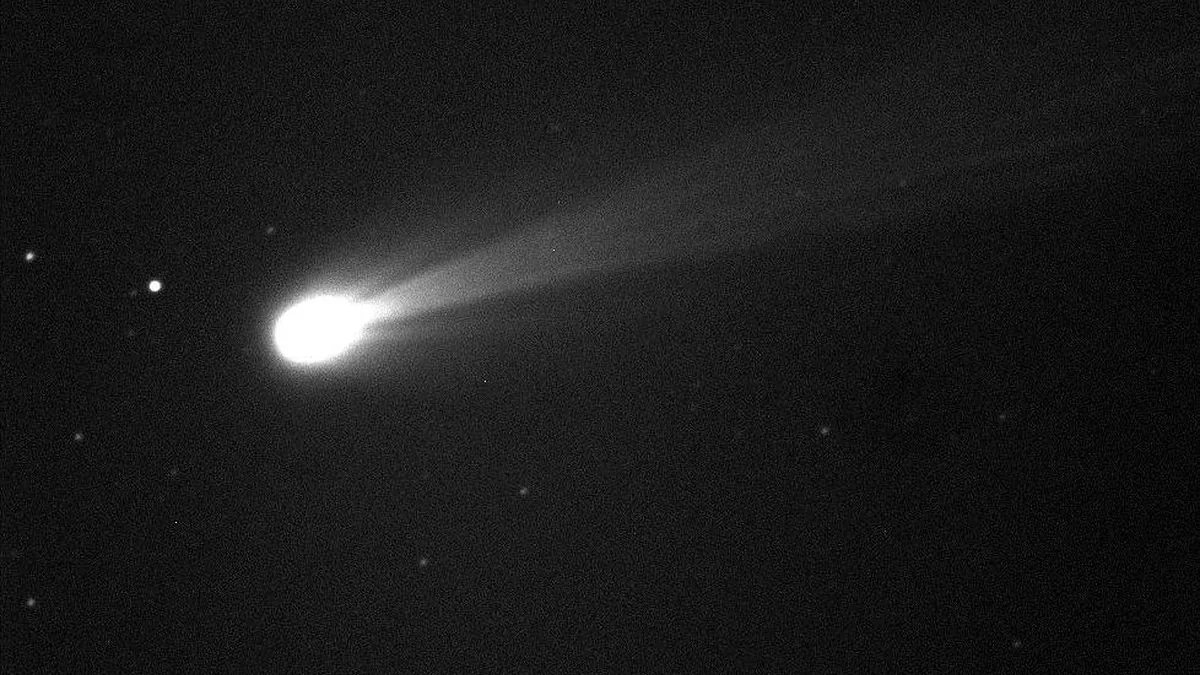
The European Space Agency’s Rosetta mission launched in March 2004, orbited comet 67P from August 2014 until the mission ended on September 30, 2016, and sent the Philae lander to the surface in November 2014. Rosetta became the first mission to orbit a comet and soft-land a probe, and ended with an intentional crash landing on 67P after more than ten years of operations. Comets are chunks of ice, dust, and rock left over from the solar system’s formation about 4.6 billion years ago, span a few hundred yards to dozens of miles, and follow elongated orbits. When they approach the sun, heat turns some ice into gas, creating a glowing cloud and long tail.
Lab experiments show concentrated hydrogen cyanide can yield fats, sugars, and genetic material such as DNA and RNA. The strong chemical bond connecting carbon and nitrogen in hydrogen cyanide can release energy powering later reactions needed for life. Comets carry carbon-bearing and nitrogen-bearing molecules left over from the early solar system’s formation, which can react to create biologically important compounds including sugars and DNA. Hydrogen cyanide contains one hydrogen atom, one carbon atom, and one nitrogen atom.
The findings could help future astronomers narrow the search for life in other systems, especially when successors to the James Webb Space Telescope such as the proposed Habitable Worlds Observatory come online. Anslow suggested the results could guide observations by future telescopes such as the proposed Habitable Worlds Observatory, with astronomers potentially prioritizing planetary systems where comets can bounce between closely orbiting worlds.
Support came in part from the Royal Society, the Leverhulme Centre for Life in the Universe, and the Science and Technology Facilities Council, which is part of UK Research and Innovation. The paper is titled “Cometary impacts an unlikely pathway towards the origins of life on Earth,” published in Scientific Reports in 2026 under DOI 10.1038/s41598-026-74214-y.





Join the discussion