On October 21, 2026, NASA unveiled Competition Model 2.0, a new selection process for several science mission classes, while Flagship missions remain under their existing process.
NASA says the current process has taken years to move mission concepts through, often causing contract management challenges, unpredictability and insufficient funding.
NASA projects selection time for Astro-Probes, New Frontiers and Discovery will fall from 35 months to about 19.5 months, up to 45 percent faster. For SMEX, Missions of Opportunity, Earth Venture, Hosted Payloads and Ride Shares, final selection drops from about 32 months to about 19 months under a single-step competition, up to 40 percent faster.
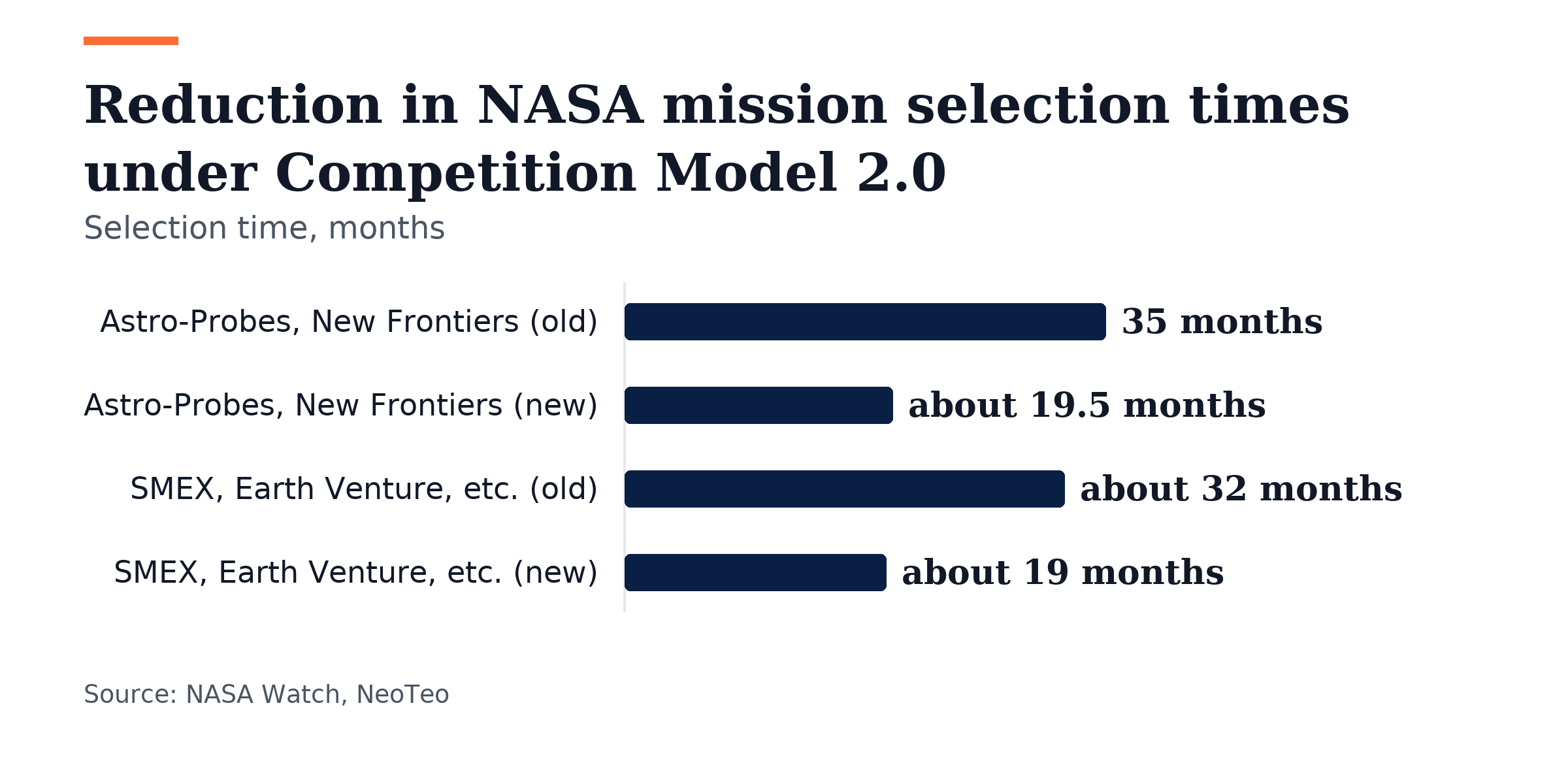
The two-step approach applies to Astro-Probes, New Frontiers, Discovery, MIDEX and Earth Explorer, and the single-step approach applies to SMEX, Missions of Opportunity, Earth Venture, Hosted Payloads and Ride Shares.
In the accelerated two-step competition for Astro-Probes, New Frontiers and Discovery, Step 1 requires a compelling science case, a science implementation plan and a proof-of-concept mission design, and it removes roughly half of the material currently required in an Announcement of Opportunity response for those mission classes. An Announcement of Opportunity is the formal call for proposals that NASA issues for mission classes. Step 2 is a Mission Implementation Study conducted with Goddard Space Flight Center or the Jet Propulsion Laboratory.
Down-selection to a single mission happens partway through Phase A. The selected mission completes Phase A and arrives at Key Decision Point B with a matured design. Teams not selected are freed from carrying their concepts through the rest of Phase A on their own.
MIDEX and Earth Explorer will use the two-step method, bringing universities and industry into the group of implementing organizations. NASA will review those groups based on their track record with projects of comparable scope and budget.
Principal investigators who do not have backing from a major university or a commercial organization will receive fair consideration. NASA PIs at any NASA Center remain eligible.
Teams are expected to adopt commercial buses, subsystems and multi-mission operations when those capabilities provide a technical or cost benefit. Commercial buses are satellite platforms developed by commercial companies. Breaches of cost and schedule control thresholds will carry real consequences of up to and including mission termination across every mission class. Mission termination means the cancellation of a mission.
CM2.0 will not change how NASA manages its largest missions because that process was already reformed after the James Webb Space Telescope through the Large Mission Study. Under the flagship approach, NASA directs the mission to a lead NASA Center, which then competes science teams and instruments through targeted solicitations. Flagships will continue to follow that reformed approach for building large missions efficiently.
NASA’s Science Mission Directorate may award an implementation study under Goddard management to JHU/APL for New Frontiers or Discovery missions depending on the science selected. The implementation study evaluates merit early and surfaces risks before they become hidden problems later in development.
NASA Administrator Jared Isaacman has empowered the Science Mission Directorate to accelerate science delivery, reduce long competitive processes and focus funding on the highest-priority missions. Nicola Fox said, “NASA Science wants to deliver science faster, so we’re changing how we compete and select missions.”
NASA says some parts of the new model will take time to implement and the agency will roll them out in stages, refining them with input from the science community. Predictability in delivering science will be at the forefront as NASA rolls out the model.


Join the discussion