Key facts
- A telescope is needed to spot Saturn's rings and moons, and a larger telescope helps cut through the Moon's glare.
- Before the transit starts, 10th-magnitude Dione approaches Saturn's northeastern limb, Tethys sits east of the rings, and Rhea lies west of them.
- Video capture might record Dione's shadow crossing Saturn's far northern polar region around 9:40 P.M. EDT, disappearing roughly half an hour later.
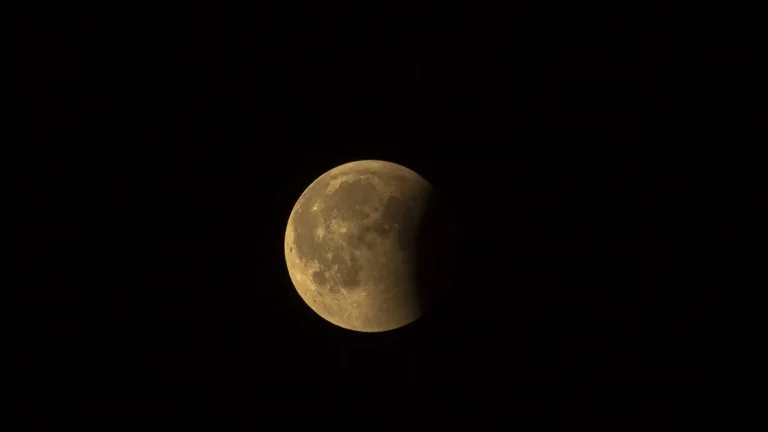
- For the reference location at 40° N 90° W, sunrise is 7:22 A.M., sunset is 6:06 P.M., moonrise is 5:33 P.M., moonset is 6:46 A.M., and the Moon phase is Full.
Saturn’s moon Dione crosses in front of the planet’s disk at 8:43 p.m. EDT on Oct. 25, 2026, and the transit favors observers in the eastern half of the United States, Astronomy Magazine said in a sky-watching column.
The magazine said viewers will struggle to see the crossing by eye from anywhere, and that recording it with high-speed video gives the best results. “Saturn’s small moon Dione transits the disk this evening at 8:43 p.m. EDT, best seen from the eastern half of the U.S.,” Astronomy Magazine said. The column explains that the moon’s small disk is difficult to see against the bright planet as the crossing begins.
The night offers a chance to watch Dione move onto and off the planet’s disk while following multiple other moons around Saturn. At about 9 p.m. EDT (8 p.m. CDT), Saturn stands well above the horizon, appearing off to the east for Midwest viewers and in the southeast for people on the East Coast.
Saturn is the brightest light in that part of the sky, and observers can spot it without a telescope even when the Moon is close. To see the rings and moons, you need a telescope, and a larger aperture helps cut through the Moon’s glare.
As the crossing begins, 10th-magnitude Dione approaches Saturn’s northeastern limb. Tethys appears east of the rings, while Rhea lies west of them. Titan glows at about magnitude 8.5 far west of Saturn all evening, roughly 2 arcminutes from the planet’s center.
When the transit begins, people watching by eye will likely see the moon seem to vanish because its small disk is difficult to see against Saturn’s bright cloud tops. Video might catch Dione’s shadow as it crosses Saturn’s far northern polar region around 9:40 p.m. EDT, with the shadow vanishing roughly half an hour later.
Just before 10:40 p.m. EDT, Dione reaches Saturn’s northwestern limb (the edge of Saturn’s disk), and observers watching by eye will see it appear just off the limb before pulling away westward. At the reference point of 40° N 90° W, the Moon is Full, where sunrise is 7:22 a.m., sunset is 6:06 p.m., moonrise is 5:33 p.m., and moonset is 6:46 a.m.
The column provides sunrise, sunset, moonrise, and moonset times at 40° N 90° W in local time, and it gives the Moon’s illumination value at 10 p.m. local time at that location. Astronomy magazine senior editor Alison Klesman, who holds a Ph.D. in astronomy, has studied minor planets and supermassive black holes.


Join the discussion