Key facts
- The Pandora mission seeks to separate stellar activity signals from measurements of exoplanet atmospheres obtained through transmission spectroscopy.
- Prime-mission planets range from 1.5 to 15 Earth radii in size and 1.7 to 11.5 days in orbital period.
- The prime mission includes 20 targets, each scheduled for 10 transit visits.
- The target-selection paper discusses early science results and possible extended-mission operations and science.
Emily Gilbert submitted Pandora’s target-selection paper to arXiv on Oct. 21, 2026, advancing the NASA SmallSat into target selection and early science.
NASA selected Pandora in 2021 under its inaugural call for Pioneer mission concepts. The mission is a collaboration among NASA’s Goddard Space Flight Center, Lawrence Livermore National Laboratory, NASA’s Ames Research Center, and other institutions. NASA describes Pandora as a small satellite designed to study exoplanet atmospheres and the activity of their host stars using long-duration multiwavelength observations, meaning data gathered across more than one wavelength range. The agency says the mission will examine no fewer than 20 known exoplanets to determine atmospheric composition, or the gases that make up a planet’s air, with emphasis on hazes, clouds, and water.
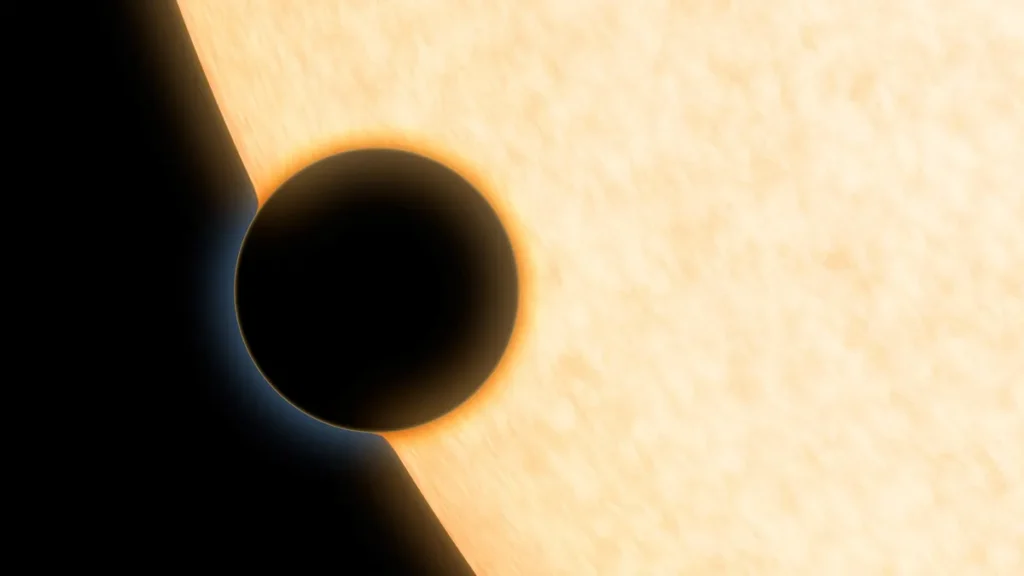
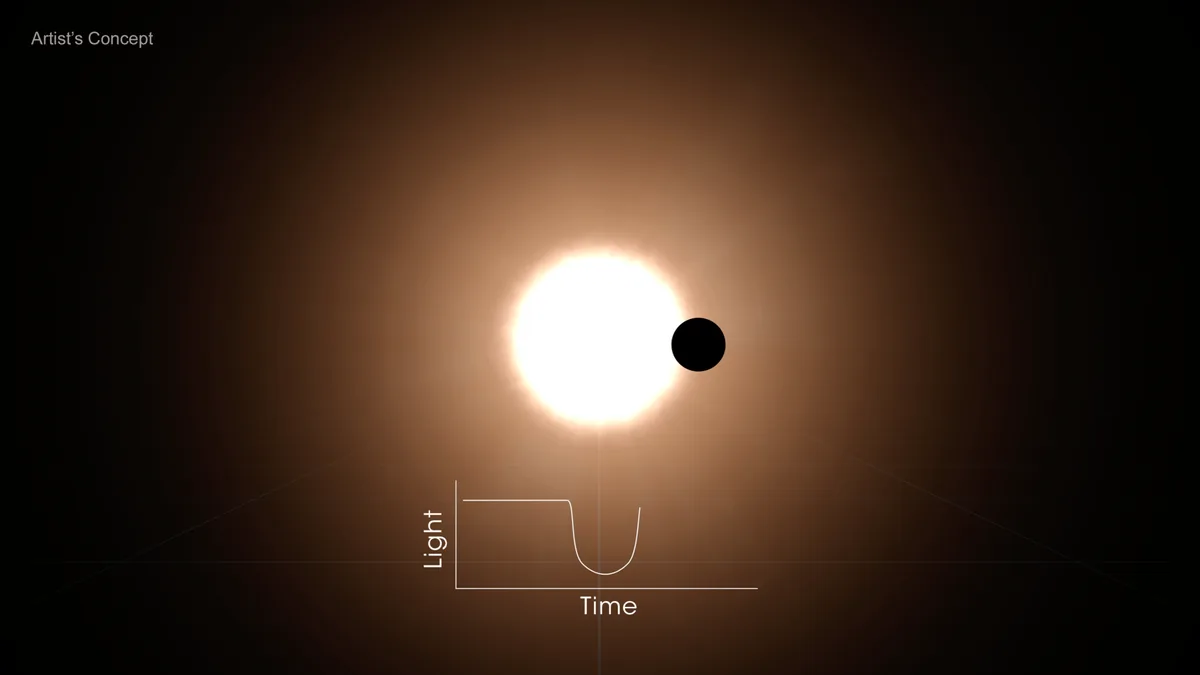
When a planet transits its star, starlight passes through the planet’s atmosphere, and comparing the transit spectrum to the star’s spectrum alone reveals atmospheric signatures. A transit occurs when a planet passes directly between its star and the observer. Pandora targets planets whose atmospheres consist mainly of hydrogen or water. NASA says Pandora will study at least 20 known planets orbiting distant stars to determine atmospheric composition, especially hazes, clouds, and water.
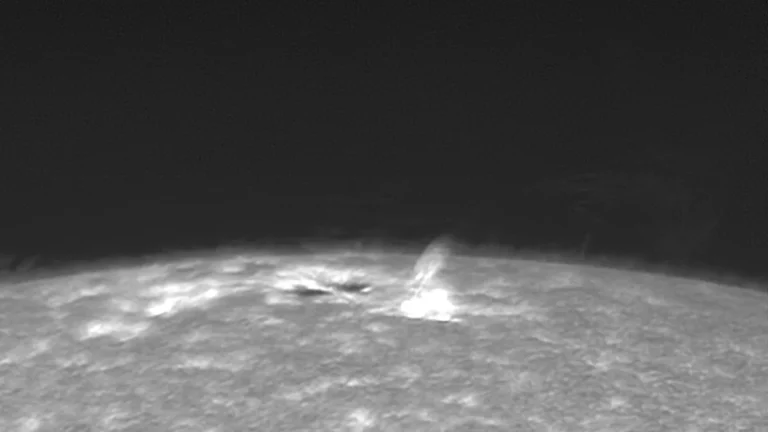
Dark or bright stellar regions such as sunspot groups or plages can vary a star’s spectrum over time in ways that mimic or suppress planetary spectral features. Sunspot groups are dark regions on a star’s surface, while plages are bright regions. A star’s spectrum is the pattern of light it emits across different wavelengths.
Pandora disentangles star and planet spectra by monitoring host-star brightness in visible light while simultaneously collecting infrared data to constrain spot coverage. Spot coverage refers to the fraction of a star’s surface covered by dark regions. The mission seeks to separate stellar activity signals from measurements of exoplanet atmospheres obtained through transmission spectroscopy, which measures starlight filtered through a planet’s atmosphere during a transit.
Pandora uses combined visible photometry and near-infrared spectroscopy across 10 separate transit observations lasting one day each for every prime-mission target. Visible photometry measures brightness in wavelengths of light that human eyes can see. Near-infrared spectroscopy measures infrared light separated by wavelength.
Each prime-mission target receives 10 transit visits. Pandora’s prime mission targets are planets around low-mass K and M dwarf stars spanning a range of rotation periods and activity levels. Prime-mission planets span sizes between 1.5 and 15 Earth radii and orbital periods between 1.7 and 11.5 days. K-dwarf and M-dwarf stars are low-mass stars cooler than the Sun.
The prime mission includes 20 targets. The primary target list covers diverse stellar activity levels, planet sizes, and atmospheric properties across the year-long prime mission.
As of July 30, 2025, the Pandora target list draws on NASA Exoplanet Archive composite tables. It covers transiting planets with orbital periods under 18 days around host stars cooler than 5300 Kelvin.
Host star brightness limits fall between 7.0 and 11.5 in J band and below 11.0 in H band. The limits prevent targets from saturating Pandora’s detectors. J band and H band cover infrared wavelength ranges used to measure stellar brightness. Saturation occurs when a detector receives more light than it can record accurately.
The Pandora Science Team calculates a Transmission Spectroscopy Metric for every planet that qualifies. The metric indicates how strong a spectral signal the atmosphere would provide for each planet meeting the selection criteria. Qualifying planets meet the orbital period, temperature, and brightness limits.
A separate Signal Detection Metric uses peak-to-peak amplitude A and weighting factor w to account for stellar rotational variability. A weighting factor of 100 doubles the metric for a star with 1% variability. Peak-to-peak amplitude A measures the range of a star’s brightness changes.
SDM ranks all qualifying exoplanets. The highest 20 SDM values form the primary target list. The 21st through 40th best values form the secondary target list.
Auxiliary targets cover stellar activity and young systems, transit timing variations of exoplanets, brown dwarf compositions, and exoplanet phase curves. Transit timing variations are changes in when a planet crosses its star. Phase curves track a planet’s brightness as it orbits. Young systems are newly formed star and planet systems.
Brown dwarfs are objects larger than planets but smaller than stars. These auxiliary targets fill gaps in prime mission operations. Auxiliary targets supplement the 20 prime mission targets and cover a variety of science topics.
The target-selection paper discusses early science results and possible extended-mission operations and science. Emily Gilbert submitted the paper as version 1 to arXiv on Wednesday, 21 Oct 2026 at 16:52:20 UTC. It runs 10 pages with 3 figures and 1 table.
The target selection framework weighs viewing geometry, observation duration, orbital constraints, planet and host star demographics, and possible coordination with the James Webb Space Telescope. Viewing geometry describes the angle from which observers see a planet’s transit. Observation duration is the length of time spent watching each transit. The demographics of planets and host stars describe the populations under study.
The chosen planets are larger than 1 Earth radius and orbit M- and K-dwarf stars. The team picked 20 primary science targets and added secondary targets for planets above 1 Earth radius around M- and K-dwarf stars.
The prime mission lasts one year, and the framework balances the mix of planets and host stars it will observe.
Pandora planned to launch in October 2025. It will observe at least 20 transiting exoplanets and host stars using simultaneous near-infrared spectroscopy and visible photometry. Simultaneous means collecting both types of data at the same time.
SpaceNews reported on Sept. 4, 2026, that the first spacecraft in a new class of small NASA astrophysics spacecraft had started operations, providing science data and lessons for future missions. NASA selected Pandora in 2021 under its inaugural call for Pioneer mission concepts.




Join the discussion