
This is a new development in a story we reported earlier: NASA schedules Artemis III for 2027 as Moon landing rehearsal.
Key facts
- NASA named Randy Bresnik, Frank Rubio, Andre Douglas, and ESA astronaut Luca Parmitano as the Artemis III crew for a 2027 Orion low-Earth-orbit test flight ahead of a lunar landing.
- Artemis III is planned to launch in 2027 and will last 14 days, with crews practicing procedures essential for landing near the Moon's South Pole in 2028.
- Artemis III uses three separate spacecraft launched on different heavy-lift rockets within a short period, unlike earlier Artemis missions that used only NASA's SLS rocket and Orion spacecraft.
- SpaceX will launch from Florida a Starship Version 3 test article later in the mission because the vehicle has a shorter on-orbit lifetime than Blue Origin's lander.
NASA has named Randy Bresnik, Frank Rubio, Andre Douglas and ESA astronaut Luca Parmitano for Artemis III, an Orion test flight in low Earth orbit set for 2027 ahead of a lunar landing.
NASA plans to use the 2027 mission as a major rehearsal for astronaut landings before crews descend to the lunar surface in 2028.
NASA plans to launch Artemis III in 2027 on a 14-day flight. The 14-day mission will have crews rehearsing procedures needed for a Moon’s South Pole landing in 2028. NASA says the flight is meant to lower risk, check hardware and build operational experience ahead of a crewed lunar landing.
The mission will use three separate spacecraft launched on different heavy-lift rockets within a short period, unlike earlier Artemis missions that relied only on NASA’s SLS rocket and Orion spacecraft. SpaceX and Blue Origin are each set to fly test versions of their own landers, while astronauts travel to low Earth orbit aboard Orion on NASA’s SLS rocket.
Blue Origin is slated to launch first, sending a test version of the Blue Moon Mark 2 lander into a circular orbit about 273 miles above Earth. The vehicle can remain on orbit for up to 30 days, giving teams time for orbital checkouts. NASA plans to launch Orion on SLS from Kennedy Space Center in Florida only days after the Blue Moon test article launches, once the vehicle is confirmed healthy and ready for joint operations.
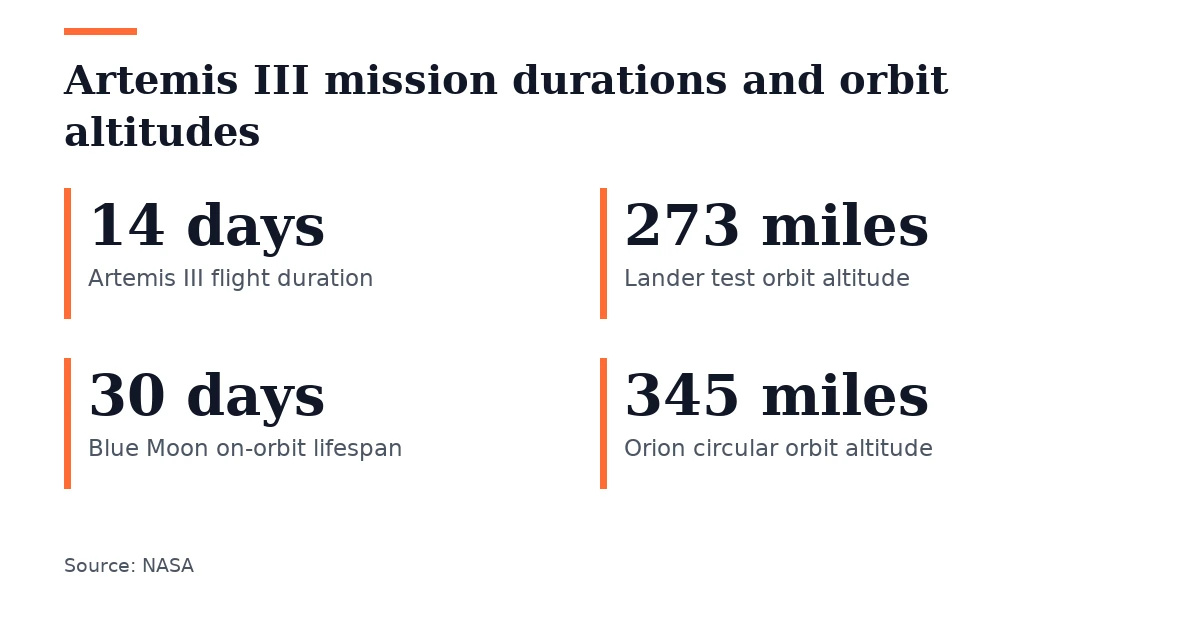
Orion will first reach an elliptical orbit measuring 18 x 1122 miles, equivalent to 16 x 975 nautical miles, then shift to a circular orbit at 345 miles, or 300 nautical miles, ahead of rendezvous with the Blue Moon lander. During the first two days in flight, crew members will check out Orion’s systems and prepare for proximity operations before meeting the Blue Moon test vehicle in orbit. That docking will mark the first time NASA assesses how Orion and a commercial lunar lander operate together in orbit.
After docking, the crew will spend roughly two days aboard the Blue Moon test article, opening the hatch to assess the cabin environment, controls and life-support systems firsthand. Before Orion undocks, the agency will finish its first crewed evaluation of a commercial lunar lander and gather data on spacecraft systems, crew operations and interoperability that teams cannot collect on the ground.
Later in the mission, SpaceX will send a Starship Version 3 test article from Florida, because its vehicle cannot stay in orbit as long as Blue Origin’s lander. Orion will rendezvous with Starship and dock during a test lasting up to two hours, though the crew will not board Starship. Orion will connect to a port beside Blue Moon’s crew cabin, then match its forward docking system with Starship’s nose, testing two docking geometries on one flight.
The two docking campaigns will show how Orion connects with two different commercial lander designs on a single flight. Following the Starship demonstration, Orion and its crew may spend as many as five days in orbit before beginning preparations to return home. The spacecraft will phase for return when ready, and the crew will prepare the cabin for reentry and splashdown in the Pacific Ocean off California, with recovery handled by NASA personnel and the United States Navy.
Investigations led by NASA will expand on Artemis II studies to gather more data for future deep-space missions, and the crew will test a health-assessment proof-of-concept for periods when direct mission-control contact is unavailable. The agency will fly a cellular biology experiment, and researchers will use the mission to test concepts for returning lunar samples to Earth while checking Orion’s environment for possible contamination concerns.
Crews will make Earth and solar observations to build critical observation skills from the spacecraft’s vantage point, and plant seeds will fly aboard Orion for scientific study and educational engagement. Planners have added flexibility to the flight timeline, so teams can complete more test objectives based on how operations actually unfold.
Jeremy Parsons, NASA’s Artemis program manager, said the mission’s Earth-orbit elements are all designed to lower risk before astronauts return to the Moon, and that each lesson learned moves NASA closer to a 2028 lunar landing. Steve Creech, who manages the Human Landing System Program at NASA’s Marshall Space Flight Center, said SpaceX and Blue Origin have proposed aggressive objectives, so NASA can gain confidence before a crewed landing.
Data collected during Artemis III, along with information from future uncrewed Moon demonstration missions, will help NASA improve astronaut safety and prepare for successful crewed lunar landings. Sources: NASA – NASA, published Oct. 23, 2026 aero-news.net – aero-news.net, published Sept. 19, 2026




Join the discussion