Key facts
- The Institute of Nuclear Physics of the Polish Academy of Sciences (IFJ PAN) developed experimental lithium fluoride detectors that recorded cosmic radiation doses near the Moon during the Artemis I mission.
- Lithium fluoride detectors used in the MARE experiment on Artemis I recorded radiation doses with a 15% margin of error compared to conventional track detectors.
- Cosmic radiation near the Moon, dominated by galactic radiation, results in a more uniform dose distribution across the human body compared to low-Earth orbit, where Van Allen belt protons cause nonuniform exposure.
- Artemis I data showed the AstroRad vest reduced radiation exposure by nearly 60% during a 1972-class solar storm, lowering the dose from 222 millisieverts (mSv) to 87.5 mSv.
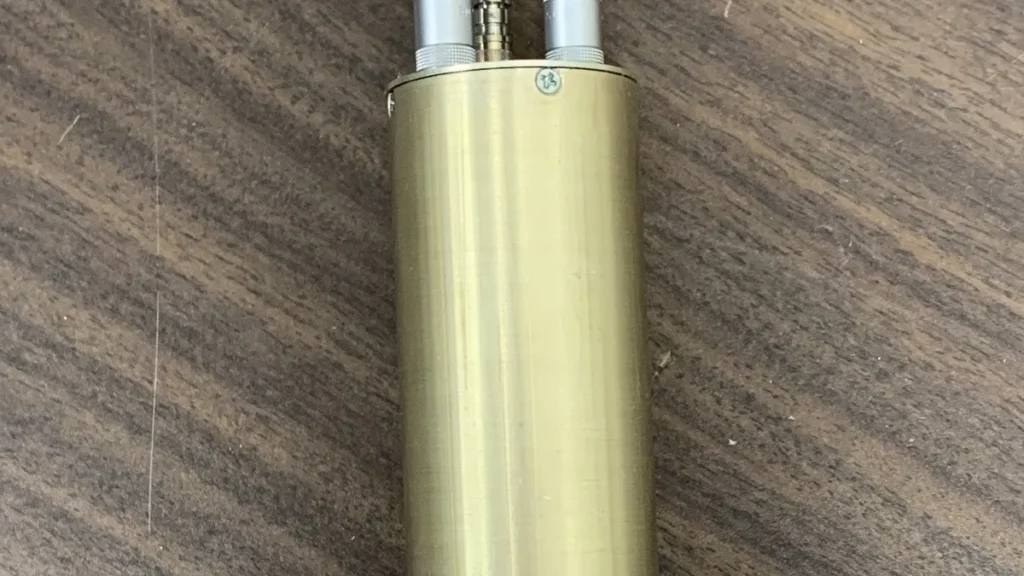
Researchers at the Institute of Nuclear Physics of the Polish Academy of Sciences recorded cosmic radiation doses near the Moon during the Artemis I mission in late November and early December 2022 using experimental lithium fluoride detectors flown aboard the Orion spacecraft.
The detectors were among more than 10,000 small crystals embedded in two human phantoms as Orion orbited the Moon. Dozens were fluorescent lithium fluoride devices developed at the institute in Cracow using the Czochralski method. They offer smaller size, better track resolution and a broader detection range than conventional track detectors, require no chemical treatment before readout under a standard fluorescence microscope, and recorded doses with a 15% margin of error compared with conventional track detectors.
Ionizing particles create defects in the lithium fluoride lattice that act as color centers and emit red fluorescence under blue light in the lab. Pawel Bilski of IFJ PAN, a co-author, said the passive detectors work like photographic film and require optical analysis under a microscope. Extracting quantitative data needed new calibration because cosmic radiation comes from all directions with every particle type and energy.
The MARE experiment used two female torso phantoms, Zohar wearing the AstroRad vest and Helga without it, during Orion’s 25.5-day lunar journey. Each phantom carried more than 5,600 radiation sensors, and the pair represented adult female bodies because of their higher cancer risk sensitivity. NASA, the German Aerospace Center and the Israel Space Agency collaborated on the experiment.
Near the Moon, the Van Allen belts are absent and galactic radiation dominates, producing an essentially uniform dose inside the body because high-energy particles pass through and deposit only part of their energy. That contrasts with low-Earth orbit, where trapped protons create depth-dependent dosing, as seen in the MATROSHKA experiment aboard the ISS more than a decade earlier. Bilski said total lunar doses are higher than in Earth orbit, though not by as much as many might expect.
Detectors enriched in lithium-6 can also record neutron doses because neutrons react with lithium nuclei to generate secondary charged particles. P. Bilski and co-authors published the readout method and results in Radiation Measurements in 2026 under DOI 10.1016/j.radmeas.2026.107806. IFJ PAN additionally supplied nearly 600 crystalline thermoluminescent detectors of another type to the MARE experiment.
Artemis I data showed the AstroRad vest reduced exposure by nearly 60% during a 1972-class solar storm, lowering the dose from 222 millisieverts to 87.5 millisieverts. Researchers derived the estimate from Orion’s passage through the inner Van Allen belt and historical storm profiles because no solar outburst occurred during the flight. The vest uses high-density polyethylene rather than lead because hydrogen-rich plastic absorbs proton energy without creating secondary X-rays. It weighs 57 pounds and places thicker material over the lungs, bone marrow, stomach, colon, breasts and ovaries.
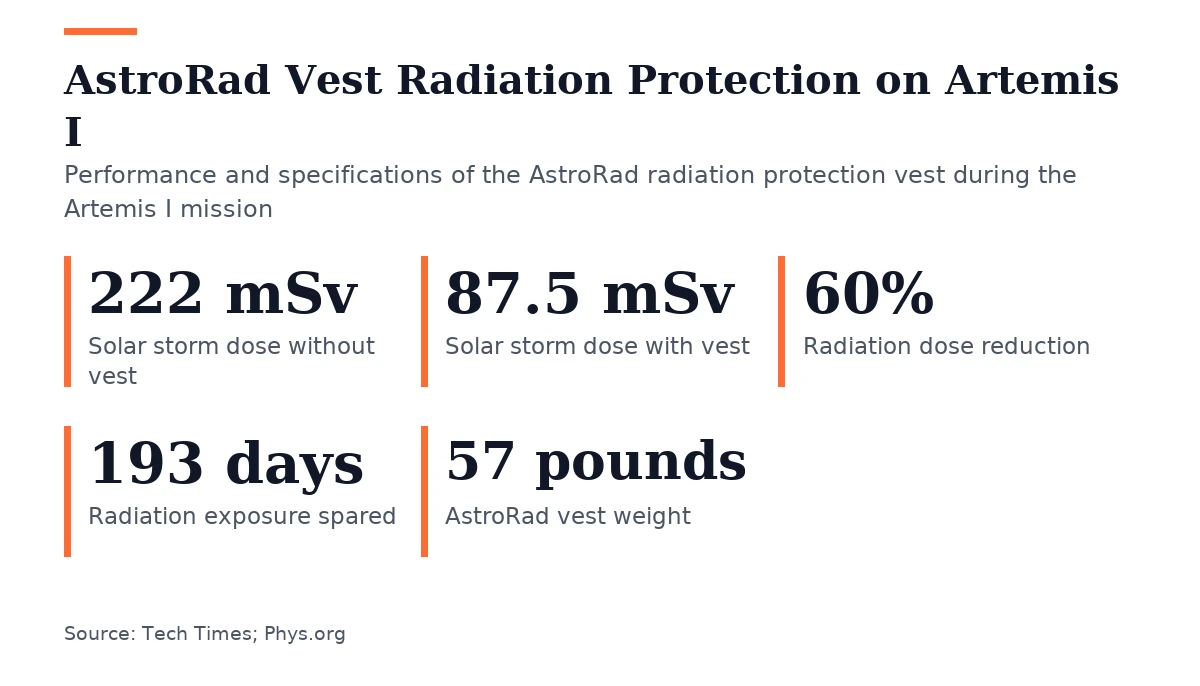
The organ-targeted shielding provides roughly 30% greater dose reduction than spreading the same material evenly, according to StemRad lead scientist Jordan Houri. Houri said the team originally expected about 45% protection and initially suspected an error when the result reached 60%. The vest’s protection during a solar storm compares with Orion’s onboard storm shelter, but it lets astronauts stay mobile and operational rather than confined. The 60% dose reduction equals sparing an astronaut 193 days of continuous deep-space background exposure.
The vest does not protect against galactic cosmic radiation, which accumulates on long missions such as trips to Mars, but it addresses acute risks from solar particle events. It serves as emergency equipment for hours or days when sensors detect elevated radiation, not for continuous wear, and ISS testing found it comfortable enough for extended use including sleep. A modular design under development would let one baseline vest fit different body types, reducing launch mass and allowing one crew member to work during a storm while others shelter.
The Israel Space Agency co-developed the vest with StemRad and Lockheed Martin, and NASA, the German Aerospace Center and the Israel Space Agency funded MARE. Redwire, based in Jacksonville, Florida, 3D-printed a vest subunit insert aboard the ISS using low-density polyethylene recycled from packaging waste in a project funded by Space Florida and the Israel Innovation Authority. The results could help engineers balance shielding, mass and crew mobility as missions travel farther from Earth.
NASA’s 600-millisievert career radiation limit, adopted in 2022 and applied to all astronauts regardless of age or sex, would keep even a 1972-class event below the ceiling when crew members combine the vest with the storm shelter. A round-trip Mars mission lasting three years or more would expose crews to galactic cosmic radiation doses exceeding the limit by at least a factor of two under current technology, even without solar particle events. That leaves the slow cumulative hazard as an unsolved engineering problem no current wearable technology resolves.
NASA targets Artemis IV for early 2028 as the first crewed lunar landing since Apollo 17, and stays of days or weeks fall within the career dose envelope without special shielding. A major solar storm during a lunar surface expedition could still deliver an acutely dangerous dose in hours. The Artemis II vest was not included on the 10-day flyby mission, even though the Israel Space Agency co-developed it with StemRad and Lockheed Martin.
NASA released over 800 GB of Artemis II lunar science data on Oct. 7, 2026, including more than 11,000 images, 8.5 hours of crew audio and crew-annotated observations. NASA uploaded the full dataset to the Planetary Data System public archive to inform Artemis III and future exploration.
Crew members Reid Wiseman, Victor Glover, Christina Koch and Jeremy Hansen captured the imagery and observations based on training in lunar geography and geology. The Artemis II dataset is the first planetary science collection captured primarily by humans in more than half a century. NASA also released the Preliminary Lunar Science Report, Lunar Science Operations Report and Lunar Science Data User Guide to support Artemis III surface planning.


Join the discussion