Key facts
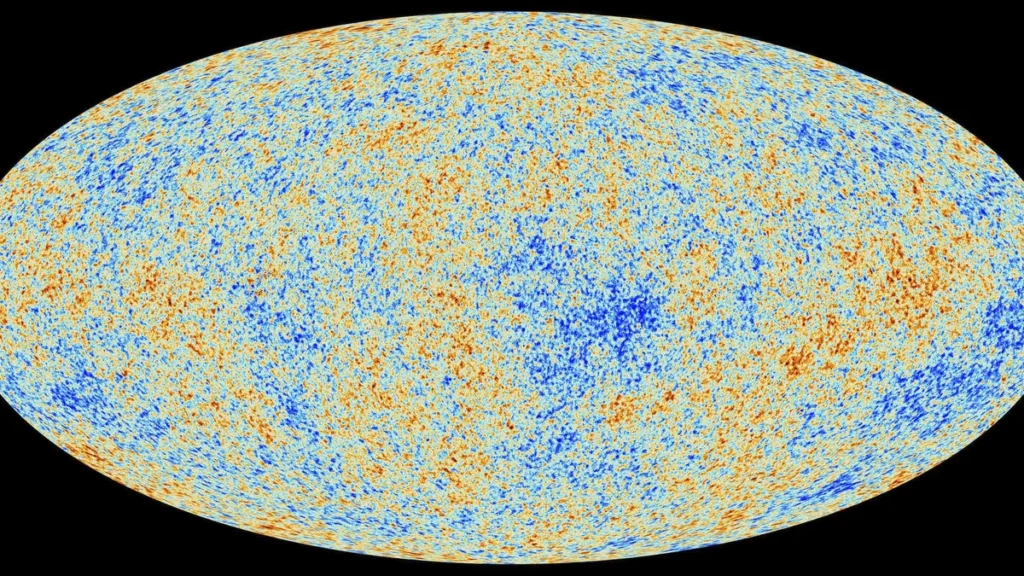
- Cosmic microwave background temperature varies across the sky by about one hundred-thousandth, reflecting matter distribution at that time, according to co-author Antonio Iovino of New York University Abu Dhabi.
- The paper is scheduled for publication on October 26 in the journal Physical Review Letters.
- A separate University of Portsmouth study proposes black holes from an earlier contracting phase of the Universe could survive a cosmic bounce and remain as relics that might explain a substantial share of dark matter.
- The cosmic bounce study's lead author is Enrique Gaztañaga of the University of Portsmouth's Institute of Cosmology and Gravitation and the Institute of Space Sciences in Barcelona.
A study posted to the arXiv preprint server on August 11, 2025, concludes that primordial black holes with stupendously large masses cannot account for a significant fraction of the Universe’s dark matter. The researchers behind the work, which includes Christopher Gerlach and Nikolas Leister of the Mainz Institute for Theoretical Physics alongside Antonio Iovino of New York University Abu Dhabi, demonstrate that black holes weighing more than roughly 10^11 solar masses would produce isocurvature perturbations exceeding limits set by the Planck satellite’s measurements of the cosmic microwave background. The black holes examined have masses exceeding 100 billion solar masses, making them more massive than entire galaxies. The researchers tested the idea using cosmic microwave background radiation, light that began traveling freely after hot plasma cooled and atoms formed about 380,000 years after the Big Bang.
This radiation still reaches Earth and contains information about matter distribution in the young Universe, making it a tool for checking large-scale graininess. The paper, titled “Closing the Mass Window for Stupendously Large Black Holes,” is scheduled for publication in Physical Review Letters on October 26, 2026. The researchers show these objects generate isocurvature perturbations above current Planck Cosmic Microwave Background limits, which excludes them as a major dark matter contributor.
The cosmic microwave background temperature varies across the sky by about one hundred-thousandth, reflecting matter distribution at that time, according to co-author Antonio Iovino of New York University Abu Dhabi. These small variations are the signal researchers examined for signs that rare, massive black holes had left an imprint on cosmic structure. Co-author Christopher Gerlach of the Mainz Institute for Theoretical Physics says a significant dark matter share concentrated in a few exceptionally massive black holes would make the Universe more grainy on large scales, and researchers designed the cosmic microwave background analysis to test this expected graininess. The analysis found no expected graininess, so co-author Nikolas Leister of the Mainz Institute for Theoretical Physics says these objects cannot constitute a substantial part of dark matter, and the absence of the predicted signal provides the observational basis for closing the mass window for stupendously large black holes as dark matter.
The study’s authors want to avoid the interpretation that such black holes are impossible, only that they are not a major dark matter ingredient, according to Space.com.
The largest black hole currently known may weigh about 36 billion solar masses, while hypothetical stupendously large objects would range from 1 million billion to 10 million billion solar masses and outweigh entire galaxies. This comparison highlights the scale gap between observed black holes and the hypothetical objects tested as dark matter candidates. Scientists stress that stupendously large black holes can still exist, but they do not make up a substantial share of dark matter.
The authors continue to investigate another possible dark matter component: small, asteroid-sized black holes. Excluding stupendously large black holes does not close the case for all primordial black holes as dark matter, leaving candidates such as these still under investigation.
While the Mainz-led study closes one mass window, a separate University of Portsmouth study proposes a contrasting hypothesis. “For almost a century, cosmologists have traced the history of the Universe back to a single dramatic moment known as the Big Bang,” says Professor Enrique Gaztañaga of the University of Portsmouth’s Institute of Cosmology and Gravitation and the Institute of Space Sciences in Barcelona. He explores an alternative cosmic history where black holes from an earlier contracting phase of the Universe could survive a cosmic bounce and remain as relics that might explain a substantial share of dark matter. The University of Portsmouth bounce study offers a contrasting hypothesis to the stupendously large black hole exclusion paper: Gaztañaga’s team suggests ancient black holes from a pre-Big-Bang contracting phase could survive as cosmic fossils and potentially supply a substantial share, or even all, of dark matter, whereas the arXiv/Space.com study excludes that same mass range as a significant dark matter component.
The prevailing cosmological model holds that the Universe began in a hot, dense state roughly 13.8 billion years ago, a framework that Gaztañaga characterizes as effective at accounting for the Cosmic Microwave Background and the large-scale arrangement of galaxies, even as core puzzles about cosmic origins and dark matter persist. Gaztañaga says dark matter outweighs ordinary matter by about five to one, listing this dominance as one of the unresolved mysteries alongside the trigger of the Big Bang and the cause of inflation.
Bouncing cosmology proposes the Universe contracted until it reached a dense but finite state, then reversed direction and expanded outward, avoiding an infinite singularity where density becomes infinite and physics breaks down. General relativity traces cosmic history back to such a singularity, motivating the bounce as a finite-density alternative. Quantum physics supplies a repulsive force under extreme compression, an effect that keeps white dwarfs and neutron stars from collapsing further and that also drives cosmic inflation, and the researchers extend this principle to the whole Universe to stop its contraction and begin expansion.
The bounce model predicts compact objects larger than roughly 90 meters could pass through the transition and survive after the Universe began expanding. Gaztañaga’s team says relic black holes produced during the bounce could account for a substantial share of dark matter, in principle even all of it, proposing that a sufficient population of black holes formed during the bounce could supply the bulk of the Universe’s dark matter.
The James Webb Space Telescope has detected unexpectedly massive objects in the early Universe, including sources sometimes described as “little red dots,” possibly connected to rapidly growing black holes appearing earlier than expected. Gaztañaga links these early massive objects to the bounce scenario, arguing that pre-existing black holes would mean the early Universe did not have to build its first galaxies from scratch.
Future observations could test the bounce idea by searching for relic gravitational waves from an earlier cosmic phase or subtle patterns in the cosmic microwave background preserving information from before the Big Bang. Gaztañaga’s study, “Cosmological bounce relics: Black holes, gravitational waves, and dark matter,” appears in Physical Review D, 2026; 113 (4), DOI: 10.1103/pr4p-6m49.
The results from the Mainz-led study narrow MACHO-style dark matter explanations by excluding galaxy-mass black holes as a significant component, leaving candidates such as asteroid-sized primordial black holes still under investigation.



Join the discussion