Key facts
- Venus reaches inferior conjunction at 4:00 Universal Time on Saturday, October 24, 2026, passing directly between Earth and the Sun.
- On the day of inferior conjunction, Venus shifts from an evening planet to a morning planet for all observers on Earth.
- Venus is unlikely to be seen on inferior conjunction day unless the observer is extremely careful and experienced with telescopes or photography, and no one should view it near the Sun without solar observing experience.
- Universe Today reports Venus shines at magnitude minus 4 on October 24 with a slim 0.75 percent illuminated disk a full arcminute wide, the largest apparent size any planet can show from Earth.
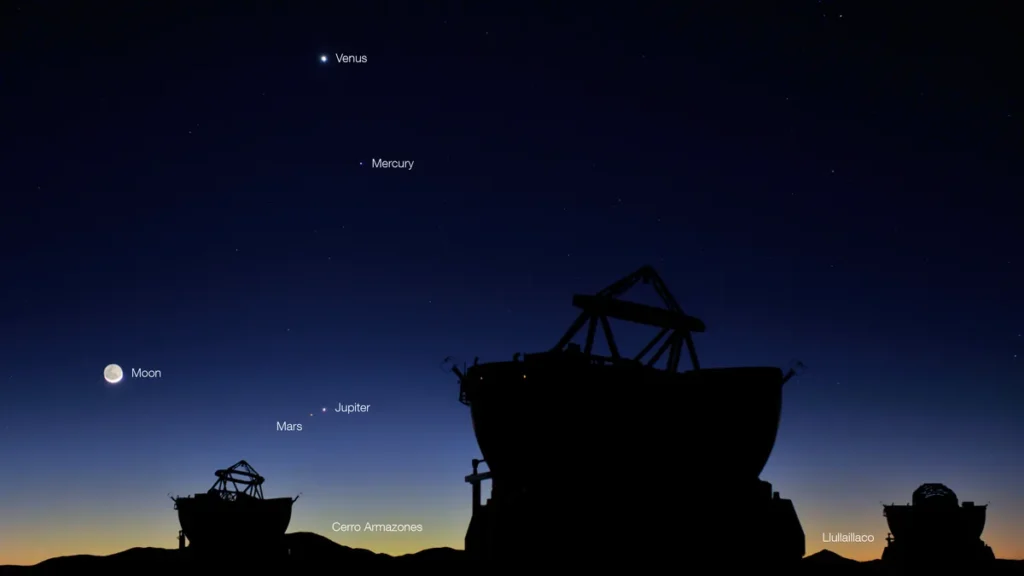
Venus passes between Earth and the Sun on Saturday, Oct. 24, 2026, shifting from the evening sky to the morning sky against the stars of Virgo.
The moment is inferior conjunction, when Venus travels directly between our planet and the Sun rather than passing on the far side of the solar disk. EarthSky sets the time at 4:00 Universal Time on Oct. 24, which is 11 p.m. CDT on Oct. 23 for North American observers. At that instant Venus officially changes from an evening planet to a morning planet for everyone on Earth. This is the definition of inferior conjunction: Venus crosses between Earth and the Sun and then rises before the Sun instead of setting after it.
This definition distinguishes inferior conjunction from superior conjunction, when Venus is on the opposite side of the Sun from Earth.
Venus will not cross the face of the Sun this time. The planet passes about 6.6 degrees south of the Sun, so the alignment produces no solar transit. EarthSky and Cosmic Herald specify that separation, while Universe Today rounds it to about 6 degrees. Because Venus misses the solar disk, the conjunction produces no dramatic spectacle for casual observers, though it remains a precise orbital alignment.
The miss happens because Venus’s orbit tilts 3.4 degrees to the ecliptic, so the planet generally passes above or below the Sun instead of directly in front of it. This geometry is why most inferior conjunctions do not produce transits, even though Venus lines up between Earth and the Sun.
Direct viewing on conjunction day is not practical for most people. Venus is unlikely to be seen unless the observer is extremely careful and experienced with telescopes or photography, and no one should view it near the Sun without solar observing experience. A slender crescent Venus crosses the daytime sky alongside the Sun deep in the glare, making the observation hazardous for untrained viewers.
There is a safe way to watch the passage online. The Solar Heliospheric Observatory’s LASCO C3 imager will show Venus crossing its wide field of view from Oct. 21 until Oct. 28, 2026. A sun-diving Kreutz comet also appeared in the same imager’s view on Oct. 19, 2026, alongside Venus. This provides a safe online way to track Venus through inferior conjunction when direct viewing is blocked by the Sun.
On the day of conjunction, Venus will be 0.27 Astronomical Units, or 40 million kilometers, from Earth. Universe Today reports the planet shines at magnitude minus 4 on Oct. 24 with a slim 0.75 percent illuminated disk a full arcminute wide, the largest apparent size any planet can show from Earth.
EarthSky estimates Venus at minus 3.9 magnitude and 61.12 arcseconds across at inferior conjunction, visible as a razor-thin crescent only to experienced telescopic or photographic observers. This level of difficulty is why casual skywatchers should skip the conjunction itself and wait for Venus to reappear in the dawn sky.
Properly equipped viewers may glimpse a “ring of fire” around Venus on Oct. 24, 2026, when an illuminated thread extends around the disk, offering proof of its atmosphere. Universe Today reports the phenomenon, though direct viewing remains difficult because the Sun must be physically blocked. The illuminated thread extends around the disk as the planet’s atmosphere catches sunlight.
Astrophotographers have had better luck imaging Venus in the infrared than observing it directly near inferior conjunction, Universe Today states. Observers in the far southern hemisphere are favored in 2026 for following Venus near inferior conjunction before sunrise or sunset with the Sun safely below the horizon.
Universe Today reports it once spied Venus with the naked eye on the day of inferior conjunction from the Chena Flood Channel outside Fairbanks, Alaska. The article mentions this rare daytime sighting while cautioning that observing Venus near the Sun demands proper safety precautions and experience.
The shift from evening to morning follows a straightforward orbital mechanic. Venus trailed the Sun and set after it as an evening object for months, then as it overtakes Earth on the inside lane its position swings across the Sun’s line of sight, and afterward it rises before the Sun. Cosmic Herald explains that this is the handoff from evening star to morning star. Venus moves from trailing the Sun to leading it in the sky as it completes the inside pass.
Northern Hemisphere observers had a poor view of Venus disappearing into the sunset glare in early October because the ecliptic slants low to the autumn evening horizon. Southern Hemisphere observers had a great view of Venus high above the sunset in early October, since spring there places the springtime ecliptic nearly straight up relative to the evening horizon. This low angle kept Venus close to the horizon after sunset as it approached inferior conjunction, making the planet difficult to see from northern latitudes.
The geometry reverses for the return. Northern Hemisphere observers should see Venus in early November, when a steep morning ecliptic sends it shooting up quickly above the sunrise. Southern Hemisphere observers should expect Venus around mid-November, because a slanted morning ecliptic makes the planet crawl slowly out of the sunrise glare. The geometry reverses from the evening disappearance, when the autumn ecliptic sat low and gave northern viewers a poor view as Venus entered the sunset glare in early October.
Wherever they are, observers should look east about 20 to 30 minutes before sunrise to find Venus, the brightest planet. Venus will surprise observers with its brightness even when very low in the predawn sky, and a clear, flat eastern horizon is essential for catching it in the narrow window.
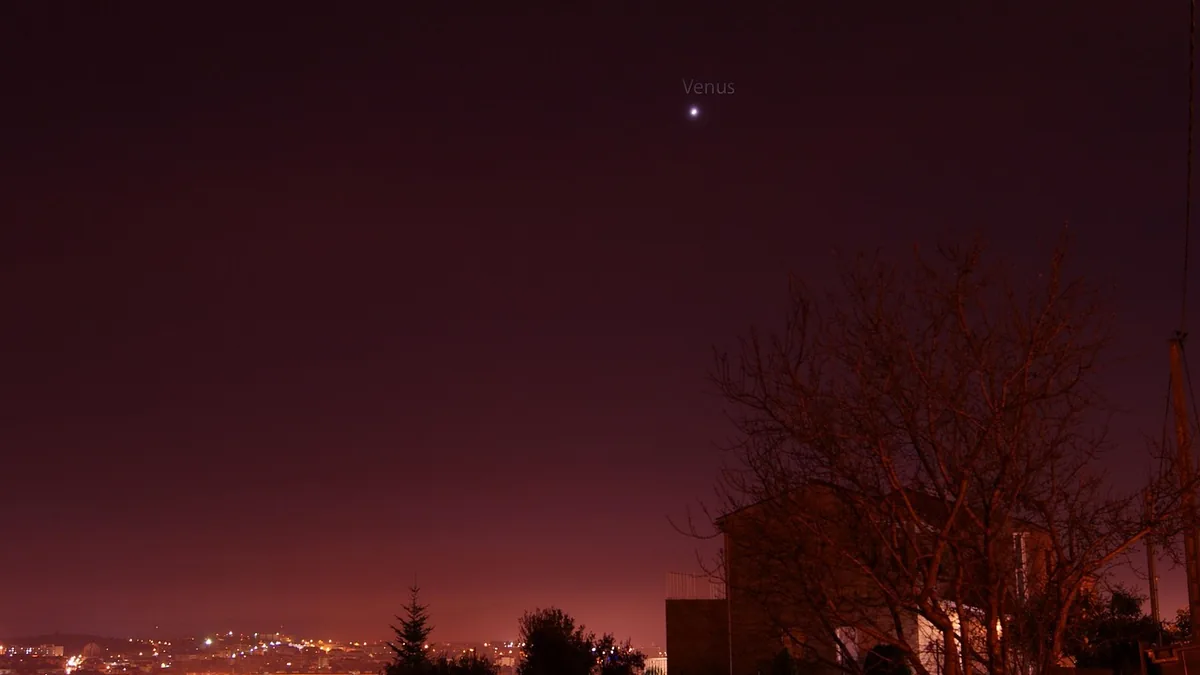
After mid-November 2026, Venus will be the bright morning star and is heading for another greatest brilliancy around November 29. The planet continues to climb in the morning sky following its reappearance after inferior conjunction. After inferior conjunction, Venus emerges into the eastern sky before dawn as a pre-dawn morning star. Once Venus swings to the far side of the Sun from Earth’s perspective, its apparent position shifts so it rises ahead of the Sun rather than following it.
On Nov. 7, 2026, Venus and a thin crescent Moon line up near Spica before sunrise, spread across about 3 degrees, with Venus nearly 10 degrees above the east-southeast horizon 45 minutes before sunrise. The crescent Moon will help point the way to Venus in this early predawn alignment. The November 7 alignment is a good test for observers with a clear view low in the east-southeast.
Venus will not be alone in the morning sky as it returns. Mars overtakes Jupiter before sunrise on Nov. 16, 2026, with Jupiter about 7 degrees from Regulus, and in November Venus joins Jupiter, currently high in the sky, and Mars, headed toward opposition in early 2027. These evening and morning objects provide additional targets for skywatchers during Venus’s transition.
Mercury will make one more dawn apparition in late November 2026, remaining visible in the dawn sky even as Venus leaves the evening sky. Universe Today states that Mercury spends more time nearest to Earth than any other planet, even though Venus is often touted as the closest. In the evening after sunset, the Hunter’s Moon appears near Saturn, while in late October 2026 the dusk sky holds few planets, with only Mercury receding from view and Saturn fresh off opposition.
Inferior conjunctions happen about every 19.5 months because Venus travels at about 35 kilometers per second compared with Earth’s 30, gaining a lap on the shorter inside orbit. EarthSky gives the speeds as about 35 km/s or 78,300 mph for Venus versus about 30 km/s or 67,000 mph for Earth. This speed advantage lets Venus gain a lap on Earth and pass between our planet and the Sun roughly every 19.5 months.
Venus orbits the Sun once every 224 days and completes 13 loops around the Sun versus Earth’s 8, so Venus apparitions follow an apparent 8-year cycle of five circuits minus 2.4 days. EarthSky calls the 1.6-year repetition the synodic period, and five synodic periods add up to eight years just two and a half days short, creating the apparent eight-year cycle of Venus conjunctions.
This recurring pattern means the 2026 path for Venus is nearly identical to its 2018 trek, according to Universe Today. Inferior conjunctions eight years apart recur at the same time of year and part of the sky, but a two-and-a-half-day variance makes them jump into the previous month over time. The similarity stems from Venus’s apparent eight-year cycle, in which the planet makes five complete circuits of the sky minus about 2.4 days.
The passages alternate from north to south of the Sun. The March 22, 2025, passage was north of the Sun, while the Oct. 24, 2026 passage is southward, Universe Today reports. EarthSky lists the previous inferior conjunction on March 23, 2025, and the next on June 2, 2028, creating a small date discrepancy for the 2025 event. This alternation is tied to the 3.4-degree tilt of Venus’s orbit relative to the ecliptic, which also causes the planet to generally miss transiting the Sun.
Transits of Venus are rare events that occur in pairs eight years apart, followed by alternating gaps of 105.5 and 121.5 years. Venus last transited the Sun on June 5-6, 2012, and the next transits are December 10-11, 2117, and December 8, 2125. The next transit is more than 90 years away. The most recent pair was June 8, 2004, and June 5-6, 2012.
EarthSky notes that on June 3, 2020, Venus passed nearly between Earth and the Sun, missing the solar disk by only a quarter of a degree. Venus last passed directly in front of the Sun on June 8, 2004, as well as on June 5-6, 2012, and transits arrive in a repeating 243-year cycle. EarthSky cites this near-miss as an example of how close Venus can come to a transit without actually crossing the solar disk.
Beyond the sky show, Venus is a hostile world. NASA describes Venus as the second planet from the Sun and Earth’s closest planetary neighbor, and the third-brightest object in the sky after the Sun and the Moon. Surface temperatures top 464 degrees Celsius with pressures above 90 atmospheres, and Russian Venera probes lasted up to a couple of hours on the surface. These figures describe the hellish landscape hiding behind Venus’s bright appearance in the sky.
NASA figures cited by Cosmic Herald put the temperature at about 467 degrees Celsius (872 degrees Fahrenheit) and pressure at about 93 times sea level. Venus spins backward compared with Earth, so the Sun would rise in the west and set in the east, and one sunrise-to-sunset cycle takes 117 Earth days; a Venus year lasts 225 Earth days. These timekeeping details come from NASA’s description of the planet’s harsh conditions.
Venus’s change from evening star to morning star gives viewers a direct look at the geometry of the solar system. The repeated cycle lets skywatchers observe planetary motion directly and understand why Venus disappears from and returns to twilight. Cosmic Herald states that knowing when it happens lets observers plan and explains why the planet has dropped out of western twilight. It also tells where to look for its return low in the east before dawn starting in early to mid-November.
Where and when to look: Northern Hemisphere observers should watch the east before sunrise starting in early November, when the steep morning ecliptic lifts Venus quickly above the sunrise. Southern Hemisphere observers should wait until around mid-November, when the slanted morning ecliptic lets Venus crawl slowly out of the sunrise glare. In both hemispheres, a clear, flat eastern horizon is essential.
Join the discussion