Key facts
- Gaia Data Release 3 yielded six possible isolated black holes within 15 parsecs of the Sun, but one was excluded as a brown dwarf, leaving five candidates.
- Follow-up checks of CatWISE, RACS and VLASS found no infrared or radio emission matching the five Gaia candidates, so the authors judge them unlikely to be accreting black holes.
- Gaia has identified three quiet stellar-mass black holes through the wobble of small stellar companions, and all three confirmed systems are binaries rather than isolated objects.
- The nearest confirmed stellar-mass black hole, Gaia BH1, lies roughly 1,560 light-years away, making a robotic probe mission to it impractical.
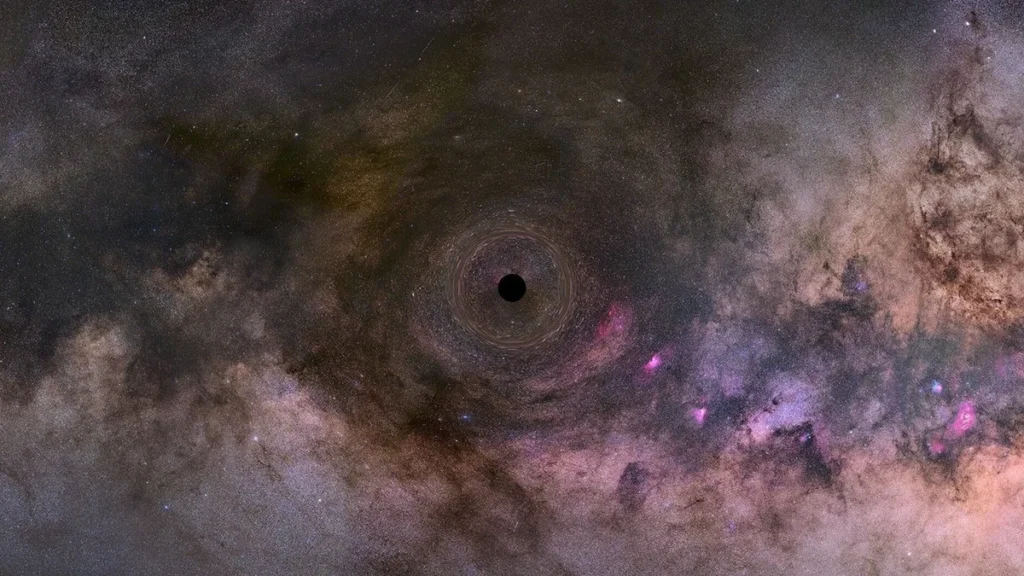
Astronomers hunting isolated stellar-mass black holes near Earth have confirmed none within about 50 light-years, even though Gaia data flagged five candidates Oct. 21, 2026, according to a team led by Abdurakhmon Nosirov of Fudan University. The Gaia DR3 isolated-black-hole paper carries the title “Searching for Isolated Black Hole Candidates within 15 pc of the Solar System in Gaia DR3.” Its lead author is Abdurakhmon Nosirov of Fudan University’s Center for Astronomy and Astrophysics, Department of Physics, in Shanghai, China.
Nosirov’s team searched Gaia Data Release 3 for isolated black holes accreting from the interstellar medium, the gas between stars, and turned up six possibilities within 15 parsecs of the Sun. One object was excluded as a brown dwarf, leaving five candidates.
All five candidates sit close to the Galactic plane, which the authors say makes them likely spurious astrometric solutions – errors in position and motion measurements – from unmodeled background crowding or unmodeled binarity. The team considered using stellar wobbles for astrometric detection within 15 parsecs but rejected the approach because the local stellar density is too low.
The researchers compared the candidates against CatWISE infrared data and the RACS and VLASS radio catalogs. Their models predicted detectable CatWISE flux if the sources were accreting black holes, but no matches appeared. As the authors put it, “Sadly for black hole aficionadoes, no sources were found that matched the Gaia candidates.”
Most stellar-mass black holes are inactive, drifting through the galaxy alone or orbiting a companion star without consuming its material, and observers can detect them only through their effects on nearby objects. Active black holes are easier to detect because superheated accretion disks emit bright X-rays, and jets streaming from their poles are seen at visible and radio wavelengths. The quiet population dominates the galaxy, and an isolated hole has no companion whose motion could reveal it.
Gaia’s main mission is to map the positions and motions of more than a billion stars in our region of the Milky Way, requiring motion measurements precise enough to detect small wobbles. In at least three cases the gravitational tug on a star is so large that the companion must have stellar mass, and because Gaia does not see a star, the companion must be a black hole. Phys.org reported, “We currently know of three such black holes thanks to the Gaia spacecraft.”
Gaia BH3 is a wide binary, while Gaia BH1 and Gaia BH2 are much closer binaries, and all three confirmed systems are binaries rather than isolated objects. The nearest confirmed system, Gaia BH1, lies roughly 1,560 light-years away, making a robotic probe mission to it impractical.
Phys.org reported that the systems likely began as asymmetrical binaries with one star much larger than the other, and the remnant of the larger star became the black hole. When a large star dies it expands tremendously, and the dying star would normally engulf a close-orbiting companion before the system could become a single black hole.
Roche-lobe overflow is one proposed survival mechanism: the Roche lobe is the region where a star’s own gravity dominates, and when outer layers of an expanding star move beyond it, tidal forces can let the companion capture material without spiraling inward. With only three observed Gaia systems, researchers say there is not enough evidence to confirm that formation channel. The work appeared in The Astrophysical Journal by Aleksandra Olejak and colleagues under the title “Nonconservative Mass Transfer as a Formation Channel for Gaia Black Hole Systems” (2026).
A Fudan University study cited in AOL.com’s reporting estimates that more than 90 percent of black holes in the Galactic disk could be isolated, making them extremely difficult to detect. The paper proposes locating isolated holes through gravitational microlensing, faint emission from captured material, or gravitational waves triggered when transient radiation disturbs surrounding spacetime. Until a nearby candidate is found, the proposed mission has no destination. Universe Today reports that Gaia gathered enough spectroscopic data to detect candidates but not enough to confirm them, so researchers say multiwavelength follow-up across radio, optical and X-ray bands is necessary.
The Local Interstellar Cloud is a cloud of partially ionized gas, and the Solar System is moving through it near its edge. Other nearby clouds such as the G-Cloud are collectively called Local Interstellar Clouds, which occupy between 5 percent and 20 percent of the local volume within 15 parsecs of the Sun.
An isolated black hole inside one of these clouds could emit detectable radiation from accreting interstellar gas. Outside the clouds, models say the accretion rate would be too low and the resulting electromagnetic flux well below the detection thresholds of current and near-future observational facilities. Predicting the emissions is challenging because of large uncertainties in the expected accretion spectra, according to the authors.
CatWISE is a catalog of infrared sources from NASA’s Wide-field Infrared Survey. RACS is the Rapid ASKAP Continuum Survey, and VLASS is the Very Large Array Sky Survey, which catalogued 10 million individual radio sources. ASKAP, the Australian Square Kilometer Array Pathfinder in Western Australia, operates 36 radio dishes each 12 m across as a powerful interferometer.
The researchers expected accreting Gaia sources to appear in CatWISE, although the radio catalog detection thresholds are close to the predicted fluxes. The Square Kilometer Array will release another tranche of data in early 2027, which the researchers call especially promising for finding isolated black holes accreting from the interstellar medium. The Nosirov team concludes that future efforts should target radio and X-ray catalogs for this accretion signature.
Cosimo Bambi of Fudan University proposes a speculative mission using gram-scale, laser-powered spacecraft to reach a black hole potentially 20 to 25 light-years away. The figure is a rough statistical estimate based on expected Milky Way populations of stars, white dwarfs and black holes, not a confirmed detection.
The concept calls for a roughly gram-scale electronic wafer attached to an extremely thin, reflective sail several meters across, pushed by radiation pressure from a powerful Earth-based laser array. The main acceleration would last about 1,000 seconds, driving the craft to roughly one-third of light speed, assuming a brief push followed by a long coast. At that speed, a probe could reach a black hole 20 to 25 light-years away in 60 to 75 years, with data returning to Earth after another 20 to 25 years.
Bambi puts at least two nanocraft near the black hole, possibly made when one arriving spacecraft divides into multiple smaller probes, leaving one farther out while the other nears the black hole. The inner probe could broadcast a steady electromagnetic signal to its partner, letting shifts in that signal show the craft’s motion and gravitational redshift.
Under general relativity, a lone spinning black hole is described by the Kerr metric, and a probe tracked over many orbits could reveal whether its measured behavior agrees. One experiment would test whether the compact object possesses a true event horizon by watching one nanocraft fall toward the black hole. Multiple probes near the black hole could also investigate whether an event horizon exists and search for changes in fundamental constants.
The paper also considers speculative compact objects without conventional horizons, such as the fuzzball concept inspired by string theory, but stresses these alternatives do not yet provide sufficiently precise predictions for a simple decisive test. A laser system powerful enough for the mission could cost around one trillion euros using present technology, though Bambi argues continued declines in the cost of coherent laser power could eventually lower that figure. Cost is only one of several enormous engineering problems, alongside sail survival and autonomous navigation.
Finding the black hole accurately enough is a major obstacle, because a slight targeting error at launch could become an enormous miss after decades of travel. The difficulty of orbital capture at arrival compounds precision targeting. The hardest problem is arrival: a probe moving at a fraction of light speed must alter its trajectory enough to enter orbit, one of the mission’s most difficult unresolved challenges. Bambi describes the concept as a roadmap for questions future generations would have to solve rather than a proposal ready for construction.
Existing proposals such as Breakthrough Starshot have examined similar laser-sail technology for sending gram-scale probes toward Alpha Centauri at about 20 percent of light speed. The comparison shows the concept builds on studied technology while extending it to a much harder destination. A black-hole mission would add far more demanding navigation and scientific requirements.


Join the discussion