Key facts
- The James Webb Space Telescope released an infrared image of NGC 7129 on October 6, 2026, revealing many stars previously hidden by dust clouds in the stellar nursery about 3,300 light-years from Earth in Cepheus.
- A few young stars visible within the cavity are pre-main-sequence stars that generate stellar winds, creating nearby bow shocks and smaller cavities as the winds push into surrounding gas.
- The central star and the stars inside the cavity heat a zone that presses against colder, denser gas beyond it, creating a photodissociation region where hydrogen molecules split into individual atoms.
- When protostars gather material and grow heavier, they release superheated outflows that strike surrounding dense gas, producing shocks and a textured look that adds to the red glow.
On Oct. 6, 2026, the James Webb Space Telescope shared an infrared view of the NGC 7129 stellar nursery, showing stars hidden by dust clouds about 3,300 light-years from Earth in Cepheus.
Webb can see through thick clouds of gas and dust that block visible light, revealing stars and structures that remained hidden before. The telescope’s sensitivity to near- and mid-infrared light allowed astronomers to see many stars in NGC 7129 less than one million years old. Telescopes lacking infrared capability cannot see young stars hidden by dust.
ESA released the Webb image of NGC 7129, and the agency partners with NASA and the Canadian Space Agency on the mission. This release is a new telescope image rather than a newly published scientific study. NASA directs the telescope as an international effort with ESA and CSA. NASA, ESA, CSA, and STScI credit the image, with image processing by A. Pagan of STScI, and the agency releases it under CC BY 4.0 INT.
Astronomers have identified more than 130 stars in the NGC 7129 cluster and sorted them into development stages by mass, with heavier stars evolving faster than lighter ones. Stars with greater mass develop more quickly than smaller ones, giving astronomers a view of various phases of stellar growth in one area.
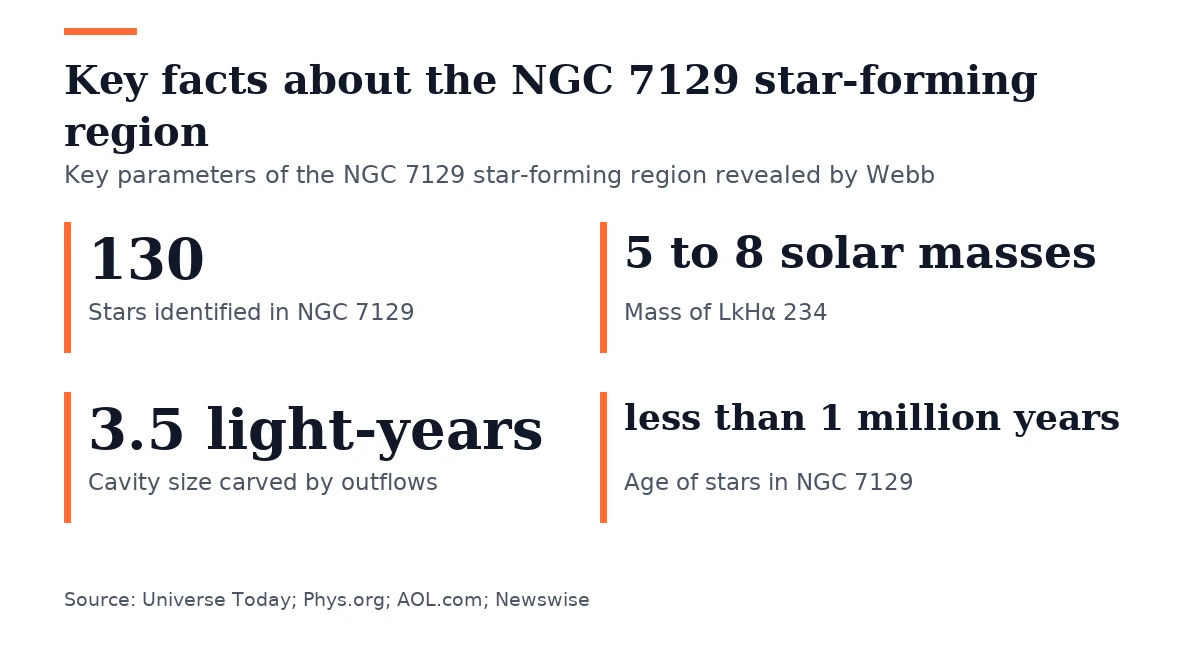
At the center of NGC 7129 sits LkHα 234, the region’s most massive and mature star, a pre-main-sequence object of about 5 to 8 solar masses. A pre-main-sequence star is a young object that has not yet begun the continuous hydrogen fusion defining main-sequence life. The star has nearly finished gathering mass but has not yet begun that fusion. During this phase, gravity pulls the young star inward, and contraction heats the interior until the core is hot enough to ignite hydrogen fusion.
Earlier outflows from LkHα 234 carved a hydrogen cavity about 3.5 light-years across, and it appears in gold on the left side of the image. LkHα 234’s birth outflows scattered much of the hydrogen gas in the cavity and squeezed other regions, triggering the formation of more stars inside it. The star’s radiation and outflows add energy to the gas so it shines. Radiation and outflows sweep away some hydrogen and squeeze other gas, creating conditions that can support the formation of more stars.
Some young stars inside the cavity are pre-main-sequence objects that send out stellar winds, pushing into nearby gas to form bow shocks and smaller cavities. Pre-main-sequence stars inside the cavity emit stellar winds that press on colder, denser gas beyond the cavity, forming the sharp ridge seen at the top of the golden feature. Bow shocks are curved, compressed gas regions formed where stellar winds push into energetic gas. Several young stars also create that sharp ridge at the top of the golden cavity.
The central star and cavity stars warm a zone pressing against colder, denser gas beyond, forming a photodissociation region where hydrogen molecules split into individual atoms. A photodissociation region is an area where intense radiation breaks molecules into atoms. This process alters the temperature and chemistry of the cloud and shapes its evolution over millions of years. Radiation, winds and outflows can scatter gas or change its chemistry, slowly wearing down molecular clouds.
Clumpy red material on the right side of the central star hides much younger protostars that keep gathering gas and dust after their birth clouds began collapsing and breaking apart. Cold molecular gas and dust collapse into dense clumps to form young objects, which then keep pulling in material while launching narrow, hot outflows into surrounding dense matter. As protostars gather material and grow heavier, they release superheated outflows that hit surrounding dense gas, creating shocks and a textured look that adds to the red glow.
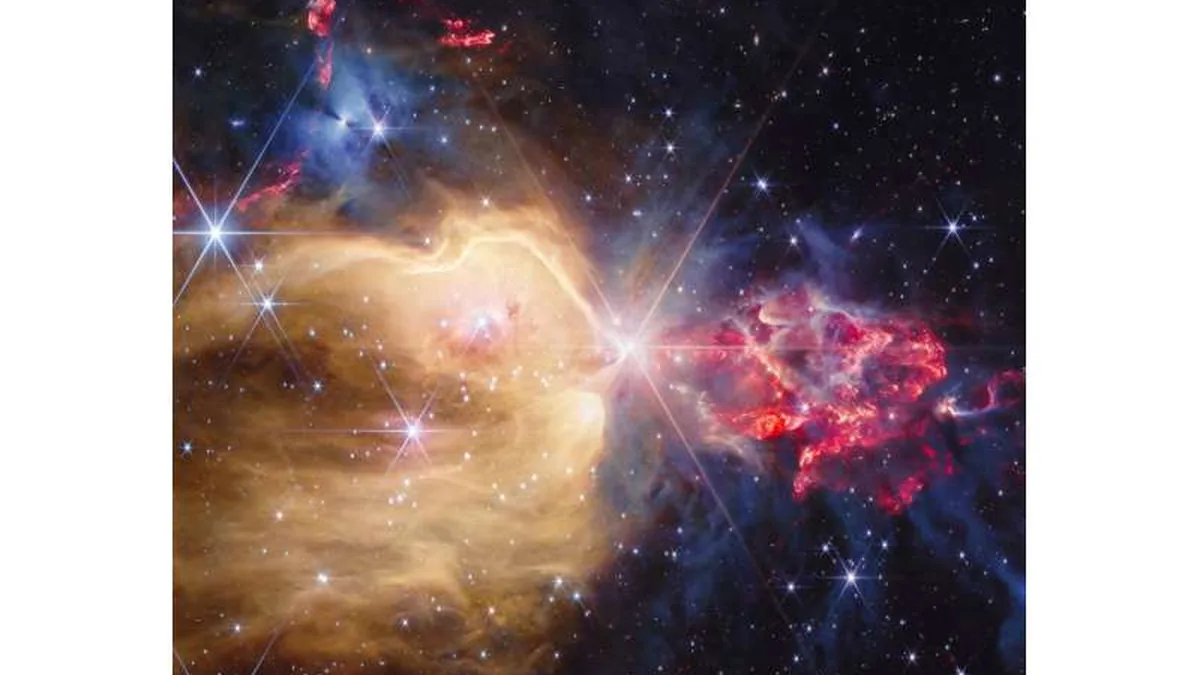
Protostars are young stars still collecting material from their birth clouds. Many protostars are active at the same time in NGC 7129, so their outflows overlap as seen from Earth and make that side look especially tangled. The collisions produce shocks in the gray material around protostars, creating the textured appearance and contributing to the red glow.
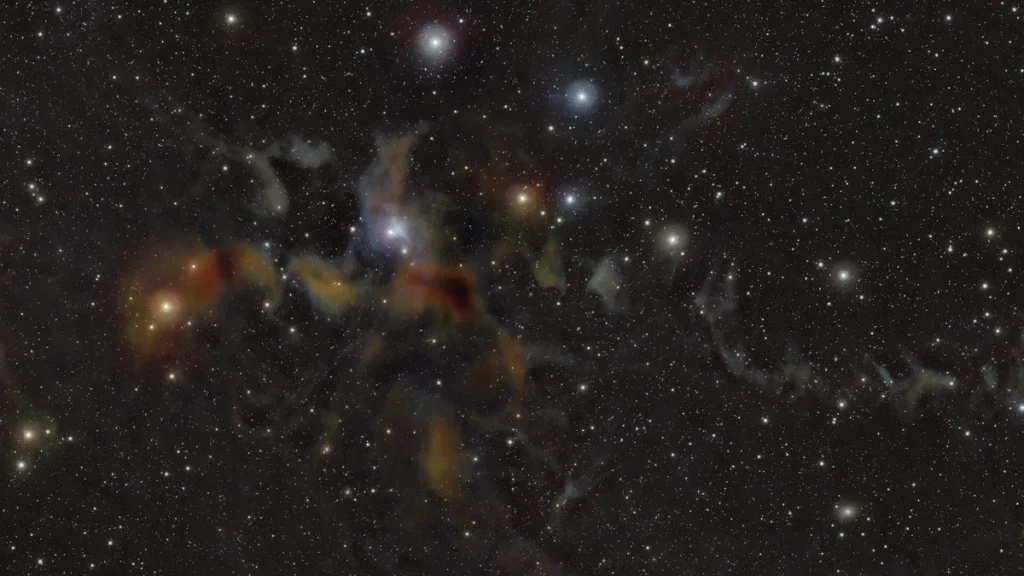
Webb’s image displays hot atomic hydrogen gas in a golden area on the left, whereas cooler gas stirred by protostar outflows appears red on the right, together with smaller clouds in the upper left. The golden color ties to outflows triggered by LkHα 234’s birth, which created the cavity and compressed gas to form more stars.
In the upper left, a bright blue nebula glows around a protostar encircled by a ring-shaped disk of material, with outflows visible nearby. The disk casts a shadow on nearby nebula gas, echoing the Bat Shadow feature once seen by NASA’s Hubble Space Telescope. The telescope’s sharp imaging revealed many detailed features in the gas.
Webb’s sharper view shows finer filaments of gas and dust along with numerous background galaxies, building on earlier observations from NASA’s retired Spitzer Space Telescope. Earlier Spitzer images of the region show less detail.
NGC 7129 contains objects at several points in early stellar development, from stars still gathering material to stars nearing the long stable phase of hydrogen fusion known as main-sequence life. Main-sequence life is the long stable period when a star fuses hydrogen in its core. Larger stars typically develop more quickly than smaller ones, giving researchers access to various phases of stellar life in a single area.
NGC 7129 is especially useful because its stars sit at different developmental stages, and their combined activity shows that star formation can disrupt a cloud while squeezing other areas into conditions where more stars can form. Young stars can blast powerful streams of material into surrounding gas before they reach the main sequence, and those outflows can reshape a stellar nursery across large distances. This connects to outflows from LkHα 234 that carved a golden cavity roughly 3.5 light-years across in the surrounding molecular cloud.
After its young stars mature, the nursery will keep evolving as gas disperses, dense pockets could collapse, and some newborn stars will eventually enter the hydrogen-fusing phase that powers the Sun. This presents what happens next as Webb captures stars at different points along their developmental path and reveals how strongly they affect their surroundings.
Understanding how the entire cloud changes over millions of years will require more study of both the stars and the surrounding gas and dust. Scientists plan to keep using these Webb observations to learn how the stars and protostars affect the surrounding gas and dust. Continued observation of the region should show how the stars and protostars affect their environment and wear down the molecular clouds over long periods. The newly released Webb image of NGC 7129 is already improving astronomers’ understanding of how new stars form and evolve over time.





Join the discussion