Key facts
- The UK Space Agency (UKSA) launched a £2 million grant call on October 19, 2026, under its Unlocking Space for Business (USB) program to fund UK-based companies developing satellite-based emissions monitoring solutions.
- The grant call focuses on two challenge areas: Environmental Intelligence for Climate, Nature, and Natural Capital, and Environmental Intelligence for Emissions Monitoring and Verification.
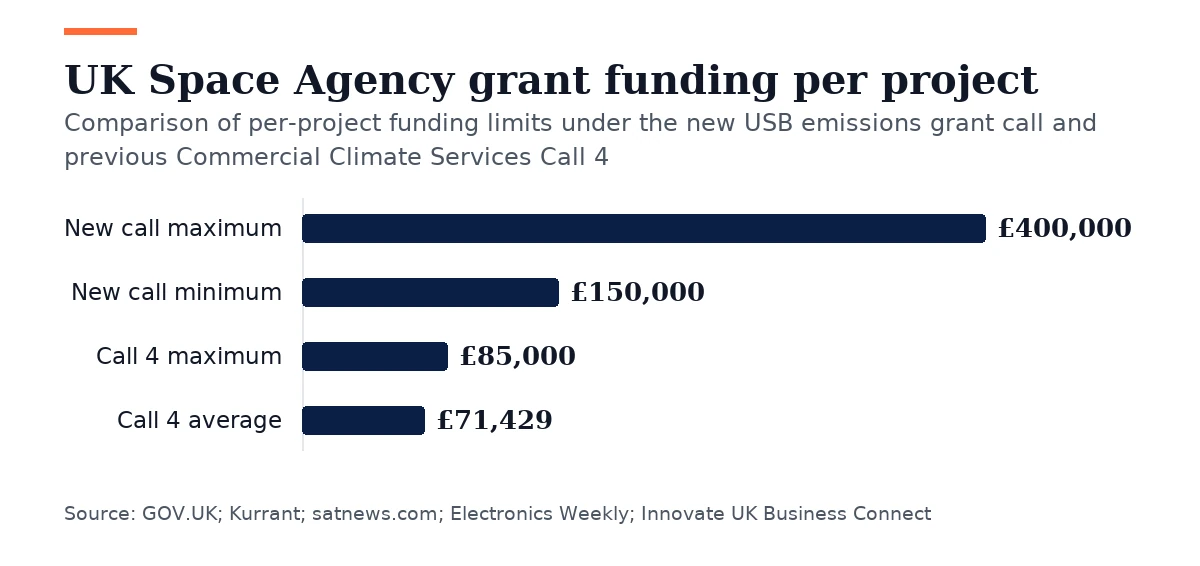
- Each funded project can receive up to £400,000 in grant funding, with projects expected to start by mid-January 2027 and conclude by September 30, 2027.
- Projects must begin at Technology Readiness Level 5 or higher and advance to at least TRL 7 by project close, the UK Space Agency requires.
The UK Space Agency opened a £2 million grant call on Oct. 19, 2026, under its Unlocking Space for Business programme to fund UK-based companies developing satellite-based emissions monitoring solutions.
The call covers two challenge areas: Environmental Intelligence for Climate, Nature, and Natural Capital, and Environmental Intelligence for Emissions Monitoring and Verification. Each funded project can receive as much as £400,000. Work is expected to start by mid-January 2027 and finish by Sept. 30, 2027. The first milestone, representing at least 25 percent of the requested grant value, is due March 31, 2027.{
A UK end-user business must lead proposals in partnership with at least one UK space supplier. Projects must integrate space-enabled technologies such as Earth observation, satellite communications, or positioning, navigation and timing. They must begin at Technology Readiness Level 5 or higher and advance to at least TRL 7 by project close.
The agency defines an end-user business as a firm operating outside the space sector that uses satellite data or services for decisions, operations, risk management or environmental outcomes. The lead applicant must have a clear use case and head a consortium that includes a UK space supplier and any relevant integrators.
Applications must arrive by 16:00 GMT on Dec. 11, 2026, through the Flexigrant portal, and applicants must register before submitting. The agency will not accept late submissions. The UK Space Agency will hold a briefing webinar on Nov. 3, 2026, at 11:00 GMT, and the agency plans an in-person event for Oct. 27, 2026, from 9.30 to 12.30 at KPMG in Canary Wharf, London.
Selected projects may secure match funding on top of their grant. Collaborations involving an SME or a research and knowledge dissemination organisation may receive a 15% subsidy uplift, while businesses in a consortium can claim up to 70% of total costs depending on project type and company size. The agency releases funding on a cost-recovery basis only after successful milestone completion. Kurrantly calculates that the £2 million pot could fund five awards at the ceiling or 13 at the floor.
The Unlocking Space for Business programme began in October 2023 with an initial focus on financial services and transport and logistics. It has engaged more than 350 organisations and supported pilots including wildfire risk assessment, environmental risk evaluation and satellite imagery tools for infrastructure monitoring. A second USB call in June 2025 also offered £2 million with grants up to £400,000. The environmental call follows a successful pilot and two previous funding rounds.{
The most recent predecessor, Commercial Climate Services Call 4, opened on June 25, 2026, and closed on Aug. 7, 2026. It invested £500,000 across seven projects with an £85,000 ceiling per award, an average Kurrantly calculates at £71,429. Kurrantly notes that the new £400,000 ceiling is 4.7 times the Call 4 limit. The first awards fall in the call’s opening weeks while Call 4 projects finish in February 2027, and their results will set the benchmark for the nine-month £400,000 projects.
One Call 4 project, the Platform Environmental Evidence & Performance Sentinel by Callala and the University of Strathclyde, uses satellite-derived nitrogen dioxide data to verify emissions from offshore oil and gas platforms. Researchers will develop the prototype and calibrate algorithms through early 2027, with pilot trials alongside banking partners and institutional asset owners.{
Existing offshore energy emissions reporting relies almost entirely on voluntary self-disclosures and theoretical engineering estimates from platform operators. PEEPS ingests nitrogen dioxide observations from low Earth orbit optical spectrometers and applies local wind vectors and spatial modelling to isolate plumes from individual rigs, then benchmarks each installation against industry peers.

The UK Space Agency’s Methane Monitoring Data Supply programme, delivered with GHGSat and the Satellite Applications Catapult, gave 120 UK organisations access to high-resolution satellite methane data dating back to 2016. Government agencies could task satellites over sites of interest, and the Environment Agency embedded satellite alerts into workflows across agriculture, waste and oil and gas.
The agency also partners with the United Nations Environment Programme’s International Methane Emissions Observatory to integrate GHGSat data into global monitoring systems. Methane accounts for about 30% of warming since pre-industrial times, and the work supports the Global Methane Pledge target of cutting methane 30% by 2030.
Environmental intelligence combines satellite-derived monitoring data, AI and terrestrial data to provide actionable insights for businesses in financial services, insurance, energy, utilities, agriculture and land management. Research cited in the guidance estimates Earth observation applications could help cut up to two billion tonnes of CO2 globally, about 3.8 percent of annual greenhouse gas emissions.{
The UK’s space sector generates £18 billion in annual income and supports more than 50,000 jobs. The Unlocking Space for Business programme aims to stimulate demand for UK space applications, reduce adoption barriers and build cross-sector partnerships to scale space-enabled solutions.
Beth Greenaway, head of Earth observation and climate at the UK Space Agency, described UK Earth observation leadership and said partnerships show UK expertise turning satellite insights into solutions. “The UK has a proud track record of leadership in Earth Observation data analytics, transforming satellite insights into actionable solutions for global challenges.”
The UK instead funds private firms that partner with space suppliers rather than building tools itself, so adoption risk rests with commercial customers instead of a public body.




Join the discussion