
Key facts
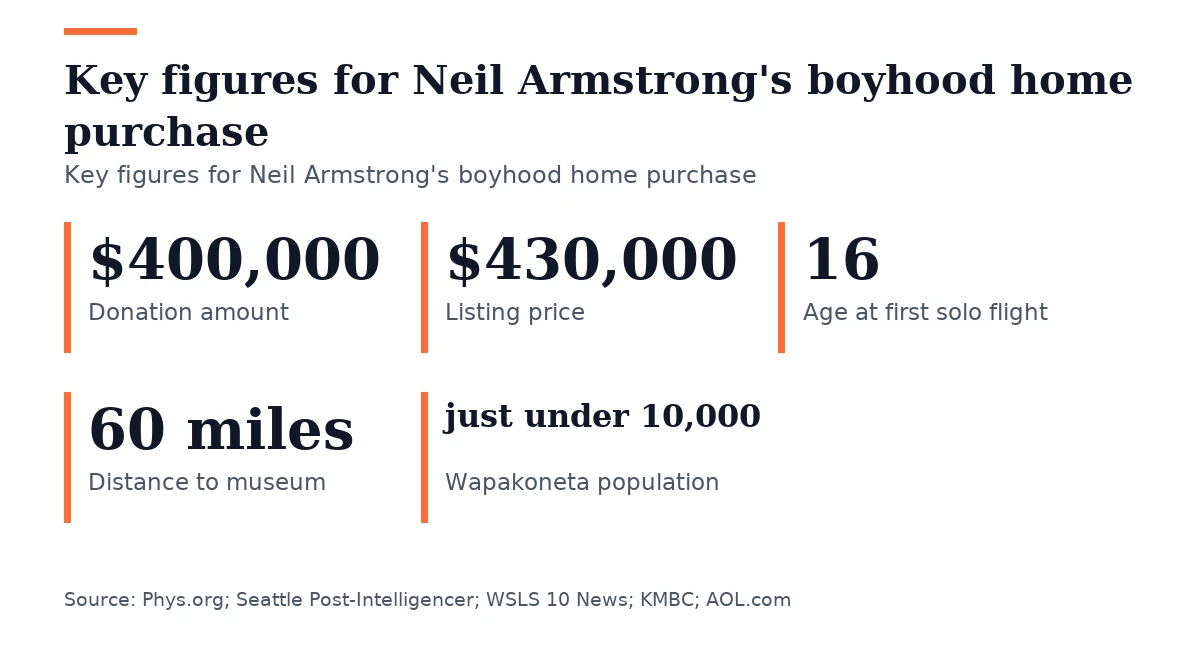
- The Auglaize County Historical Society will acquire Neil Armstrong's boyhood home through a $400,000 donation from Ken Schreiber, with the sale set to close on Monday.
- Armstrong's former bedroom is currently adorned with photographs of the Moon landing and autographed pictures of visiting astronauts.
- The property was placed on the market in August 2026, the first time it had been listed in nearly forty years, after being owned by Karen Mikesell since 1988.
- Over the years Mikesell hosted nine astronauts, including Buzz Aldrin, who recalled tears streaming down his cheeks after entering Armstrong's upstairs bedroom a few years following the astronaut's 2012 death.
The Auglaize County Historical Society will acquire Neil Armstrong’s boyhood home through a $400,000 donation from retired pilot Ken Schreiber, with the sale set to close on Monday.
Ken Schreiber said he felt compelled to act after learning in August 2026 that no one had come forward to preserve Neil Armstrong‘s boyhood home, recalling his father’s advice to “make a mark in life” and stating somebody had to step up to the plate. “I just thought somebody has got to step up to the plate,” Schreiber said, remembering his father’s advice to “make a mark in life.” — Ken Schreiber
Schreiber, who was nine years old when Armstrong first walked on the Moon in 1969 and had become a military fighter pilot like his hometown hero, initially asked friends to contribute but ultimately provided the full $400,000 himself to enable the Auglaize County Historical Society’s purchase of the home. Schreiber, who grew up in Dayton about 60 miles (96 kilometers) south of Wapakoneta, has long admired Armstrong’s achievements, modesty, and character.
Ken Schreiber, who lives about 60 miles from Wapakoneta, had not entered the Armstrong Air and Space Museum until summer 2026, when he toured Neil Armstrong’s boyhood home. He said it felt as if Armstrong’s ghost were present, imagining him running up and down the stairs. “It was almost like the ghost of Armstrong was there,” he said. “I could imagine him running up and down the stairs.” — Ken Schreiber
The Auglaize County Historical Society plans to have the renovated boyhood home ready for its first public tours by 2030 to commemorate the 100th anniversary of Neil Armstrong’s birth. Society president Gerald Siesel explained that the group cannot undertake the restoration without external assistance, noting they realized they could not do it themselves when the opportunity arose. The society intends to restore the house to its appearance during Armstrong’s boyhood, when he built model aircraft in the dining room and tested them in a basement wind tunnel he constructed.
The two‑story residence in Wapakoneta has drawn visitors to the Armstrong Air and Space Museum for years, yet the historical society has not opened it for regular tours. For years, the two‑story home on Benton Street in Wapakoneta has attracted visitors interested in Armstrong’s early life, yet it remains closed to the public. The property was placed on the market in August 2026, the first time it had been listed in nearly 40 years, after being owned by Karen Mikesell since 1988.
Mikesell represents one of only a handful of owners since the Armstrong family vacated the home in the mid‑1960s. In August 2026 the boyhood home of Neil Armstrong at 601 W. Benton Street was listed for sale at $430,000, though the property lacks legal protections against alteration. Karen Mikesell said she hopes a purchaser will donate the boyhood home to the Armstrong Air and Space Museum, noting the museum currently lacks the funds to acquire the property.
Over the years of stewardship, Mikesell has been given a moon rock and a piece of gold foil from the Apollo 11 capsule, and astronauts have left personal messages on their autographed photos, such as Mike Foreman’s note thanking her for caring for Neil’s home. Mikesell said she felt a responsibility to preserve the home as the Armstrongs had it and hoped a buyer would keep its legacy for future generations.
Over the years Mikesell hosted nine astronauts, including Buzz Aldrin, who recalled tears streaming down his cheeks after entering Armstrong’s upstairs bedroom a few years following the astronaut’s 2012 death. The two‑story residence on Benton Street features a large front porch, has undergone minimal exterior alteration, and retains an interior floor plan close to its 1940s configuration aside from modern updates. The backyard still contains a garage constructed by Neil Armstrong and his father from scrap lumber, whereas the chicken coop that once hosted Boy Scout gatherings has disappeared.
While living at the boyhood home, Neil Armstrong launched model airplanes out of the rear window to measure how far they’d fly. In Armstrong’s old bedroom, a model of the Wright brothers’ first production airplane hangs from the ceiling, and the aviation pioneers from nearby Dayton served as an inspiration for Armstrong. Armstrong’s family purchased the boyhood home in 1944 after his father, a government auditor, had moved the family about a dozen times.
Neil Armstrong was born in a farmhouse just outside Wapakoneta, which today is a city of just under 10,000 people. After moving frequently during his early years, Neil Armstrong’s family settled in western Ohio when he was a teenager, and while living at the Benton Street house he conducted experiments, made his first solo flight, and earned his pilot’s license at age 16.
Armstrong’s former bedroom is currently adorned with photographs of the Moon landing and autographed pictures of visiting astronauts, and exterior alterations have been minimal while the interior floor plan remains largely unchanged aside from modern updates. Karen Mikesell never met Neil Armstrong, who was famously private, but she spoke with his parents, siblings, and children about the home’s role in his upbringing. According to Logan Rex, spokesperson for the Armstrong Air and Space Museum, the museum lacks funds to acquire the property, as noted by Karen Mikesell.
When Karen Mikesell bought the home in 1988, the rooms were covered with rainbow-colored wallpaper, prompting her to restore the original appearance. Although the boyhood home, listed at $430,000, lacks legal protection against alteration, Karen Mikesell is optimistic that future owners will respect it, whether it remains a private residence or is used for overnight stays.




Join the discussion