Key facts
- The posted images showed giant water lilies that were initially identified as Victoria amazonica but the location lay outside the known range of that species.
- The species is considered extremely vulnerable to extinction.
- Boat captain Gustavo Melo, a member of the Indigenous Tucano community, said he knew where to find more water lilies.
- At 1:00 a.m. Melo led the team to a small lake where they found five additional Victoria plants, one of which was blooming.
Botanist Carlos Magdalena spotted the Instagram post from December 2021 showing a giant water lily in Colombia’s Inírida River, a location outside the known range of Victoria amazonica, and suspected a new species might be present. He noted that the location fell outside the documented range for any South American giant water lily. He is a botanical and scientific research horticulturist at the Royal Botanic Gardens, Kew in the U.K.
The Instagram photos from December 2021 had geolocation pointing to the Inírida River, a tributary of the Orinoco Basin, a location that caught experts’ attention because it falls outside the known habitat of Victoria amazonica. He also used the images to locate a third lake where the water lily was present.
Magdalena, together with Mauricio Bernal and local guides including boat captain Gustavo Melo of the Indigenous Tucano community, organized an expedition during which they hoped to find flowering specimens despite time constraints. The expedition party drew on personnel from the Indigenous reserves of the Atabapo River and from local specialists who know the region’s waterways. They aimed to gather specimens and determine if the plants constituted an undescribed species.
The five-day field trip began with days of exploring the flooded jungle without success. When the driver finally suggested a location, the team had just 10 hours before their flight and set out after dark to reach a hidden lake within the flooded rainforest. During the expedition the team initially found only two water lily plants, neither of which had flowers.
In the laboratory, analysts examined leaf shape, blossom features and DNA, and concluded that the specimens belong to a species not described. The team collected material needed to start the official scientific description, naming the new species Victoria colombiana. The same Phytotaxa paper, a journal of botanical taxonomy, that described Victoria colombiana also introduced a second new Victoria, named Victoria mattogrossensis.
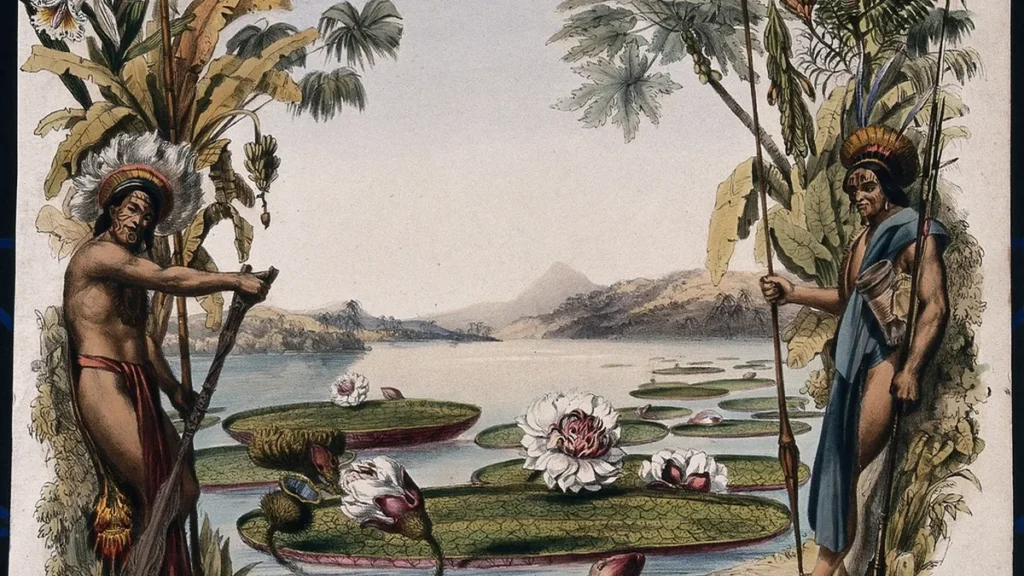
Giant water lily leaves can exceed three meters across and create distinct circular patterns on the water surface. The lily pads of Victoria colombiana can measure up to two meters in diameter. These giant water lilies are among the oldest flowering plants still alive today, existing before the continents split apart.
Boat captain Gustavo Melo said he knew where to find more water lilies and led the team at 1:00 a.m. to a small lake where they found five Victoria plants, one of which was blooming. The blooming specimen provided material needed for formal identification. Magdalena described the discovery as emotional, and he shed a tear upon seeing the flower.
Researchers estimate there are between 30 and 50 wild Victoria colombiana plants. The species is considered vulnerable to extinction and faces severe threats that place it in the critically endangered category. Researchers are working to get the plant officially categorized as Critically Endangered by the International Union for Conservation of Nature (IUCN) Red List.
Efforts are under way to support long‐term conservation, including the possibility of establishing a naturalized population in a more accessible lake within Indigenous territory. Scientists hope to continue collecting seeds with the aim of cultivating the species in Bogotá, and if successful there is a chance the waterlily may be grown at Kew Gardens. Social media linked the photographer’s images to researchers, making the find possible where it might have gone unnoticed.
As Magdalena noted, giant water lilies give away their secrets slowly, and there is still much to discover and protect. One can even see the new giant water lily from space, a striking reminder of how much life on Earth remains unknown.



Join the discussion