Key facts
- In September 2025, the Space Force's Commercial Satellite Communications Office set up Warrior Plans for Joint Force LEO service; June notices show task orders to SpaceX for Starshield and OneWeb Technologies for OneWeb.
- Belgium, Canada, Finland, Germany, Italy, the Netherlands, Norway, Sweden, Türkiye and the United Kingdom pledged STARLIFT funding on Oct. 29, along with Seoul.
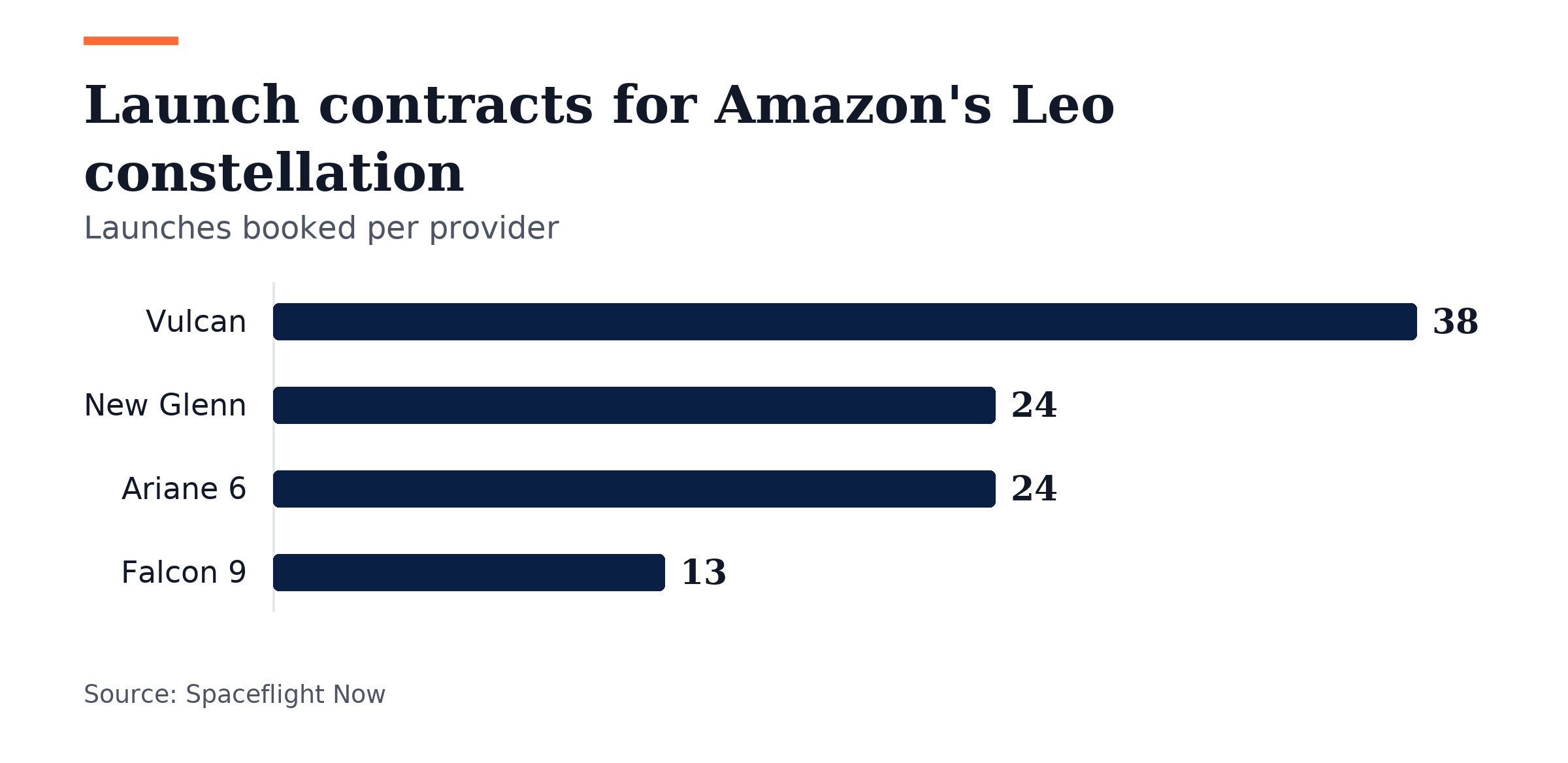
- Amazon booked 38 Vulcan launches, 24 New Glenn launches, 24 Ariane 6 launches and 13 Falcon 9 launches, according to Spaceflight Now; the failed Nov. 15 Vulcan flight was the first Amazon mission.
Eutelsat Network Solutions disclosed a Warrior Plans award on Nov. 17 valued at more than $60 million across two years, while the Pentagon and France remain paying government customers for a second LEO network constrained by launch availability, satnews.com reported.
The Pentagon had placed OneWeb under contract by June through the Warrior Plans program, which also buys Starshield, and France holds a priority-access contract with OneWeb worth up to €1 billion, according to British think tank BISI. The award covers OneWeb airtime, deployable terminals and alternative positioning, navigation and timing, though the announcement does not say how it relates to the June contract notice.
Ian Canning, the unit’s president and CEO, said military operations demand communications capabilities that are agile, resilient, and available anywhere in the world. The statement accompanied Eutelsat Network Solutions’ Nov. 17 Warrior Plans award announcement.
On Oct. 14, Starshield terminals used by the military in Ukraine lost connections while moving faster than roughly 100 mph, and Ukrainian units said interceptor drones lost links in flight before service came back later in the month. Accounts dispute who ordered the cap, attributing it to the White House, to Elon Musk, and to President Volodymyr Zelenskyy calling it a planned operation on Oct. 17. Zelenskyy said on Nov. 12 that service had returned and on Nov. 17 that it remained in place over occupied territory, while SpaceX and Musk denied the cap.
Germany pays for Starshield under a contract running through April 2027, and Foreign Minister Johann Wadephul told broadcaster ntv on Oct. 16 that the restrictions must end, a call that follows the Oct. 14 cap on military terminals in Ukraine. The Space Force‘s Commercial Satellite Communications Office established Warrior Plans in September 2025 for Joint Force LEO service, and June notices show task orders to SpaceX for Starshield and OneWeb Technologies for OneWeb, predating the October cap and establishing the Pentagon’s second source before the Starshield restrictions.
Launch availability, not customer demand, is the binding constraint on the emerging second LEO network, according to the satnews.com reporting. Amazon Leo had put 396 satellites into orbit before Nov. 15, when a United Launch Alliance Vulcan failure destroyed 40 spacecraft, and the constellation requires more than 3,300 satellites. Amazon’s manifest includes 38 Vulcan launches, 24 New Glenn flights, 24 Ariane 6 flights and 13 Falcon 9 flights, according to Spaceflight Now, and the Nov. 15 Vulcan failure was the first mission for the constellation.
Vulcan faces an FAA-overseen investigation, while New Glenn has not flown since a pad explosion in May. Ariane 6 has completed four flights in 2026 versus a target of seven to eight, according to The Space Review. The next Ariane 6 mission, carrying 36 Amazon Leo satellites, is set for no earlier than Nov. 23, ESA said, while Telesat moved commercial Lightspeed service to mid-2028 last month as commercial Falcon 9 capacity winds down and replacements still prove themselves.
OneWeb operates roughly 650 satellites compared with more than 10,000 Starlink satellites in BISI’s count, and ABI Research principal analyst Andrew Cavalier notes OneWeb lacks Starlink’s terminal and capacity scale. Cavalier judges that Starlink remains dominant but is no longer the uncontested default, an assessment that explains growing government interest in alternatives after the Starshield speed restrictions in Ukraine. He says buying criteria now explicitly cover operator jurisdiction and unilateral restriction authority, with tender documents revealing the shift first.
Clayton Swope, deputy director of the Aerospace Security Project at the Center for Strategic and International Studies, told Breaking Defense after the Vulcan failure that “the launch bottleneck is real and set to get worse.” Amazon Leo would add scale yet remains a U.S. firm under the same government oversight, meaning a buyer concerned about one government’s control over links would still rely on Washington, Cavalier writes, a second limit for allied governments considering Amazon as a Starlink alternative because of unilateral restriction authority.
Taiwan Space Agency Director General Wu Jong-shinn proposed a shared constellation in April at Space Symposium among like-minded countries, and the agency is in early talks with three to four partners on a network of more than 300 communications satellites developed by private companies, Aviation Week reported Nov. 16 citing Ukraine throttling. Taiwan has published no budget or schedule for its shared constellation.
Europe’s IRIS2 constellation has first launches scheduled for 2029, and Ukraine has a test satellite in orbit for a sovereign network, which SatNews reported on Oct. 29; none carries traffic yet, making these plans and early commitments rather than operational services. NATO said on Nov. 17 it had begun operating STARLIFT, a brokerage that lets militaries reserve launch slots on commercial rockets from spaceports in member countries plus South Korea. On Oct. 29, Seoul joined Belgium, Canada, Finland, Germany, Italy, the Netherlands, Norway, Sweden, Türkiye and the United Kingdom in pledging STARLIFT funding.
Capacity on networks already in orbit is bought as a hedge, with OneWeb the main seller and the Pentagon and France as reference customers. Hedge-market agreements range from tens of millions of dollars up to a billion euros, and operators with spare capacity and multi-network terminals can sell now. Taiwan’s talks, IRIS2 and Ukraine’s test satellite face schedules running into years when commercial Falcon 9 capacity winds down and replacements prove themselves, covering the second market for sovereign constellations whose timelines overlap with constrained launch availability.
Manufacturers bidding on sovereign constellation programs will field questions about launch before payloads, reflecting the prioritization of launch access in procurement for planned networks. The industry’s harder question is who can field a second network at scale before 2030, since every alternative still requires construction and launch as launch outside SpaceX grows scarcer. Two developments would show how far the procurement shift goes: Taiwan naming its partners, and the Space Force issuing a third Warrior Plans order.



Join the discussion