
Key facts
- Military satellite communications (MILSATCOM) is projected to contribute $19.2 billion in revenue by 2035.
- Enterprise networks are forecast to expand by $17.2 billion in revenue by 2035.
- Novaspace's Satellite Communications for Defense and Security, 2nd Edition projects commercial satellite service revenues will exceed $22.6 billion by 2035.
On October 12, 2026, Novaspace issued the 33rd version of its Satellite Connectivity and Video Market report, forecasting a 44% increase in global satellite services revenue to $145 billion by 2035.
By 2035, data‑centric services are expected to produce nearly $100 billion in yearly revenue, increasing their portion of total satellite sector income from 26% to 68%. The share of video distribution in overall capacity revenue is projected to fall to 3 % by 2035, driven by cord‑cutting from legacy DTH services. Consumer broadband is forecast to contribute an additional $22.6 billion each year by 2035. MILSATCOM is expected to generate $19.2 billion in revenue by 2035.
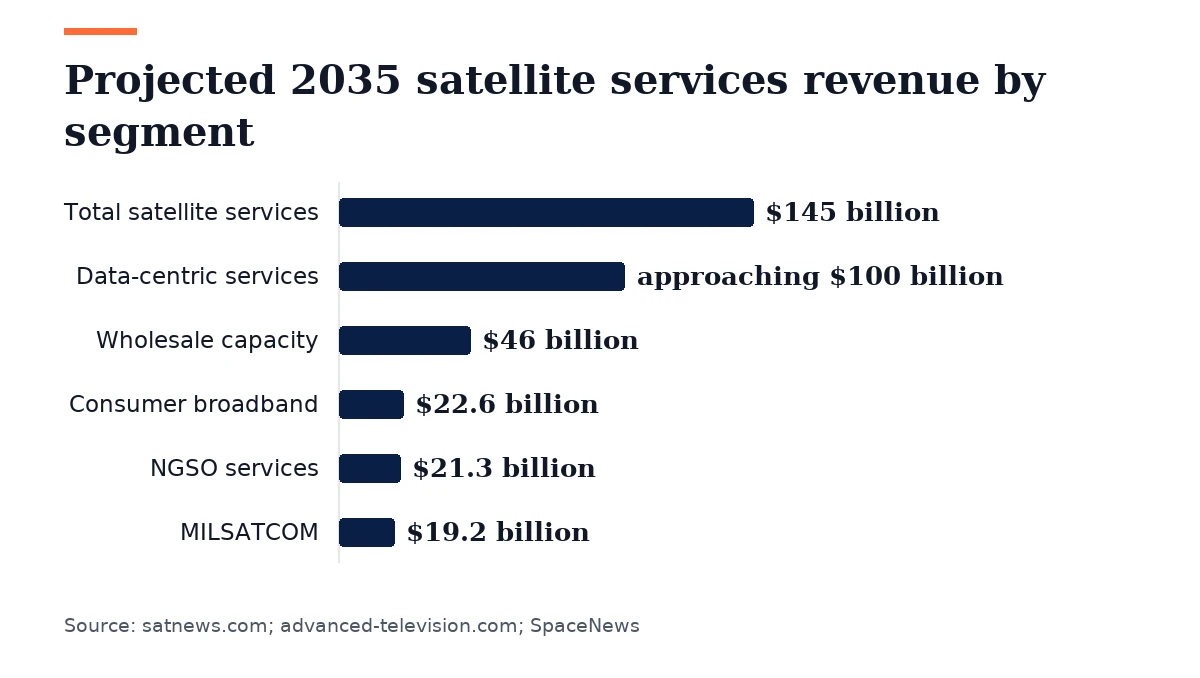
Enterprise network services will increase revenue by $17.2 billion by 2035. Wholesale satellite capacity sales will surpass $46 billion by 2035, over triple the 2025 figure. Together, consumer broadband and government MILSATCOM will represent more than half of total satellite capacity revenue by 2035.
Analysts at Novaspace say future operator success will rely on hybrid network orchestration instead of relying on a single orbit. Dimitri Buchs, the report’s project manager and editor, noted that satellite connectivity has entered the mainstream. He explained that the forthcoming era will combine GEO and NGSO systems, with each architecture addressing distinct, complementary requirements.
It concludes that sustained margins will stem from integrated flat‑panel terminals, direct‑to‑device NTN connections, and secure multi‑orbit managed service offerings. Large NGSO constellations keep pushing wholesale megabit prices lower. Fleet operators maintain high‑value broadcast and secure trunking corridors through fresh commercial GEO satellite orders equipped with software‑defined payloads.
Following a trough of six commercial GEO orders in 2024, demand climbed to ten in 2025 and stood at fourteen by mid‑September 2026. The renewed GEO order activity reflects evolving multi‑orbit strategies and sustained demand for GEO capability alongside expanding NGSO systems.
Declining bandwidth costs, driven by high‑throughput satellite systems and a growing number of NGSO projects, are speeding satellite connectivity’s expansion into mass‑market applications. Providers such as Starlink increasingly compete with terrestrial broadband on price. This competition makes satellite broadband a credible substitute for fiber and wireless links in an expanding set of markets.
Novaspace’s Satellite Communications for Defense and Security, 2nd Edition forecasts that commercial satellite service revenue will be above $22.6 billion each year by 2035. By 2035, worldwide defense Satcom demand will rise above 7.5 Tbps as operators adopt next‑generation NGSO constellations. Revenue from NGSO services will hit $21.3 billion by 2035.
By 2035, GEO income will fall to $1.3 billion from $2.3 billion in 2025, even as demand for GEO capacity will grow threefold. The United States will stay the top defense Satcom market through 2035, representing over half of global demand and 48% of the revenue. China will account for roughly 30% of worldwide defense Satcom demand and revenue through 2035.
Santiago Perez, Senior Manager at Novaspace, said that growing adoption of distributed satcom architectures improves military satcom resilience to disruption, jamming, and kinetic attacks. He added that multi‑orbit links are forming the foundation of future defense networks and will influence procurement, operations, and strategy for years ahead.




Join the discussion