
MDA Space will integrate Jena-Optronik’s ASTRO HP star sensor on an upcoming LEO mission, marking the sensor’s first spaceflight. The ASTRO HP star sensor features a radiation-hard Faintstar2 detector. Its design is compact and light, suited for small and medium high‑performance satellites. It brings together the precision and agility of the ASTRO APS3 with the flight‑tested electronics and software of the ASTRO CL, all tied together by the ASTROlib package.
Because it’s modular, the unit can achieve higher attitude accuracy and faster rates without a redesign of the host platform, letting performance and cost be adjusted for each mission. The ASTROlib software enables specialized space situational awareness capabilities. The initial flight‑qualified ASTRO HP unit will be installed on MDA’s upcoming LEO mission. The sensor delivers attitude accuracy of ≤1.2 arcsecond in the X and Y axes and ≤9.0 arcsecond in the Z axis (1σ) at a rate of 0.06°/s.
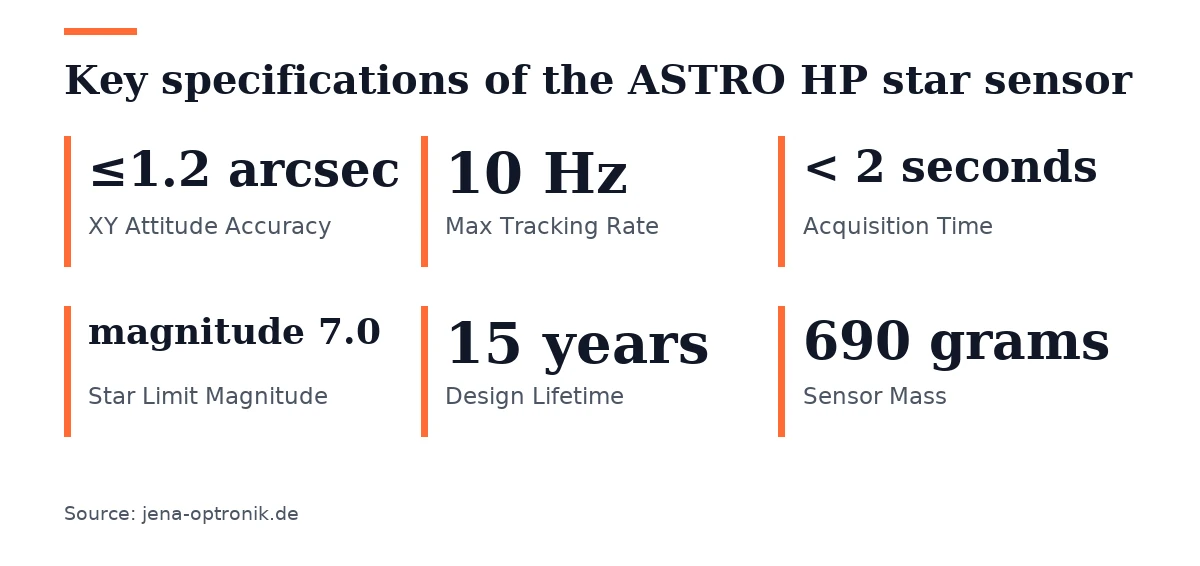
The tracking update rate can be 5, 8, or 10 Hz. Acquisition time is less than 2 seconds, usually better than 1 second. Slew rate during acquisition is at least 3.0 deg/sec, and during tracking is at most 5.0 deg/sec. The sensor can track stars down to magnitude 7.0.
The sensor has a design lifetime on orbit exceeding 15 years. The sun exclusion angle is 26 degrees. The sensor mass is ≤690 grams. Nominal power consumption is ≤1.2 watts.
The sensor operates over a temperature range of -35°C to +50°C. The sensor tolerates radiation for up to 15 years in LEO and GEO orbits without additional shielding. The sensor uses a SpaceWire interface for data output.




Join the discussion