Gravitics announced a $1.7 million SpaceWERX contract on April 25, 2024, to develop tactically responsive orbital platforms (platforms designed to quickly respond to military needs in orbit).
On March 25, 2024, the Air Force Research Laboratory issued a purchase order worth up to $1,699,733 to Gravitics for an Orbital DroneSat Carrier (a spacecraft designed to carry and deploy small drones in orbit) intended for space-based tactically responsive missions. The purchase order supports the development of an Orbital DroneSat Carrier for space-based tactically responsive missions. On April 25, 2024, Gravitics announced a $1.7 million Small Business Innovation Research Direct-to-Phase II contract from SpaceWERX. Space Systems Command’s Space Safari Program Office made the award.
Under this contract, Gravitics works with Rocket Lab to refine mission architecture for the orbital platforms. Gravitics also collaborates with True Anomaly to develop use-specific outfitting for the platforms. Space Exploration Engineering partners with Gravitics to produce flight hardware for the orbital carriers. Eta Space is a partner to refine mission architecture, develop use-specific outfitting, and produce flight hardware for the Orbital Carrier concept.
Lt Col Jason Altenhofen noted that the Gravitics module offers an unconventional approach to tactically responsive space. The April 2024 contract is part of the Space Force’s tactically responsive space initiative, which aims to obtain commercial capabilities on accelerated timelines. The contract calls for Gravitics to develop tactically responsive orbital platforms capable of pre-positioning military assets.
On March 26, 2025, Gravitics secured a Space Force STRATFI (Strategic Funding Increase) award worth up to $60 million to demonstrate its Orbital Carrier capable of pre-positioning military assets for tactically responsive deployment, a Space Force prototyping program to accelerate technology development. The STRATFI award aims to show the Orbital Carrier’s ability to pre-position military assets for tactically responsive deployment. The Orbital Carrier serves as a pre-positioned launch pad in space. It’s analogous to an aircraft carrier, allowing rapid selection of deployment orbits.

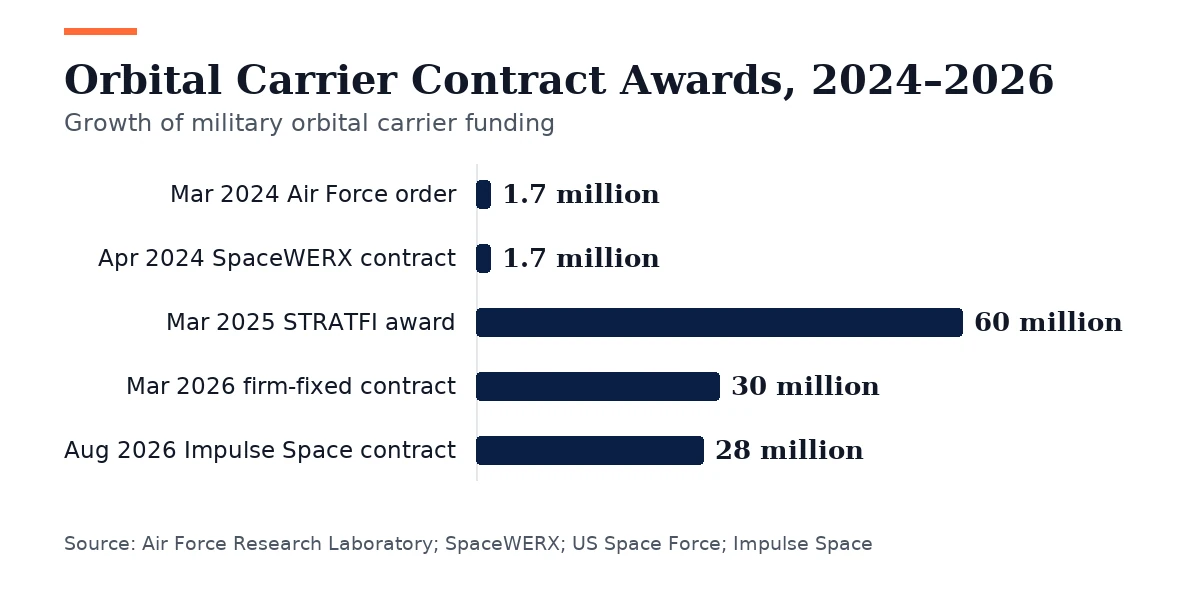
- March 2024: Gravitics received a purchase order worth up to $1,699,733 from the Air Force Research Laboratory for an Orbital DroneSat Carrier intended for space-based tactically responsive missions.
- April 2024: Gravitics announced a $1.7 million Small Business Innovation Research Direct-to-Phase II contract from SpaceWERX, in partnership with Space Systems Command's Space Safari Program Office, to develop tactically responsive orbital platforms.
- March 2025: Gravitics secured a Space Force STRATFI (Strategic Funding Increase) award worth up to $60 million to show its Orbital Carrier capable of pre-positioning military assets for tactically responsive deployment.
- March 2026: Gravitics received a $30 million firm-fixed-price contract to show an orbital carrier, with work slated for completion by December 31, 2028.
- August 2026: Lockheed Martin selected Gravitics to support a government contract of national security importance, likely involving the U.S. Space Force.
- August 2026: Impulse Space received a $28 million Small Business Innovation Research Phase III contract extension to deliver two Mira orbital transfer vehicles for the VICTUS SALO 2 and VICTUS SALO 3 missions.
As of October 2026, Gravitics is under a $30 million firm-fixed-price contract awarded in March 2026 to show an orbital carrier, with work planned to finish by December 31, 2028. The contract calls for Gravitics to show an orbital carrier capable of pre-positioning military assets for tactically responsive deployment. In August 2026, Lockheed Martin selected Gravitics to support a national security government contract likely involving the U.S. Space Force.
Also in August 2026, Impulse Space secured a $28 million SBIR Phase III contract extension to build two Mira orbital transfer vehicles for the VICTUS SALO 2 and VICTUS SALO 3 missions.
Each Mira vehicle is capable of delivering up to 850 meters per second of delta-v for a 100-kilogram payload using eight Saiph thrusters (delta-v is a measure of a spacecraft’s capability to change velocity; Saiph thrusters are a type of propulsion thruster). This delta-v capacity supports tactically responsive missions. Impulse Space plans to launch the VICTUS SALO 1 mission in 2027, followed by VICTUS SALO 2 and VICTUS SALO 3.
Compared to the initial $1.7 million award in April 2024, Gravitics now holds a $60 million STRATFI award and a $30 million demonstration contract for its Orbital Carrier. The company has also partnered with Lockheed Martin on a national security contract and continues to work with Rocket Lab, True Anomaly, Space Exploration Engineering, and Eta Space on the earlier SpaceWERX effort. Meanwhile, Impulse Space is advancing its Mira vehicles to support the VICTUS SALO series of tactically responsive missions.




Join the discussion