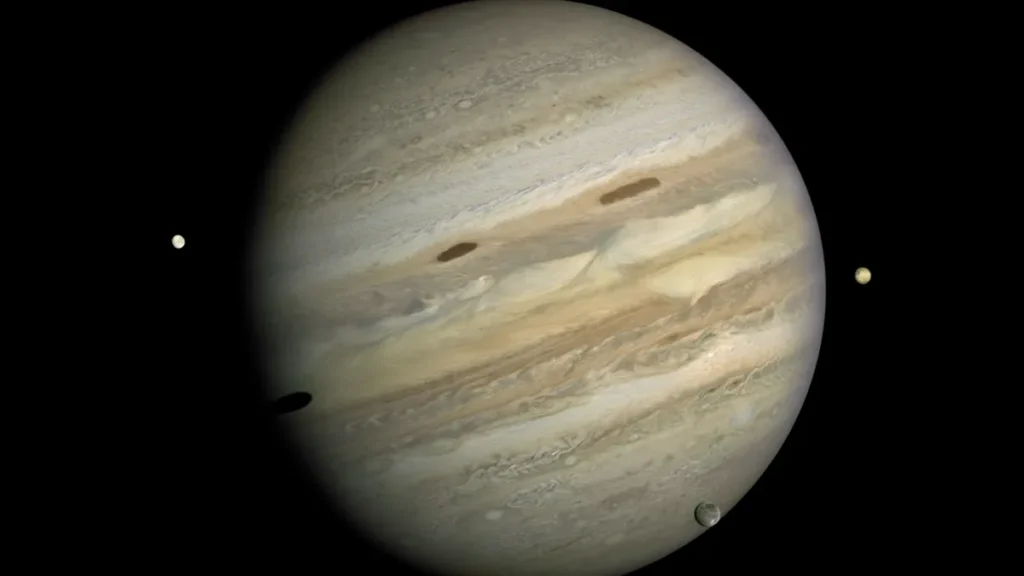
Astrobiology Web reported that researchers Jasmine Sun, Benjamin Idini and Ruth Murray-Clay found Jupiter’s internal oscillations can cause repeated heating episodes on Europa, in work submitted Nov. 24, 2026.
The researchers describe frequency-dependent tidal dissipation among Jupiter’s major moons as the mechanism. As Jupiter’s interior shifts, its changing gravitational pull can push Europa through orbital resonances, producing bursts of internal warmth instead of a steady state. Tidal heating is the heat created inside a moon when a planet’s gravity repeatedly stretches and relaxes the moon’s body.
The team found the resonance interaction itself is sufficient to make Europa’s heating episodic. That removes the requirement for an internal thermal-feedback loop inside the moon. A thermal-feedback loop would use the moon’s own heat flow to regulate the heating cycle.
Short-lived resonance crossings can pump up Europa’s orbital eccentricity while leaving the Laplace resonance intact. Strong tidal-resonance encounters with Jupiter can shift the way the Laplace angle oscillates, lift orbital eccentricity or snap the resonant chain.
The outcome depends on which moon moves the fastest under tidal forces. The Laplace resonance locks Io, Europa and Ganymede into a repeating orbital pattern. Libration means an angle swings back and forth around a set value. Eccentricity describes how oval an orbit is.
If Io or Europa undergoes enhanced tidal migration, the Laplace resonant chain keeps spreading outward. If Ganymede is the fastest-migrating moon, the chain breaks instead. The identity of the fastest-migrating moon sets the chain’s fate. A resonant chain is a repeating orbital lock in which the moons line up in a predictable pattern.
The team ran simulations of Io, Europa and Ganymede’s orbital paths with REBOUNDx, an N-body integrator that models the gravity-driven paths of multiple objects together. They drew tidal migration timescales from three representative models of Jupiter’s interior. The integrations followed all three moons at once under each interior assumption. Jasmine Sun submitted the paper to the preprint server arXiv on Tue, Nov. 24, 2026 at 07:27:35 UTC.
Join the discussion