
Key facts
- NordSpace said the work begins with a six‑kilometre access road to the launch site.
- NordSpace said it aims to finish Phase 2 by spring 2027.
- Newfoundland and Labrador said the remainder of the loan is a term loan.
- NordSpace said it broke ground at SLC-02 in 2025.
NordSpace said work on the second phase of the Atlantic Spaceport Complex began in St. Lawrence, Newfoundland and Labrador. NordSpace announced that Phase 2 should be completed by spring 2027. It said orbital launches from the site will not begin before 2028. NordSpace said the Tundra light-lift rocket will launch first from SLC-01 (Space Launch Complex 01, a launch pad), with the Tempest medium-lift rocket to follow.
After the road is finished, NordSpace said it will add two orbital launch pads along with mission control, propellant storage, integration hangars and ground stations. NordSpace explained that funding includes a $10 million package announced in August, split equally between the firm and two government partners. NordSpace said the Atlantic Canada Opportunities Agency provided $1 million via its Regional Economic Growth through Innovation program. The province said it will forgive three-quarters of the $4 million loan if NordSpace creates 100 full-time permanent jobs by 2033.
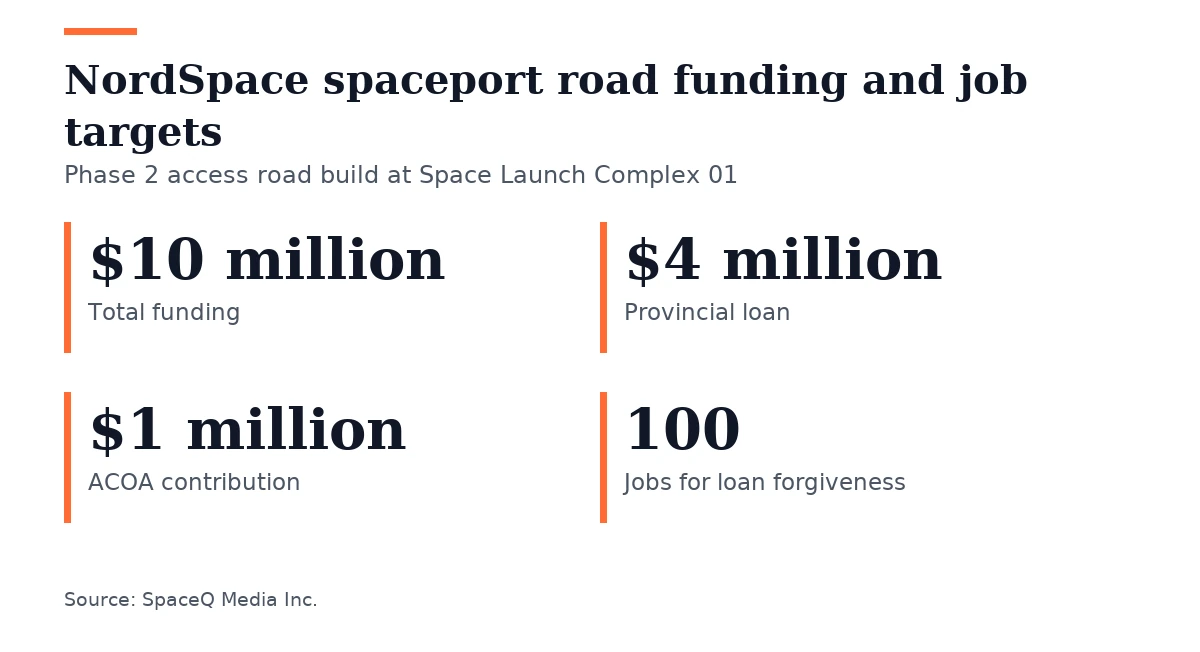
It noted that the outstanding balance will be structured as a term loan. NordSpace said provincial environmental clearance was granted last December and that initial work started in 2024. NordSpace said the initial stage awarded crown land rights and set up Pad 2A at the SLC-02 (Space Launch Complex 02, a launch pad) launch site. NordSpace described Pad 2A at SLC-02 as the smaller of the two launch zones, meant for suborbital missions and modest orbital payloads.
Construction at SLC-02 commenced in 2025, according to NordSpace. In June, Rahul Goel said to SpaceQ that upgrades to hangars, pad extensions and security were in progress at SLC-02. According to NordSpace, a Taiga launch attempt from SLC-02 occurred in August 2025. The company cited an unresolved liquid‑oxygen shortage on the ground as the reason the Taiga launch was halted.
NordSpace noted that a second Taiga launch try, originally set for December, was rescheduled to March 2026. Taiga remains pending final regulatory clearance prior to another launch try. NordSpace added that Taiga flights will continue from SLC-02 after the SLC-01 orbital pads become operational. Following Taiga’s inaugural flight, NordSpace said the initiative would be renamed VERTEX.
According to NordSpace, VERTEX means Vehicle for Experimental Rocket Testing and Exploration and would offer suborbital services to state agencies, colleges and private companies. SpaceQ pointed out that Canada previously fired over 3,500 research rockets from the Churchill range in Manitoba. SpaceQ added that the Churchill site saw little use from the mid‑1980s onward, with its final launch occurring in 1998. NordSpace noted that Magellan Aerospace continues to produce the Black Brant suborbital rocket at its Winnipeg facility.
According to NordSpace, five Black Brant rockets have flown this year, each launched for a U.S. customer from a U.S. location. It added that additional Black Brant missions are planned before the year’s end for customers in the United States and Sweden. SpaceQ observed that with no domestic buyers for Black Brant flights, the prospects for VERTEX in Canada remain uncertain. NordSpace explained that it is collaborating with Transport Canada to secure launch licences under the forthcoming Canadian space launch law.
According to NordSpace, the Canadian Space Launch Act (Bill C‑28) remains at second reading in the House of Commons. It noted that members of parliament last discussed the legislation on April 28. NordSpace said Transport Canada has been granting launch approvals individually under a temporary framework that started in 2023. NordSpace said the Department of National Defence allocated nearly $25 million, dividing it equally between NordSpace, Canada Rocket Company and Reaction Dynamics.
It explained that the money comes from the initial phase of Launch the North, which seeks a Canadian‑owned launch capability by 2028. NordSpace affirmed that the project remains on track to meet the 2028 target. Since unveiling the spaceport in July 2024, NordSpace has been promoting the St. Lawrence site to additional launch operators. When the spaceport was announced, NordSpace reserved a second launch pad mainly for rockets from American firms.
It noted that American launches from the facility would require a signed Canada‑U.S. Technology Safeguards Agreement, which has not yet been completed. NordSpace added that it is currently engaged in discussions with unnamed launch partners. According to NordSpace, its inaugural satellite, Terra Nova, lifted off on October 1 aboard a SpaceX rideshare and now operates in orbit.


Join the discussion