Key facts
- The two ESCAPADE spacecraft named Blue and Gold completed powered Earth flybys on Nov. 7 and Nov. 9, 2026, respectively, and are now headed to Mars.
- Blue's engine burned for over nine minutes beginning at 5 a.m. EST on Nov. 7, 2026, at an altitude near 1,000 miles (1,700 kilometers).
- Gold performed a comparable engine firing at 6 a.m. EST on Nov. 9, 2026, from about 650 miles (1,000 kilometers) up.
- On arrival at Mars, both spacecraft will conduct an 11-minute engine burn to slow down for orbit insertion.
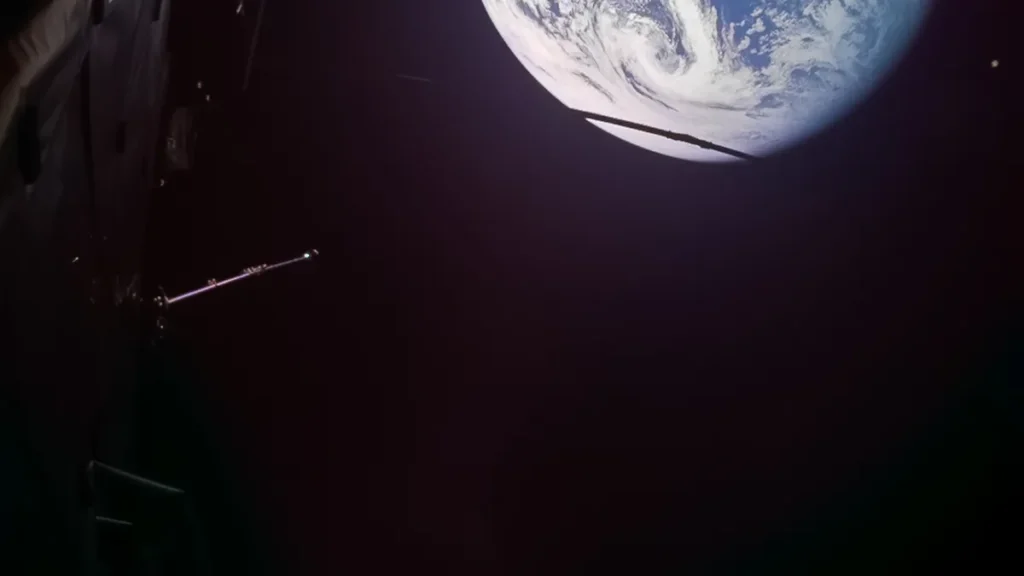
NASA’s twin ESCAPADE spacecraft completed powered Earth flybys on Nov. 7 and Nov. 9, 2026, and are now headed to Mars.
The Nov. 7 and Nov. 9 flybys marked the first time NASA used a powered Earth flyby to propel a spacecraft toward Mars, executed twice in two days. The maneuver is also known as an Oberth maneuver, and no Mars-bound spacecraft has successfully executed one before. NASA says no agency spacecraft has flown this type of maneuver before.
Previous Mars missions launched only when Earth and Mars aligned roughly every 26 months to shorten the trip and use the least amount of fuel. Launch opportunities open under this method nearly anytime rather than only every two years when planets line up. Mark Lewis, manager of SSL’s Mission Operations Center, said nobody else has flown a standard Holman transfer using a powered gravity assist.
Blue’s engine burned for over nine minutes beginning at 5 a.m. EST on Nov. 7, 2026, at an altitude near 1,000 miles (1,700 kilometers). Gold performed a comparable engine firing at 6 a.m. EST on Nov. 9, 2026, from about 650 miles (1,000 kilometers) up. The burn and Earth’s gravity combined to put Blue on a trajectory intersecting Mars’s orbit, while Gold’s twin maneuver put the spacecraft on its way to Mars.
NASA Science gave the maneuver start times as 4:51 a.m. EST on Nov. 7, 2026, for Blue and 5:51 a.m. EST on Nov. 9, 2026, for Gold. SpaceNews reported Gold passed within about 1,050 kilometers and Blue within about 1,600 kilometers, with the flybys separated by over 48 hours. Each burn raised speed from about 6.3 miles per second to about 6.7 miles per second, roughly Mach 30 to Mach 31, adding more than 1,000 miles per hour.
The probes avoided a direct Holman transfer by entering a first-of-its-kind kidney-bean-shaped loop around the Earth-Sun Lagrange point 2 roughly a million miles away, then came back to Earth for the slingshot. During the loiter phase, the spacecraft flew multiple times through Earth’s magnetotail, a region no spacecraft had directly explored before. NASA Science said mission scientists observed interesting magnetotail activity and structure and plan to share those findings soon.
Sources disagree on which ESCAPADE spacecraft arrives at Mars first. UC Berkeley dates Blue’s arrival to Sept. 9, 2027, and Gold’s to Sept. 7, 2027, while NASA’s pre-flyby preview listed Sept. 7 for the first spacecraft and Sept. 9 for the second. Planned trajectory correction maneuvers will adjust the probes’ path during the 10-month cruise to keep them on course for the September 2027 Mars rendezvous.
On arrival at Mars, both spacecraft will conduct an 11-minute engine burn to slow down for orbit insertion. The twin orbiters will begin by flying together in one Mars orbit, separated by as much as 30 minutes, to observe how space weather changes. The start of science work is set for June 2028 after several months of formation maneuvering. Six months after science operations begin, the spacecraft will shift into separate orbits for a five-month campaign, with one observing the incoming solar wind from farther away and the other studying Mars’s response from closer in.
ESCAPADE will be the first science mission to fly two orbiters in formation around Mars, making coordinated simultaneous observations of the planet’s magnetosphere and environment. Rob Lillis, ESCAPADE’s principal investigator, said formation flying will allow investigation of how the dynamic Martian magnetosphere changes across space and time. ESCAPADE science will examine the interaction between the million-mile-per-hour solar wind and the Martian environment, including how that flow drives atmospheric loss. Mars has patches of magnetized rock in its crust, especially in the southern highlands, left over from an ancient global field, and some regional fields are surprisingly strong.
Michele Cash, NASA’s ESCAPADE program scientist, said understanding solar wind effects on Mars would aid planning for future human missions there. Researchers anticipate ESCAPADE data will clarify how Mars shed most of its atmosphere and magnetosphere over time, informing questions about past or future habitability. During the 10-month cruise to Mars, the spacecraft will study the dynamics of the solar wind between Earth and Mars.
ESCAPADE launched from Cape Canaveral, Florida, on Nov. 13, 2025, aboard Blue Origin’s New Glenn rocket during its second flight. The New Glenn rocket’s reusable booster landed safely on a platform after launching ESCAPADE on Nov. 13, 2025. Total mission cost came in below $80 million, roughly 10% of a standard Mars spacecraft’s price.
ESCAPADE was picked for SIMPLEx development in 2019 with Janus and Lunar Trailblazer; Janus was later canceled in 2023, Lunar Trailblazer ended in 2025 following a malfunction, and two other SIMPLEx cubesats failed. NASA canceled Janus in 2023 after Psyche delays blocked its rideshare asteroid flybys; Lunar Trailblazer malfunctioned after its February 2025 launch and ended five months later; LunaH-Map and Q-PACE also failed. Citing budget pressures, NASA has not solicited proposals for new SIMPLEx missions and has not stated plans to do so for the foreseeable future.
NASA’s Heliophysics Division pays for ESCAPADE under the SIMPLEx program backing innovative small-budget solar system exploration. UC Berkeley’s Space Sciences Laboratory leads the ESCAPADE mission with key partners Rocket Lab, NASA’s Goddard Space Flight Center in Greenbelt, Maryland, Embry-Riddle Aeronautical University, Advanced Space and Blue Origin. SpaceNews said ESCAPADE is the last surviving SIMPLEx mission after the cancellation or failure of Janus, Lunar Trailblazer, LunaH-Map, and Q-PACE.
Rob Lillis told a Nov. 9, 2026, meeting of the Mars Exploration Program Analysis Group that the burns were critical like Mars orbit insertion and had been executed perfectly. “This is the first time NASA has used a powered Earth flyby to propel a spacecraft toward Mars,” said Asal Naseri, acting associate flight director in NASA’s heliophysics division.





Join the discussion