Key facts
- Thomas Gottschild, managing director of MBDA Deutschland, said the initiative aligns with MBDA's strategic vision for the space domain, including defense of space and space for defense.
- In orbit, the 1967 Outer Space Treaty prohibits nuclear weapons and weapons of mass destruction, while conventional weapons have no general prohibition and remain subject to international law.
- As a first step, the PODS agreement uses an MOU, while further development depends on separate agreements, corresponding authorizations and additional assessments.
- Sebastian Klaus, CEO of ATMOS Space Cargo, said in a Nov. 18 statement that combining proven defense systems with new orbital technologies could strengthen Europe's conventional deterrence.
MBDA Deutschland and ATMOS Space Cargo signed a cooperation agreement on Nov. 18, 2026 to study Precision Orbital Deep Strike, a precision conventional strike capability based in space.
MBDA will contribute weapon-systems know-how, guidance and integration of military payloads, while ATMOS will contribute experience in orbital transport and reentry technologies. ATMOS’s work will be coordinated by ATMOS WORKS, its unit specializing in European government and defense customers. The first step is a memorandum of understanding, and further development depends on separate agreements, corresponding authorizations and additional assessments, though the companies said the work could lead to demonstrations. Any deployment or use would be subject to approval by governmental and military authorities.
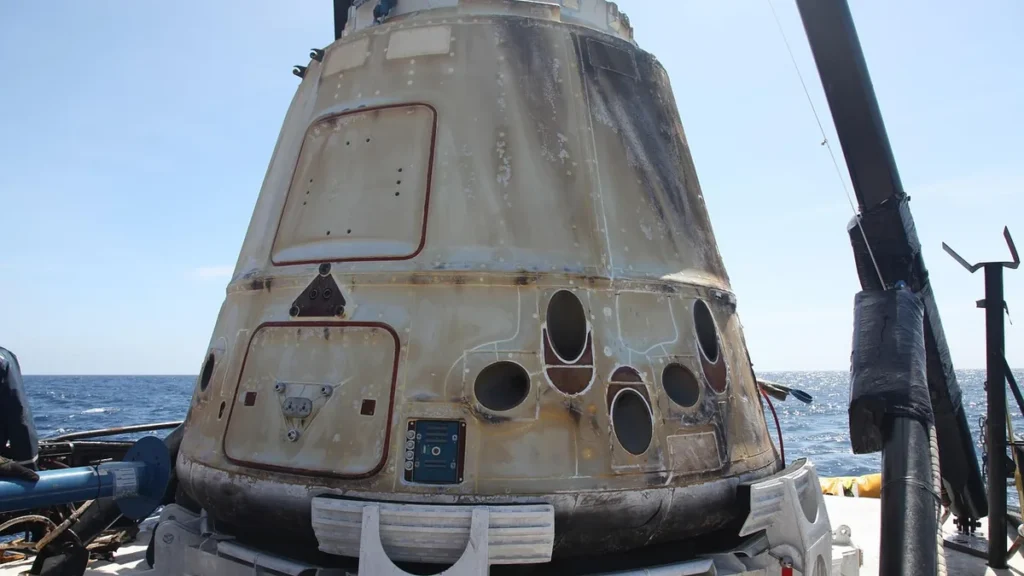
PODS seeks to combine orbital transport and atmospheric reentry with military payloads to store weapons in orbit and use them against ground targets when required. The concept carries a payload into space on a conventional launcher, keeps it in orbit until a strike is ordered, then uses a reentry vehicle to guide it toward the target. ATMOS explored carrying a conventional projectile aboard a satellite shielded by a reentry vehicle, according to reports cited by The War Zone and German media.
Technical challenges for PODS include controlled reentry, precise guidance to the target, and survival of the military payload during descent. ATMOS has demonstrated that its Inflatable Atmospheric Decelerator can survive an orbital flight and reentry, but that does not equal a weapon delivery system capable of controlled reentry and precision targeting.
Aviacionline reported PODS might reach any spot on Earth in less than 60 minutes, though the companies said that is not an official requirement. Israel Defense reported that Klaus said in March 2026 an orbital conventional capability could strike any military target worldwide within 60 minutes.
In orbit, the 1967 Outer Space Treaty prohibits nuclear weapons and weapons of mass destruction, while conventional weapons have no general prohibition and remain subject to international law. Thomas Gottschild, managing director of MBDA Deutschland, said the initiative aligns with MBDA’s strategic vision for the space domain, including defense of space and space for defense.
Sebastian Klaus, CEO of ATMOS Space Cargo, said in a Nov. 18, 2026 statement that combining proven defense systems with new orbital technologies could strengthen Europe’s conventional deterrence. Klaus also called orbital transportation and return a new layer of strategic infrastructure that determines what Europe can achieve on its own terms.
He said in a LinkedIn post that the agreement connects ATMOS expertise in orbital transport and atmospheric reentry with MBDA defense systems expertise in exploring a new conventional defense capability. Europe’s conventional deterrence is the goal as the companies examine merging existing defense technology with emerging orbital technology. Defense News reported that Klaus said Europe needs orbital deterrence to address a capability gap in deep precision strike.
Gottschild called the initiative a highly innovative path to give European armed forces a sovereign capability, adding that he looks forward to it.
“Today, Guardians operate on-orbit weapons that can defend the joint force against space-enabled attacks” — Gen. Douglas Schiess, U.S. Space Force Chief of Space Operations, said on Sept. 15, 2026. The remarks came a few months before the Atmos-MBDA announcement.
ATMOS Space Cargo’s Phoenix capsule completed its first test run in space aboard a SpaceX Falcon 9 rocket during a rideshare mission in February 2025. The test evaluated inflatable heat shields designed to help future space-manufactured cargo survive Earth’s atmosphere.
ATMOS successfully tested its reentry concept in April 2025.
Phoenix 2, a spacecraft with a 100-kilogram payload capacity and mission durations ranging from three hours to 12 months, is under development at ATMOS. ATMOS and the European Space Agency are examining Phoenix 3, a larger variant whose potential payload capacity is approximately one metric ton. In April 2026, ATMOS raised 25.7 million euros in a Series A funding round to fund Phoenix 3 development and three Phoenix 2 spacecraft for an initial fleet.
Civilian Phoenix vehicles stay separate from the dedicated defense system under evaluation with MBDA, ATMOS stated. ATMOS allied with ARX Robotics in 2025 to put unmanned systems into its reentry vehicle, envisioning that Phoenix craft would land autonomous systems on Earth, including for ground defense operations. This alliance predates the November 2026 MBDA cooperation agreement.
MBDA is jointly owned by Airbus, BAE Systems, and Leonardo and is Europe’s largest missile manufacturer. PODS takes advantage of contemporary advances in the commercial space sector, particularly orbital transport and payload recovery using reentry vehicles, distinguishing it from earlier Cold War concepts.
Keeping military payloads in orbit for long stretches would allow use without starting a launch every time a strike is required, and platforms could operate throughout their service life without periodic physical maintenance. Under PODS, launch infrastructure would be a key vulnerability to pre-emptive attacks or interference, as would satellites in orbit, communications and control centers.
The United States, Russia, and China have demonstrated direct kinetic anti-satellite capabilities, while laser systems and electronic interference can also threaten space assets. The initiative, driven by an industrial and strategic ambition, seeks to develop European technologies for designing, building and operating military capabilities without reliance on external infrastructure or suppliers.




Join the discussion