
Key facts
- LBN 182 is a Cygnus nebula that encircles the Wolf-Rayet star WR 134, which lies some 6,000 light-years from Earth.
- WR 134’s powerful stellar wind has blown a faint bubble into surrounding gas, appearing in the frame as a bright blue shock front at the upper left.
- NASA’s Fermi Gamma-ray Space Telescope study found that cosmic rays are corralled in the Cygnus X star-forming region about 4,500 light-years away.
- Massive stars in Cygnus X have intense outflows that clear cavities in local gas clouds, while their combined winds and ultraviolet radiation heat and push gas away from young star clusters.
Astronomy Magazine published an image feature on Nov. 9, 2026 identifying the LBN 182 nebula in Cygnus as a bubble around the Wolf–Rayet star WR 134, placing the star roughly 6,000 light-years from Earth and crediting its powerful stellar wind with blowing the faint bubble and its bright blue shock front at the upper left of the frame. The article identifies LBN 182 as the nebula shown and places WR 134 inside it. No alternate distance figure is provided on the page.
The photograph was made by Vergani using roughly 11 hours of integration time on a 3.1-inch f/6 refractor equipped with a dual-band Hα/OIII narrowband filter, according to the magazine. Hα/OIII is a narrowband filter setup that isolates hydrogen-alpha and oxygen-III light. The magazine does not break the exposure down by filter band, and it provides no dimensions or expansion speed for the bubble.
NASA’s work on the Cygnus X star-forming region describes how massive stars generate intense outflows that clear cavities in local gas clouds. Combined stellar winds and ultraviolet radiation heat gas and drive it away from clusters, forming low-density bubbles. The agency calls O stars the most massive, luminous and hottest stellar type. Cygnus OB2 contains 65 O stars and nearly 500 B stars, and NASA identifies it as one of the region’s OB associations.
NASA’s Scientific Visualization Studio introduces Cygnus X as a star factory first detected as a diffuse radio source in the 1950s. The region sits near the second-magnitude star Gamma Cygni. It holds enough gas and dust to form two million solar-mass stars, and it contains many young clusters and several OB associations of related O- and B-type stars. Besides Cygnus OB2, the region hosts the OB9 association and the cluster NGC 6910. NASA’s description of the region’s stellar contents comes before its focus on Cygnus OB2.
Eight-micron infrared images of Cygnus X show ridges of denser gas marking the boundaries of cavities produced by massive-star outflows and ultraviolet radiation. Bright spots inside those ridges indicate where stars are forming today. Gamma-ray emission detected by Fermi’s LAT instrument fills bubbles of hot gas created by the region’s most massive stars. Shock waves linked to massive-star activity also impede the movement of cosmic rays through Cygnus X. NASA lists young stellar groupings in the region when describing an infrared image of cavities.
Cosmic rays are subatomic particles, mainly protons, that travel through space at nearly the speed of light. Fermi detects gamma rays when those particles strike gas nuclei or starlight photons. NASA’s Fermi study found that cosmic rays are corralled in Cygnus X about 4,500 light-years away. Magnetic fields deflect the particles and scramble their paths, making it impossible to backtrack them to their sources. The page describes the galactic journey of cosmic rays and explains why their origins cannot be directly traced.
NASA’s Galaxy Evolution Explorer captured the ultraviolet image of the Cygnus Loop, a supernova remnant in Cygnus about 1,500 light-years away. The remnant resulted from a massive stellar explosion between 5,000 and 8,000 years ago. It covers more than three times the full moon’s apparent diameter and lies beside one of the swan’s wings in the constellation. The image presents the Cygnus Loop as an expanding remnant.
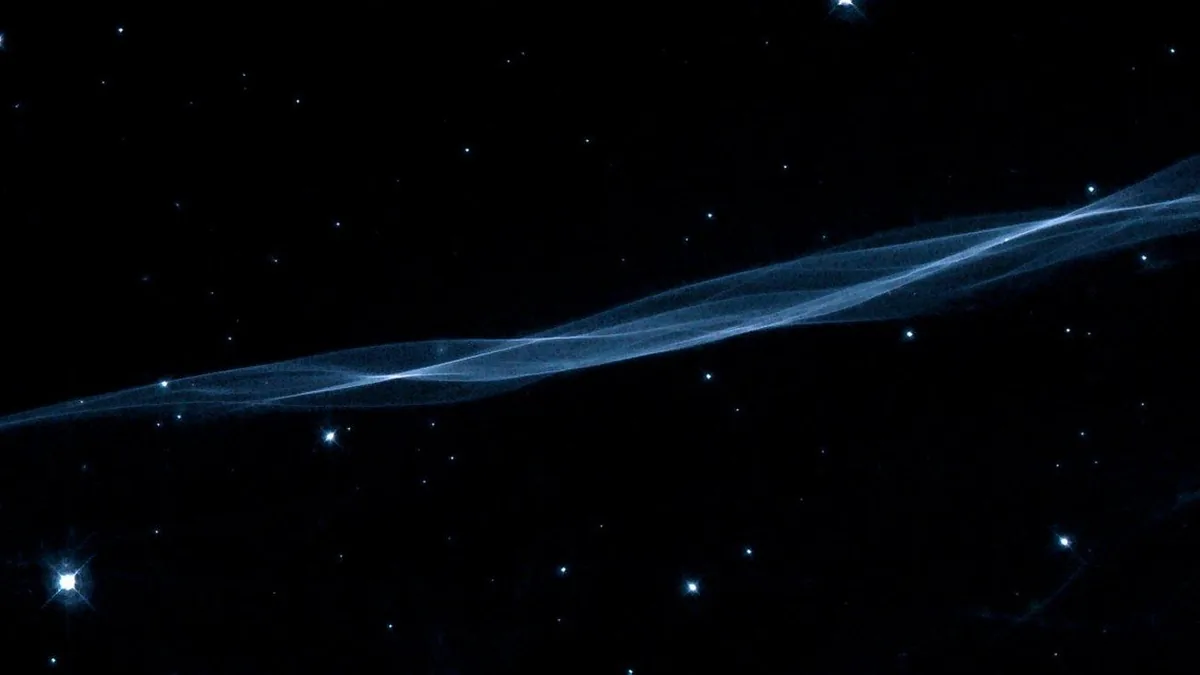
The glowing ultraviolet filaments are gas heated by a supernova shockwave that continues to spread outward. NASA says the original explosion would have been plainly visible from Earth without a telescope. ROSAT X-ray images reveal gas at about one million degrees, produced when shattered star material crashes into nearby interstellar clouds and dust. HEASARC describes the hot gas as generally circular, implying a symmetric explosion, but points to a southern blowout where the surrounding space has unusually low density.
HEASARC assembled the high-resolution X-ray image of the Cygnus Loop by stitching together individual pictures taken with the ROSAT High Resolution Imager detector. A ROSAT PSPC temperature map displays cooler material as purple-blue and hotter material as yellow-red. The map provides a visual gauge of the shock-heated gas in the remnant. HEASARC’s image feature describes how the X-ray view of the remnant was assembled from detector data. The page explains how the temperature map displays hot gas in the supernova remnant.
NASA’s Cygnus mosaic spans 28 by 18 degrees near the northern end of the Great Rift. It combines 400 hours of image data gathered over 10 years. Deneb, Cygnus’s bright hot supergiant alpha star, sits at the left edge of the mosaic. The star serves as a marker for the Summer Triangle and the Northern Cross, and northern skywatchers use it to find those patterns.
Observers can use Deneb as an entry point to the constellation. The Cygnus Loop lies beside one of the swan’s wings, while Cygnus X sits near Gamma Cygni. Astronomy Magazine’s image places WR 134 inside LBN 182, adding a telescopic target within the same broad region of Cygnus. The magazine provides no alternate distance figure for WR 134.
NASA’s multiwavelength image of Cygnus X also includes the expanding shell of the Gamma Cygni supernova remnant. The shell is about 80 light-years across and stands out in radio data as a ruffled brown disk in the upper right. Diffuse ionized gas blown into delicate filaments and arcs by massive-star outflows appears green in the image. Hot dust filling the region shows up as blue. NASA explains the color coding of an image combining radio and infrared observations of Cygnus X.




Join the discussion