Key facts
- Researchers determined VVV CL001 lies about 7.34 kiloparsecs, roughly 24,000 light-years away, inside the galactic bulge, with the smallest distance error reported to date.
- Researchers identified around 155 cluster stars, including horizontal branch and main-sequence turnoff stages not previously revealed in this cluster.
- The study was led by J. Olivares Carvajal of the INAF Capodimonte Astronomical Observatory.
- The main-sequence turnoff point depends on age and is the best age marker, while horizontal branch stars have steady brightness for distance reference.
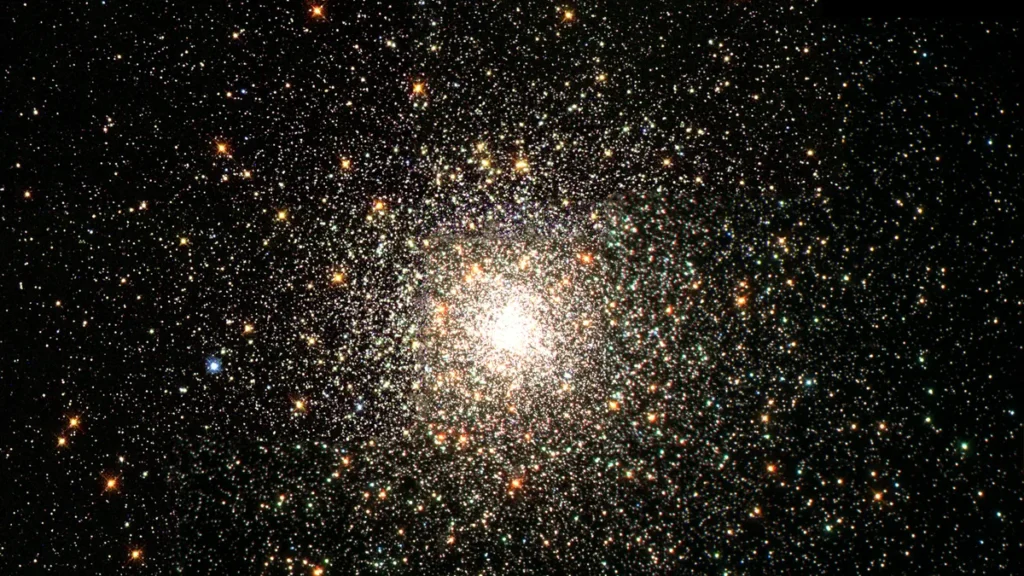
A team led by J. Olivares Carvajal of the INAF Capodimonte Astronomical Observatory estimates that VVV CL001, a metal-poor globular cluster near the Milky Way’s center, is about 13.4 billion years old, with the research posted to the arXiv preprint server on Oct. 20, 2026.
A globular cluster is a tightly bound group of stars orbiting a galaxy. VVV CL001 was discovered by the VISTA Variables in the Vía Láctea Survey in 2010 and confirmed as a cluster in 2019. It lies inside the Milky Way’s galactic bulge, the central densely packed region of the galaxy, about 7.34 kiloparsecs—a large unit of astronomical distance—roughly 24,000 light-years away, with the smallest distance error reported to date. A light-year is the distance light travels in one year.
VVV CL001 moves toward Earth at a different speed than other stars near the galaxy’s center, so researchers suspected it might not belong there. Radial velocity is the speed at which an object moves toward or away from Earth. To determine its origin, the team examined its path around the galaxy, but different studies assumed different distances and produced different orbital paths because distance uncertainty was the main culprit.
Astronomers also found no RR Lyrae stars, which are variable stars often used as distance markers. These obstacles—dust dimming starlight in this crowded region, the cluster’s small and faint profile, earlier images that were too shallow, and the missing RR Lyrae stars—explain why distance and age remained highly uncertain before the new study. Interstellar reddening is the dimming and color change of starlight caused by dust, and it makes the crowded bulge region especially hard to observe.
Astronomers used deep near-infrared observations from the FourStar Infrared Camera on the Magellan Baade 6.5m Telescope to refine the distance and Hubble Space Telescope pictures to estimate the age. Hubble images are less affected by dust than other wavelengths, making them suitable for age measurement, while near-infrared data from FourStar helped penetrate the obscuring material. Infrared light is radiation at wavelengths longer than visible light, able to pass through dust that blocks visible wavelengths. The FourStar Infrared Camera is an instrument designed to capture near-infrared light.
The team selected cluster members using proper motion calculations, which track a star’s apparent motion across the sky, the HDBSCAN machine learning algorithm, and Markov-Chain Monte Carlo iterations in a 5-dimensional parameter space. HDBSCAN is a machine learning algorithm that groups data points based on density. Markov-Chain Monte Carlo is a statistical method that samples possible solutions to narrow down the most likely values. This member selection was part of an effort to study the cluster’s role in Milky Way formation and determine whether it is the oldest Galactic globular cluster.
Researchers identified around 155 cluster stars, including horizontal branch and main-sequence turnoff stages not revealed in this cluster. The turnoff is where a star finishes burning hydrogen in its core before swelling into a red giant and burning helium on the horizontal branch. A red giant is a late-stage star that has expanded and cooled after exhausting core hydrogen. Horizontal branch stars have steady brightness, which makes them useful for distance reference.
The main-sequence turnoff point depends on age and is the best age marker. VVV CL001 could be the oldest globular cluster in the bulge and perhaps the galaxy, representing an ancient stellar population that formed in place. Its age and chemical properties can limit the galaxy’s age, and older clusters typically contain few metals. Metallicity is the fraction of a star’s matter made of elements heavier than hydrogen and helium.
The universe’s age upper limit is roughly 13.8 billion years, so the cluster’s age estimate must fall below that value within its uncertainty. Researchers plan a high-resolution spectroscopic follow-up to verify the findings based on the cluster’s chemical composition. Spectroscopy is the study of how matter absorbs and emits light. The team will receive new optical observations to improve the distance result in future work.
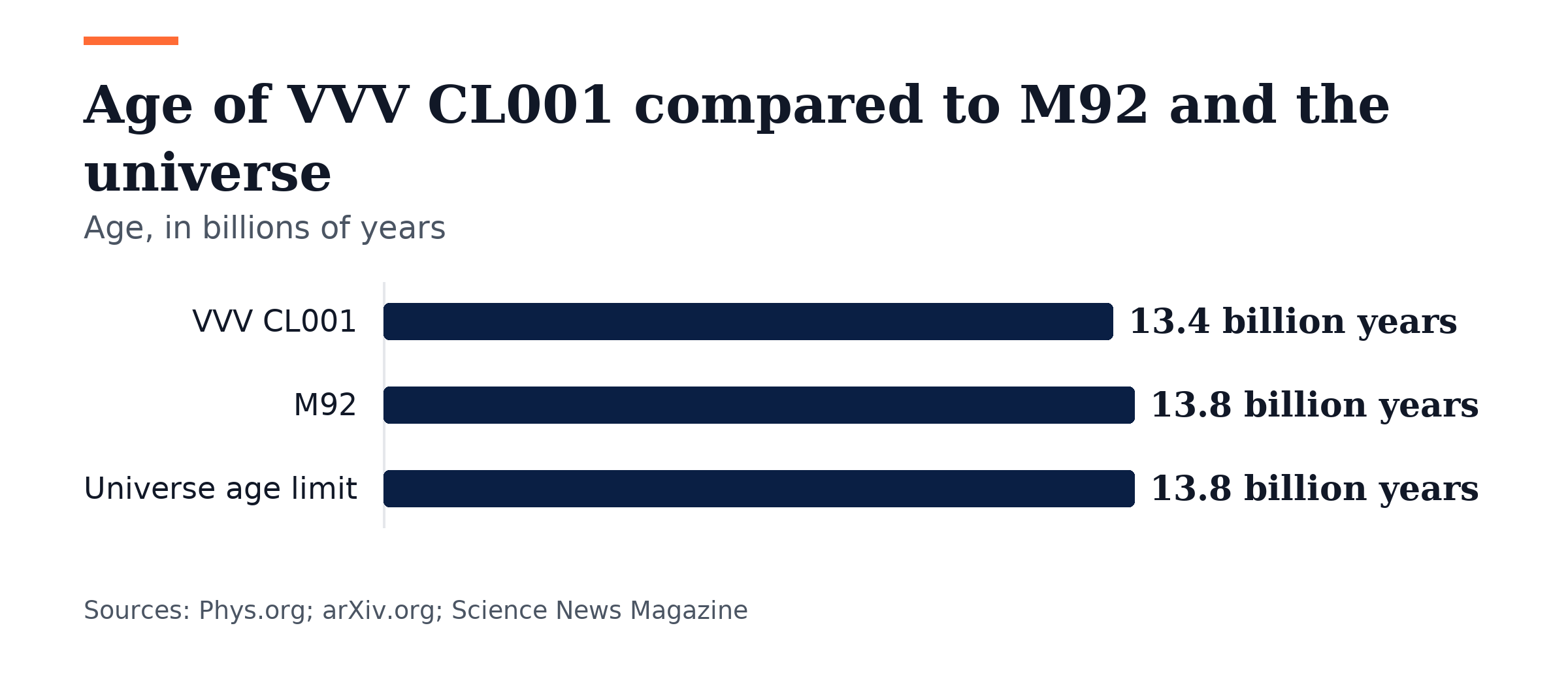
Star cluster M92 is about 13.8 billion years old, plus or minus 750 million years, and roughly 27,000 light-years from Earth, nearly the same age as the universe. The universe’s best estimate is just over 13.8 billion years plus or minus 24 million years from Planck. The M92 estimate comes from a paper submitted to arXiv on June 3, and refining cluster ages can help set limits on the universe’s age. M92’s age sits on the edge of the universe’s estimated age and helps set a lower bound on when the universe began.
A Dartmouth study led by Jiaqi (Martin) Ying determined the absolute ages of eight Milky Way globular clusters ranging from approximately 11.5 to 13.5 billion years. The researchers used Hubble Space Telescope photometric data compared to isochrones on a Hertzsprung-Russell diagram to estimate the clusters’ absolute ages. Isochrones are lines on a chart that represent stars of the same age but different masses.
Measuring distance and interstellar reddening cause the greatest errors in globular cluster ages, contributing over 50 percent of the total uncertainty. ESA’s Gaia mission provides more accurate parallax measurements, but many globular clusters in the outer halo have sparse Gaia data. Parallax is the apparent shift of a nearby object against a distant background as the observer moves.
Martin Ying of Dartmouth College said, “It helps us set the lower bound of the age of the universe.”
The VISTA Variables in the Vía Láctea Survey covers 520 square degrees with at least 355 open and 33 globular clusters, using infrared light to penetrate dust. VISTA uses wide-field, high-resolution infrared imaging to study the Milky Way’s deep structures, revealing objects hidden behind thick dust clouds. A square degree is a unit of solid angle used to measure patches of sky. Dante Minniti said, “This part of the galaxy was completely unknown until our VVV survey found it!”
Rubin-GC1 is a dusty compact cluster on the Milky Way’s far side, estimated at 100,000 light-years away and roughly nine billion years old, possibly linked to Sagittarius dwarf galaxy debris. Rubin Observatory preview observations identified Rubin-GC1, and its proposed origin as Sagittarius dwarf galaxy debris remains an interpretation based on positions and motions.





Join the discussion