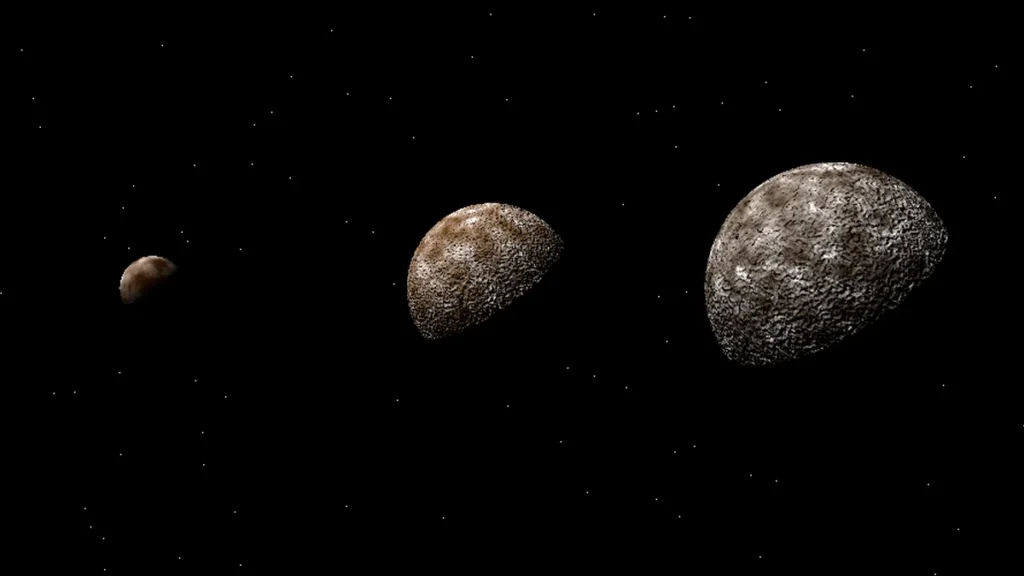
This is a new development in a story we reported earlier: Japan plans to launch the world's first mission to return samples from Phobos, Mars's larger moon.
Key facts
- A German-French rover named Idefix, weighing 55 pounds, will land on Phobos in early 2029 without braking rockets, bouncing to a stop due to Phobos' low gravity.
- The MMX spacecraft will study Deimos during flybys before returning to Earth in 2030, with the sample capsule landing in Australia in July 2031.
- NASA’s Thomas Statler stated that Phobos and Deimos resemble asteroids from the outer asteroid belt but may also be remnants of a giant impact involving Mars.
- The MMX spacecraft will enter Mars orbit in September 2027 and spend three years studying Phobos and its environment.
JAXA sent the Martian Moons eXploration (MMX) mission into space on Oct. 19, 2026, using an H3-24L rocket launched from Tanegashima Space Center. The launch was declared successful after separation from the rocket’s upper stage. Flight controllers celebrated the milestone, marking the beginning of the spacecraft’s journey to Mars. The mission is designed to last five years, aiming to study Mars’ moons and retrieve a sample from Phobos for return to Earth, seeking to clarify the origins of Phobos and Deimos and their connection to early solar system processes.
CBS News reported that the Idefix rover weighs 55 pounds and is scheduled to land on Phobos in early 2029. It will touch down without braking rockets, bouncing to a halt because Phobos’ gravity is low, and it rights itself after landing. The Idefix rover will move at 1 millimeter per second (0.04 inches per second) and act as a scout to identify safe landing zones for the MMX lander.
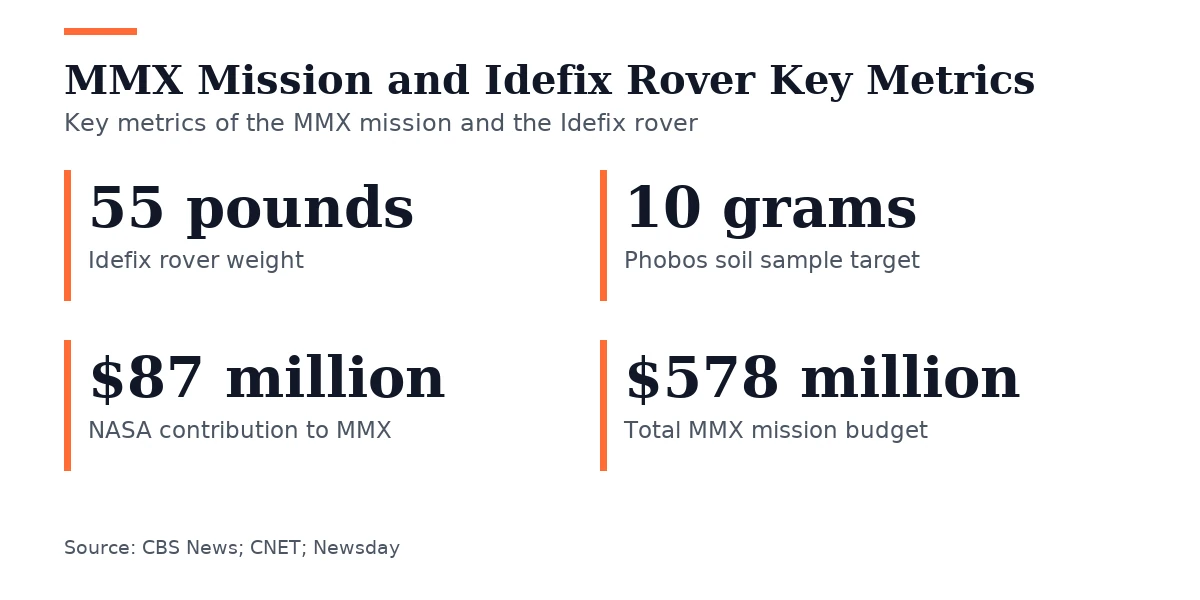
CBS News reported that the MMX spacecraft will collect at least 10 grams (less than half an ounce) of soil from Phobos in late 2028 or 2029 using two sampling devices: one built by JAXA and another by NASA. After gathering the samples, the spacecraft will conduct remote observations of Deimos during flybys in 2030 before beginning its return to Earth. The sample capsule will land in Australia in Jul. 2031.
CBS News reported that the MMX spacecraft will enter Mars orbit in Sep. 2027 and spend three years studying Phobos and its environment, and will later conduct remote observations of Deimos during flybys. During this period, the spacecraft will synchronize its orbit with Phobos to enable detailed observations. This orbital alignment will also enable detailed observations of Phobos.
NASA contributed $87 million to the MMX mission, providing the Megane spectrograph and pneumatic sampler technology for collecting Phobos samples. According to CNET and Newsday Thomas Statler of NASA said that Phobos and Deimos are like asteroids from the outer asteroid belt, though they may also be remnants of a giant impact involving Mars, highlighting the dual possibilities for their origins and the need for direct analysis to resolve the debate. According to CBS News Nicky Fox noted that MMX samples will provide paradigm-shifting science on the Mars system, aiding plans to send humans to Mars, advancing understanding of Mars’ history and the broader solar system and supporting future human exploration efforts. According to CNET, NASA’s contributions also include scientific instruments and technology demonstrations to support sample collection and deep‑space communication. According to CNET and Newsday
Newsday reported that with a total budget of $578 million, the MMX mission receives funding from JAXA, NASA, France, Germany, and ESA. The mission’s international collaboration advances planetary science and sample return technology.
CBS News reported that the MMX mission seeks to find out if Phobos and Deimos originated from a major impact on Mars early in its history or if they were instead captured asteroids. Researchers suggest the moons might stem from a Martian impact or be asteroids snared from the outer belt, and the mission aims to settle this enduring debate by studying their makeup. The mission will analyze the composition of Phobos and Deimos to test these hypotheses.
China intends to send its Tianwen-3 spacecraft toward Mars in 2028, with the goal of bringing Martian samples back to Earth around 2031. The Tianwen-3 mission aims to collect Martian surface samples for return to Earth. This effort creates a potential race with JAXA to return the first samples from the Martian system.
No previous mission has ever brought back material from Mars or its moons, making MMX the inaugural effort to return samples from the Martian system. According to Newsday This milestone also aims to provide never-before-seen insights into the origins of Phobos and Deimos and their connection to early solar system processes. Nicky Fox emphasized that the mission’s findings will advance understanding of Mars’ history and the broader solar system, supporting future human exploration efforts. According to CNET



Join the discussion