Key facts
- China's Tianwen-3 Mars sample return mission is scheduled to launch in 2028 and return approximately 500 grams of Martian material to Earth around 2031.
- Tianwen-3 will use two Long March 5 launches from Wenchang in late 2028; one launch carries the lander and ascent vehicle, the other carries the Mars orbiter and Earth return orbiter.
- After touchdown on Mars, the Tianwen-3 lander will conduct surface operations for roughly one year to collect and seal samples.
- The full Tianwen-3 mission, from launch to the delivery of Martian samples to Earth, will last more than three years.
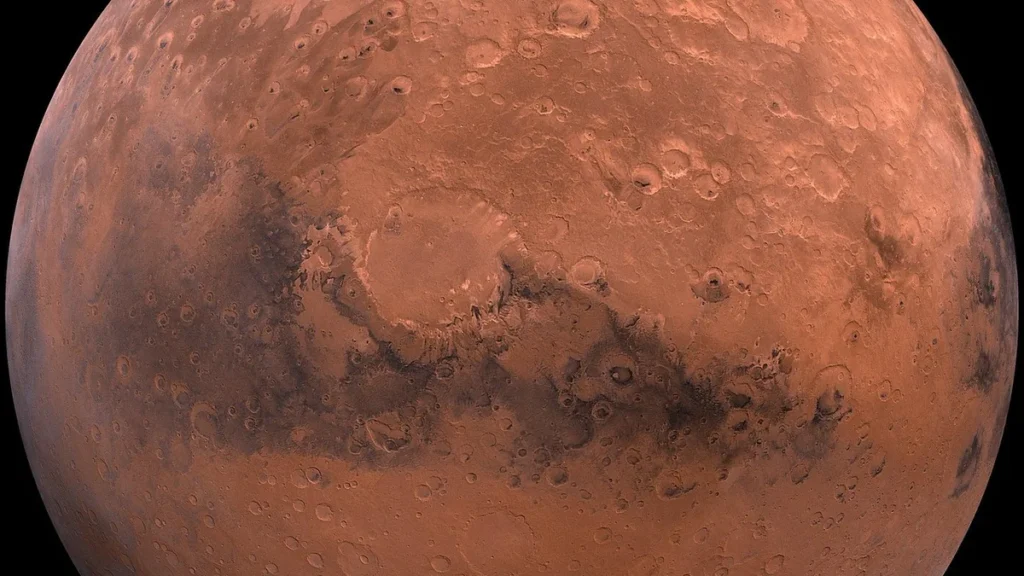
CNSA plans to launch China’s Tianwen-3 Mars sample return mission from Wenchang in late 2028, aiming to return about 500 grams of Martian material to Earth around 2031.
The mission will collect at least 500 grams of Martian rock and regolith from both surface and a two‑meter‑deep drill hole. Tianwen-3’s primary scientific goal is to detect biosignatures, and locations where water was once present offer the optimal conditions for preserving the biological and chemical markers that life would have left behind.
Two Long March 5 launches from Wenchang in late 2028 will split the mission mass, with one launch carrying the lander and ascent vehicle and the other carrying the Mars orbiter and Earth return orbiter. The mission architecture enables the lander to descend to Mars while the orbiter remains in space to later rendezvous with the ascent vehicle after sample launch.
Tianwen-3 planners began with over 80 candidate landing sites, narrowed them to 19 using elevation, latitude, slope and rock‑abundance limits, and will select three final sites by the end of 2026. The three preselected zones are Amazonis Planitia, Utopia Planitia (where the Zhurong rover landed in May 2021) and Chryse Planitia, all showing geological signs of past water such as sedimentary features from prolonged standing water.
Tianwen-3’s landing site selection draws from the discoveries of the Curiosity and Perseverance rovers, which identified ancient aqueous environments and authigenic minerals on Mars. Observations of brines and iron oxides precipitated by iron bacterial metabolism in an evaporative Mars analog basin support the hypothesis that low‑lying, closed crater basins on Mars have high astrobiological value for sample return missions.
Unlike mobile rover missions, Tianwen-3’s stationary lander will use a built‑in two‑meter drill to acquire subsurface samples and a robotic arm to collect surface deposits at a single location. The drill can reach two metres (6.5 feet) into the Martian subsurface, a world‑first capability that shields samples from surface‑level ionizing radiation and increases their potential to retain biosignatures. After touchdown, the lander will conduct surface operations for roughly one year to collect and seal samples before preparing the ascent vehicle for launch.

The full Tianwen-3 mission, from launch to the delivery of Martian samples to Earth, will last more than three years, including seven to eight months of outbound transit, a year of surface operations, and another seven to eight months for the return cruise. China is constructing a dedicated planetary protection laboratory in Hefei’s Deep‑Space Science City to handle Tianwen-3 Mars samples around 2031, and it will be the only such facility being built on Earth.
The Hefei laboratory will conform to COSPAR planetary protection policies, requiring ultra‑clean conditions to avoid forward contamination and Biosafety Level‑4 containment to prevent backward contamination of Earth’s biosphere. No existing lab combines the ultra‑clean setting for contaminant‑free sample handling with Biosafety Level‑4 containment, making a purpose‑built facility essential for Mars sample return. COSPAR labels Mars sample return as Category V Restricted Earth Return, its highest stringency tier, grounded in Article IX of the 1967 Outer Space Treaty.
After the 2026 U.S. Congressional cancellation of the NASA‑ESA Mars Sample Return program, the United States and ESA have no funded Mars sample receiving capability, as the Sample Receiving Facility and Earth Return Orbiter were defunded. As of August 2026, China’s Tianwen-3 mission is the sole funded and on‑schedule Mars sample return effort, positioning it to be the first to return Martian material to Earth.
Two National Academies Decadal Surveys rated the NASA‑ESA Mars Sample Return as top priority, emphasizing that only Earth‑based lab analysis of pristine samples can determine whether Martian organics are biotic or abiotic. The NASA‑ESA Mars Sample Return cost grew from about $4 billion to roughly $11 billion; NASA’s 2025 $7 billion restructuring was not funded by Congress for FY 2026.



Join the discussion