Key facts
- Observations indicate that gully activity occurs during late spring when seasonal carbon dioxide ice sublimates, not during colder periods when liquid water would be unstable.
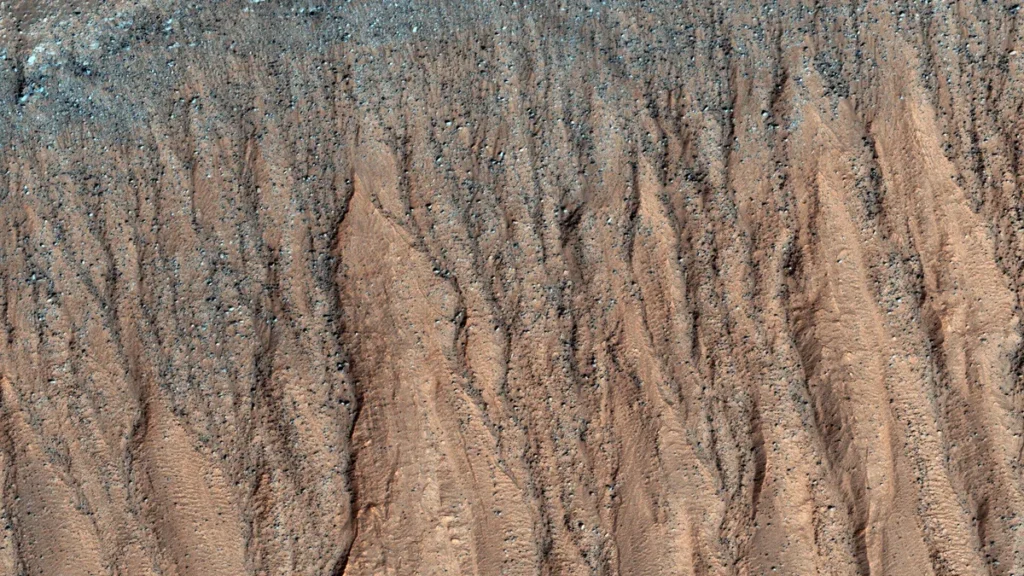
- NASA's Mars Reconnaissance Orbiter observed new channels appearing, old channels lengthening, and fresh material accumulating at the bottoms of slopes, indicating that some gullies were still changing.
- On Mars, carbon dioxide ice sublimates directly from solid to gas under the planet's low atmospheric pressure, rather than melting into liquid.
- CO2 geysers form when sunlight passes through translucent dry ice slabs, heating the underlying soil, causing subsurface CO2 to pressurize and erupt through cracks, carrying dust onto the surface.
Seasonal carbon dioxide frost on Mars can carve gullies that closely resemble water‑eroded features through a CO2‑ice‑driven fluidization (a process where released gas loosens soil, allowing it to flow like a liquid) or avalanche process, according to a French team of astrophysicists led by Université Paris‑Saclay reporting in an arXiv preprint in 2026.
On Mars, carbon dioxide ice sublimates directly from a solid to a gas under the planet’s low atmospheric pressure, rather than melting into a liquid. As the carbon dioxide frost sublimates, the emerging gas infiltrates the soil, separates grains and reduces friction, allowing dust, rock and dry ice to flow downhill almost like a liquid, analogous to an air‑hockey puck gliding on a cushion of air. At Sisyphi Cavi, the carbon dioxide ice remains translucent through much of the season, providing suitable conditions for CO2 geyser formation (formed when sunlight passes through translucent dry ice slabs, heating subsurface soil, causing subsurface CO2 to pressurize and erupt through cracks).
On Mars, CO2 geysers operate via the Kieffer mechanism (a process where sunlight through translucent ice heats subsurface soil, causing CO2 to sublimate, pressurize and erupt). A translucent dry ice sheet allows sunlight to heat subsurface soil, sublimating CO2, and the pressurized gas erupts as high‑velocity jets, lofting dark plumes of sand and soil observed as dark spots.
Dark spots associated with CO2 geysers appear in late winter and early spring, whereas gully erosion and deposition peak later, as the seasonal ice thins, creating a temporal mismatch that makes geysers an unlikely primary cause of gully changes. The research focused on Sisyphi Cavi, a system of steep‑sided depressions located near the south pole of Mars, where active gullies are currently being modified by ongoing processes.
Sisyphi Cavi, a system of deep polar pits situated near the south polar ice cap, lies well outside the more temperate latitudes where Martian gullies typically occur.
The paper is titled “Properties of Seasonal Ice at Sisyphi Cavi and Implications for Current Modification of Martian Gullies,” was authored by Apolline Leclef and colleagues, and was published on the arXiv preprint server in the year 2026. The article can be found using the DOI 10.48550/arxiv.2609.03885.
The Mars Global Surveyor spacecraft first photographed the gullies in images reported in 2000, revealing features that closely resembled terrain eroded by flowing water. Scientists had proposed that groundwater, melting snow, or thawing buried ice carved these Martian gullies, possibly during a period when Mars was warmer or when orbital changes increased the amount of sunlight hitting icy slopes. NASA’s Mars Reconnaissance Orbiter later observed new channels appearing, while also observing old channels lengthening, and fresh material accumulating at the bottoms of slopes, indicating that some gullies were still changing.
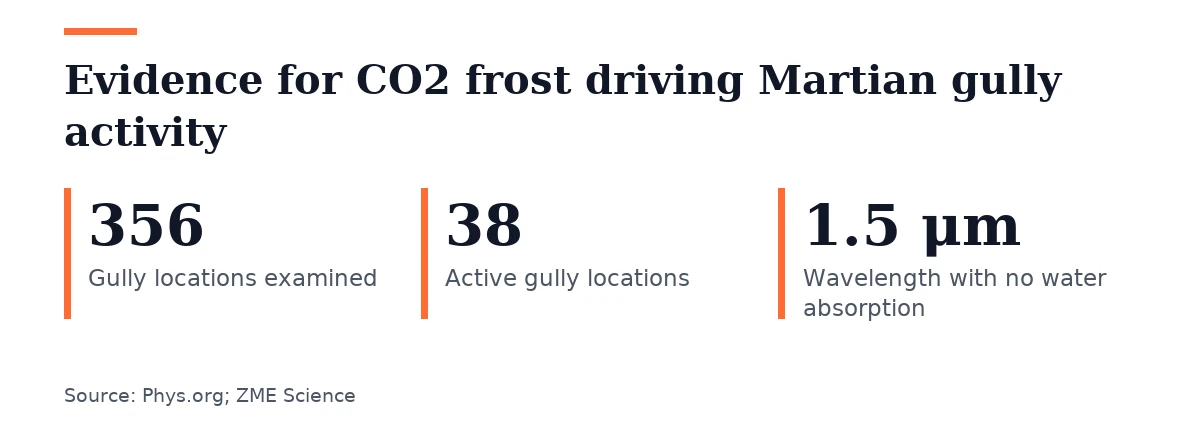
A 2014 NASA study examined gullies at 356 locations. The study identified active changes at 38 of them, and found that activity coincided with seasonal carbon dioxide frost and temperatures too low for liquid water. This directed scientific attention toward dry ice as a driver.
A 2014 NASA study also indicated that Martian gullies are younger than previously thought, suggesting that they are the result of recent activity and pointing to seasonal carbon dioxide freezing as the responsible process. In 2002, Australian geologist Nick Hoffman proposed that frozen carbon dioxide formed Martian gullies, an idea that his colleagues initially met with skepticism.
Observations show that gully activity occurs during the late spring season when seasonal carbon dioxide ice sublimates, rather than during colder periods when liquid water would be unstable.
The team found abundant carbon dioxide ice at Sisyphi Cavi. They found no independent deposits of water ice during the late spring, when the gullies were changing. This indicates that liquid water was not driving the observed changes.
Spectral data showed no water absorption band at a wavelength of 1.5 micrometers during the spring. Salts and clays were detected only on high plateaus and crater rims, not near the active gullies.
Although small amounts of water ice might be trapped inside the carbon dioxide frost at Sisyphi Cavi, observations showed no evidence that it melted. They showed no evidence that it drove the gully flows.
Faint signs of sulfate salts and clay minerals appear mainly on the surrounding plateaus and near the rims of depressions, not beside the active gullies. This suggests that erosion may have exposed older mineral‑bearing layers.
The findings do not eliminate proof that ancient Mars once hosted rivers and lakes. Certain gullies could have formed through water erosion initially, later altered by CO2 frost processes. Gullies that differ in shape or position might have followed distinct formation paths.
The study’s conclusions apply specifically to present‑day changes at Sisyphi Cavi. They do not necessarily explain the original formation of every gully on Mars. At Sisyphi Cavi, Mars can produce a convincing imitation of water erosion using little more than frozen atmosphere, sunlight and gravity, without the need for liquid water.
The researchers noted that gullies at lower altitudes may or may not share the CO2‑ice‑driven fluidization process. It is too early to rule out CO2 geysers as a contributing factor.
Gullies are not the sole indicator that scientists use when they search for water on Mars.



Join the discussion