Key facts
- A University of Arizona-led team observed WISE 0855 with JWST for 11 hours, recording light every 15 minutes.
- Cloud signal changes on WISE 0855 originate higher in the atmosphere than changes in those gases.
- WISE 0855 atmosphere exhibits simultaneous upper-layer cloud shifts and deeper-layer gas uplift.
- Further JWST observations could determine WISE 0855's rotation and reveal three-dimensional atmospheric motions.
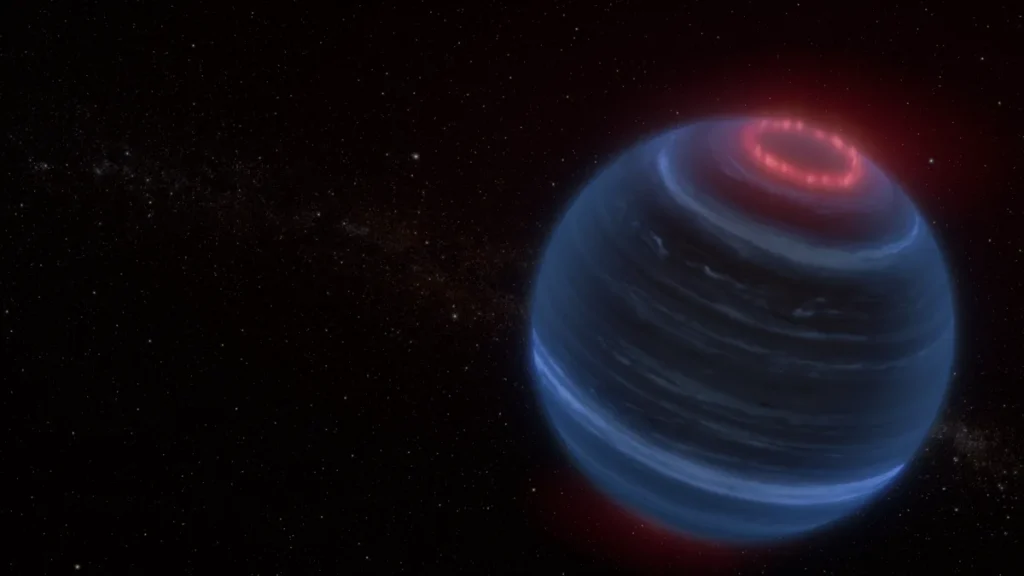
A University of Arizona-led team used the James Webb Space Telescope to observe WISE 0855 for 11 hours, recording light every 15 minutes. Using JWST, researchers confirmed for the first time that water clouds outside our solar system thicken and thin over time on WISE 0855.
The data revealed high-altitude water cloud patches on WISE 0855 that varied in thickness with the object’s rotation. Cloud signal changes on WISE 0855 originate higher in the atmosphere than changes in gases such as carbon monoxide and phosphine.
At the same time, carbon monoxide and phosphine showed variations that followed a different pattern than the clouds on WISE 0855. The study indicates that convection, the upward movement of heat, drives carbon monoxide and phosphine up from hotter, deeper layers of WISE 0855’s atmosphere.
The atmosphere exhibits simultaneous upper-layer cloud shifts and deeper-layer gas uplift. The observed atmospheric behavior mimics that seen on Jupiter and other giant planets, even though WISE 0855 is a brown dwarf that drifts alone in space.
WISE 0855 has an atmospheric temperature of around 265 kelvins (17 degrees Fahrenheit). It has approximately twice Jupiter’s mass and roughly Jupiter’s size.
Such similarities could aid scientists in understanding the atmospheres of large exoplanets, planets that orbit stars outside our solar system. Because they generate their own heat and light, brown dwarfs are simpler to observe than objects that lie close to bright stars. Further JWST observations could determine WISE 0855’s rotation and reveal three-dimensional atmospheric motions. Researchers have secured acceptance for the WISE 0855 paper in The Astrophysical Journal, and a preprint version resides on arXiv.
SIMP 0136 has a mass of about 13 times that of Jupiter. Its temperature is around 1,500 degrees Fahrenheit (816 degrees Celsius). It lies about 20 light-years from Earth, a light-year being the distance light travels in one year, in the constellation Pisces.
JWST observations show that most atmospheric variability on SIMP 0136 arises from two dominant processes: temperature changes and vertical cloud structure changes. On SIMP 0136, the pair of processes yields three repeating weather conditions that move into and out of sight as the object turns.
Principal Component Analysis, a statistical method that identifies the main patterns in data, of JWST data identified temperature and cloud structure as the strongest components, with weaker fluctuations separated from noise. Applying this technique to many brown dwarfs and giant exoplanets will improve understanding of diverse weather systems beyond the Solar System.
The light from SIMP 0136 observed by JWST in 2023 had traveled for about two decades. That light was emitted around the year the lead researcher, Merle Schrader, was born. Scientists point out that a beam of light needs just a bit more than one second to go from Earth to the Moon, underscoring how far away SIMP 0136 lies.





Join the discussion