Key facts
- Astronomers used the James Webb Space Telescope to observe extremely faint, metal-poor galaxies from the early universe, aided by gravitational lensing from massive foreground galaxy clusters.
- LAP1-B and LAP2 both exhibit exceptionally low oxygen abundances, placing them among the most metal-poor systems studied for clues about the universe's first stars.
- A massive foreground galaxy cluster magnified LAP1-B's light by a factor of 100 through gravitational lensing, serving as a natural magnifying glass for the otherwise extremely faint object.
- The team spent more than 30 hours observing LAP1-B with spectroscopy, a technique that separates light into individual wavelengths to identify elements and measure abundances.
A team led by Kanazawa University Associate Professor Kimihiko Nakajima used the James Webb Space Telescope to identify LAP1-B, an extraordinarily primitive galaxy from the early universe that existed when the cosmos was about 800 million years old, roughly 13 billion years ago, on November 27, 2026.
Spectroscopic observations placed the galaxy at redshift 6.625 plus or minus 0.001. LAP1-B’s oxygen abundance measures approximately 1/240th that of the Sun, or 0.42% of the solar value, making it the chemically least evolved star-forming galaxy measured to date. The team gathered spectra for more than 30 hours using spectroscopy, which separates light into wavelengths that reveal chemical makeup, distance and motion and lets researchers identify elements and determine abundances.
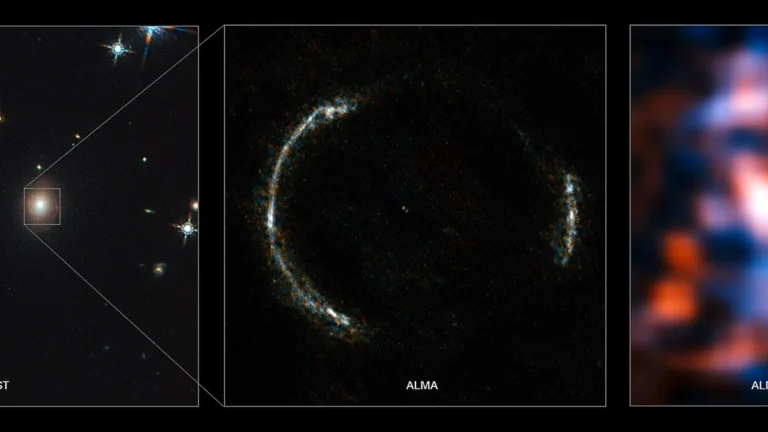
A massive foreground galaxy cluster magnified LAP1-B’s light by a factor of 100, acting as a natural magnifying glass for the otherwise extremely faint object. Gravitational lensing occurs when a massive object’s gravity bends and magnifies light from distant sources behind it, effectively creating a giant lens in space. The magnification let astronomers examine structure and chemistry that would otherwise be out of reach.
LAP1-B contains relatively more carbon than oxygen would suggest given its general lack of heavy elements. That pattern fits predictions for material ejected by stars born from gas with no heavy elements. Oxygen abundance tracks the ratio of oxygen atoms to hydrogen atoms, and because hydrogen existed from the start, it serves as a benchmark for measuring how much later generations of stars have enriched a galaxy.
The team also detected exceptionally energetic ionizing radiation in LAP1-B. Its characteristics disagree with chemically enriched stellar populations or feeding black holes but match predictions for stars with exceptionally small quantities of heavy elements. Ionizing radiation is strong enough to remove electrons from atoms, and its observed properties point toward stars with almost no heavy elements rather than black holes or enriched stellar groups.
Because the continuous glow from its stars was undetectable, researchers set an upper limit of under 3,300 solar masses for LAP1-B’s combined stellar mass. Gas motion measurements show the galaxy’s overall gravitational mass is greater than the mass of its stars and gas together, pointing to a dominant invisible dark matter halo.
Dark matter makes up about 85% of all matter in the cosmos and can be detected through its gravitational effects on visible material. It emits no light but accounts for most of the universe’s matter, revealing itself through the gravitational pull it exerts on visible material.
LAP1-B fits the predicted ancestors of Ultra-Faint Dwarf galaxies near the Milky Way because it combines tiny stellar mass, a strong dark matter halo and very primitive chemistry. These systems rank among the smallest and faintest galaxies known, hold relatively few stars, many formed over 12 billion years ago, and underwent minimal chemical change.
Nakajima said scientists can now study the primordial gas directly from that ancient epoch instead of acting like cosmic archaeologists examining old stars in our neighborhood. He hopes the finding represents a major advance in learning how the elements in human bodies originated and spread through the cosmos.
Researchers intend to keep using the James Webb Space Telescope to hunt for even more primitive objects, with the ultimate aim of finding the first galaxies that formed after the Big Bang. ScienceDaily reported on the study, which appeared in the peer-reviewed journal Nature in 2026.
A second early-universe galaxy, LAP2, was studied by a team led by Matteo Messa of the INAF Astrophysics and Space Science Observatory of Bologna.
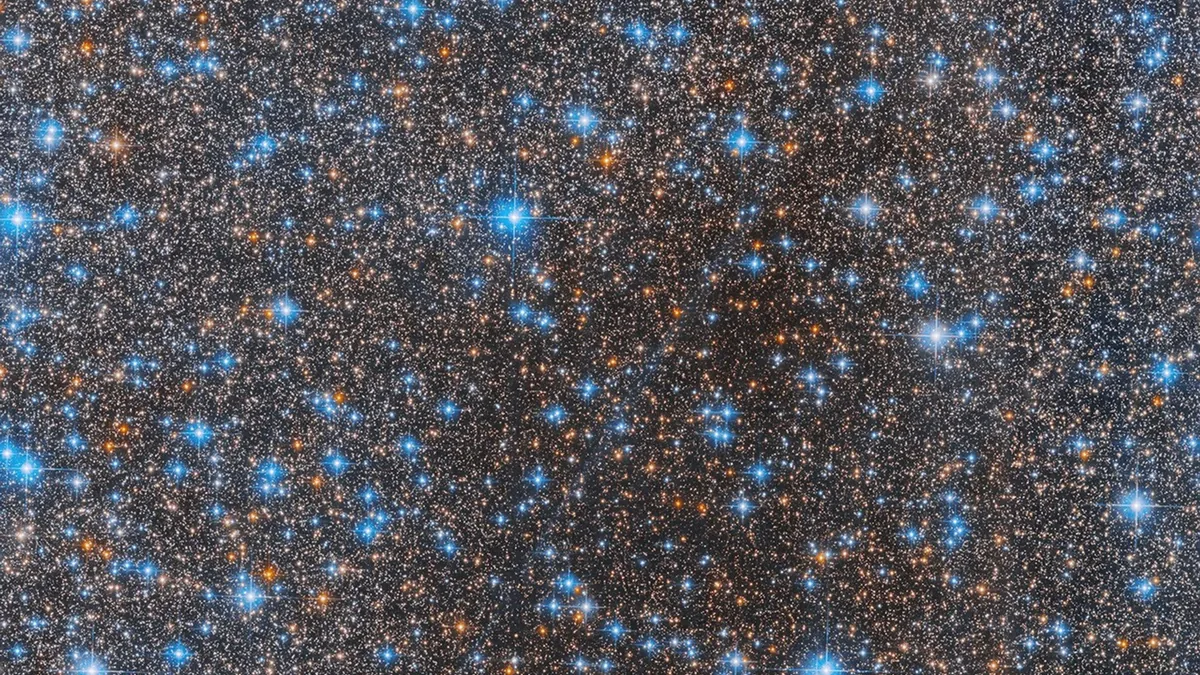
JWST observed LAP2, one of the most metal-poor galaxies known, as it appeared around 12.2 billion years ago, when its stellar mass was comparable to a massive star cluster. Modeling of its colors and emission lines puts the stellar mass at around 80,000 solar masses and the best-fit stellar age at around 7 million years, with signs of a recent burst of star formation free of dust.
LAP2 lies at redshift 4, in an epoch roughly 1.5 billion years after the Big Bang, in a fairly empty region between two groups of galaxies. Its location between two galaxy groups in an empty region may shield its gas from enrichment by neighbors.
LAP2 is strongly magnified roughly 50 times by the foreground galaxy cluster Abell 2744 and was first identified in MUSE observations in 2021. That magnification allowed detailed study of a galaxy too faint to examine otherwise, bringing its chemistry within reach.
JWST NIRSpec spectroscopy found no oxygen signal across the full galaxy of LAP2, indicating oxygen below roughly half a percent of the solar value. That ranks among the lowest measurements yet still higher than Population III expectations, though uncertainties remain because the measurement method is new at such low levels. The lack of an oxygen signal across most of LAP2 suggests extremely low metal content.
The team says LAP2’s isolation may protect gas from pollution by nearby galaxies’ winds, letting pockets of nearly pristine gas survive and supporting it as a site of pristine star formation. Extremely metal-poor galaxies contain only a small fraction of the sun’s metals or less and act as natural laboratories for tracing early star formation and galaxy evolution.
LAP1-B sits at redshift 6.625 while LAP2 lies at redshift 4. Their oxygen levels differ, at about 0.42% of the solar value for LAP1-B and below roughly half a percent for LAP2. Both exhibit exceptionally low oxygen abundances, placing them among the most metal-poor systems studied for clues about the universe’s first stars.
The Big Bang left the universe almost entirely of hydrogen and helium, with heavier elements such as carbon and oxygen produced later by the universe’s earliest stars, known as Population III stars. Those stars formed from nearly pristine gas containing no heavy elements, ended the Cosmic Dark Ages, and released newly created elements when they exploded, enabling rocky planets and living organisms.
LAP1-B offers a direct observational link between the universe’s first stars and the ancient ultra-faint dwarf galaxies near the Milky Way. That link helps test galaxy-formation models, could solve a decades-old mystery about ancient, faint galaxies near the Milky Way, and could reveal how life’s chemical building blocks first spread across the cosmos.
Astronomers used the James Webb Space Telescope to observe extremely faint, metal-poor galaxies from the early universe, aided by gravitational lensing from massive foreground galaxy clusters. The technique brings the structure and chemistry of otherwise unreachable objects into view, as with the hundredfold magnification of LAP1-B and the roughly fiftyfold magnification of LAP2 by their foreground clusters.



Join the discussion