Key facts
- A team from the Aerospace Information Research Institute of the Chinese Academy of Sciences and partners built a mathematical model that applies morphometric parameters to quickly judge lunar impact crater wear and age.
- Combined with the 2.83 Ga age of the farside basalt samples, the finding implies a degradation rate of 5.24 ± 0.22 m2/Myr, in line with past lunar mare figures.
- Measuring how worn individual craters are and dating them matters for studying how the lunar surface evolved.
- A crater's age follows from the model output through a degradation-rate calibration step.
Phys.org reported the work. Researchers from the Aerospace Information Research Institute of the Chinese Academy of Sciences and partners constructed a mathematical model using morphometric parameters to assess lunar impact crater wear and age quickly. Morphometric parameters measure crater shape, including diameter and depth-to-diameter ratio, to indicate how worn a crater is. Micrometeorite bombardment wears craters down, so assessing that wear helps researchers study lunar surface evolution.
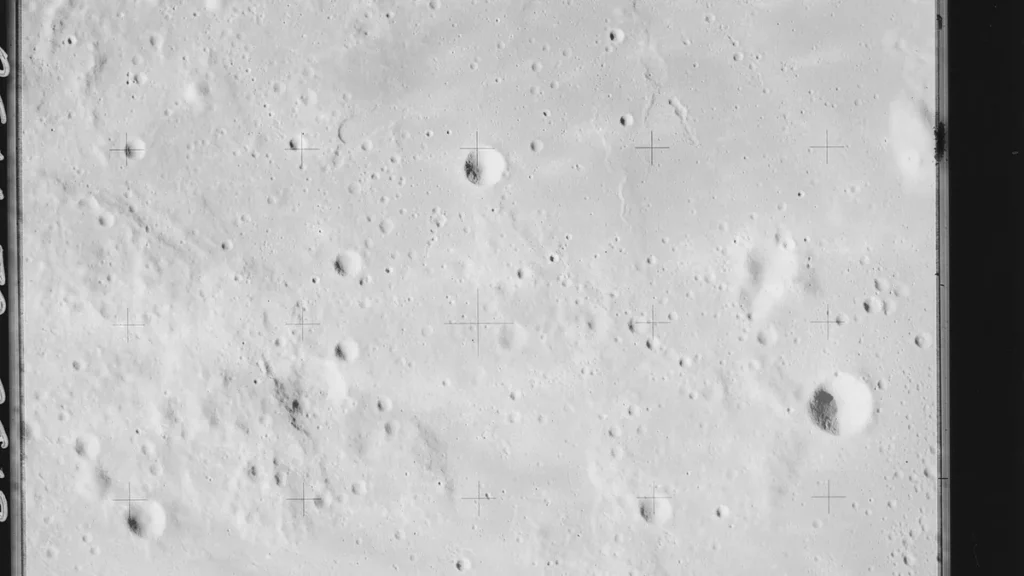
The group tested the method on craters in the Chang’e-6 landing area. Researchers ran the model on 140 craters bigger than 480 m in the Chang’e-6 landing area and recorded a maximum degradation state of 14,830 ± 645 m2. The Chang’e-6 landing area supplied the test craters on the Moon’s far side, where the mission returned farside basalt samples dated to 2.83 Ga. Combined with the 2.83 Ga age of the farside basalt samples, the result implies a degradation rate of 5.24 ± 0.22 m2/Myr, consistent with past lunar mare figures.
The rate quantifies square meters of crater change per million years and matches earlier lunar mare findings. Over long stretches, micrometeorite bombardment makes lunar craters shallower and their walls less steep. That gradual physical change explains why researchers monitor degradation state to study lunar surface evolution. Crater condition acts as a clock for the lunar surface, connecting individual wear to the Moon’s broader history.
Assessing individual crater wear and determining its age matters for studying lunar surface evolution. The older topographic diffusion method requires repeated simulations and profile comparisons, making it computationally complex and expensive. The traditional approach’s heavy computing demands motivated the team to create the faster morphometric model. Researchers combined crater-degradation simulations rooted in diffusion with symbolic regression, yielding a model that derives degradation state from crater diameter and depth-to-diameter ratio.
Symbolic regression converts the simulated data into a compact equation, replacing repeated profile comparisons with a direct calculation from current crater size and shape. Beginning with published fresh-crater profiles, the team simulated wear for simple craters spanning 0.4–5.0 km, or 0.25–3.1 miles. They applied symbolic regression to build an equation linking current diameter and depth-to-diameter ratio to K1000. K1000 serves as the standardized degradation measure, and the simulations started with assumed fresh crater shapes before tracking wear.
Keeping initial crater shape constant allowed the team to isolate the faster model’s performance against the established diffusion approach. Experiments demonstrated that the simple model matches degradation changes from conventional diffusion simulations when both use identical starting assumptions about crater shape. The equation produces degradation state rather than age directly. A crater’s age comes from the model output via a degradation-rate calibration step.
The research measured uncertainty in degradation-state estimates arising from crater-shape measurements, equation-fitting residuals and assumptions about the original crater profile. Reviewing these three error sources reveals how measurement error, curve fit and starting geometry shape the reliability of each estimate. The journal Icarus published the research.
Chenxu Zhao et al. authored ‘A mathematical model for dating a degraded lunar crater using morphometric parameters,’ which appeared in Icarus in 2027 with DOI 10.1016/j.icarus.2026.117368, according to Phys.org.


Join the discussion