Key facts
- A research team led by Qinwei Yuan of Nanjing University, China, studied the gas-rich dwarf galaxy UGCA 320 to measure how mass is distributed within it and check whether its center is cuspy or cored.
- Lambda Cold Dark Matter expects a dense central cusp where density climbs steeply inward, but observations of small galaxies reveal a flat smooth core, a conflict known as the cusp-core problem.
- Warm dark matter fits UGCA 320 only if the particle mass is about 0.003 keV, but other observations rule out warm dark matter particles lighter than roughly 3 to 6.6 keV, so it fits poorly.
- Simulations indicate that star-formation bursts and falling clumps may smooth a cusp yet produce cores only around 0.1 to 2 kiloparsecs, far smaller than UGCA 320's 7 to 12 kiloparsecs core.
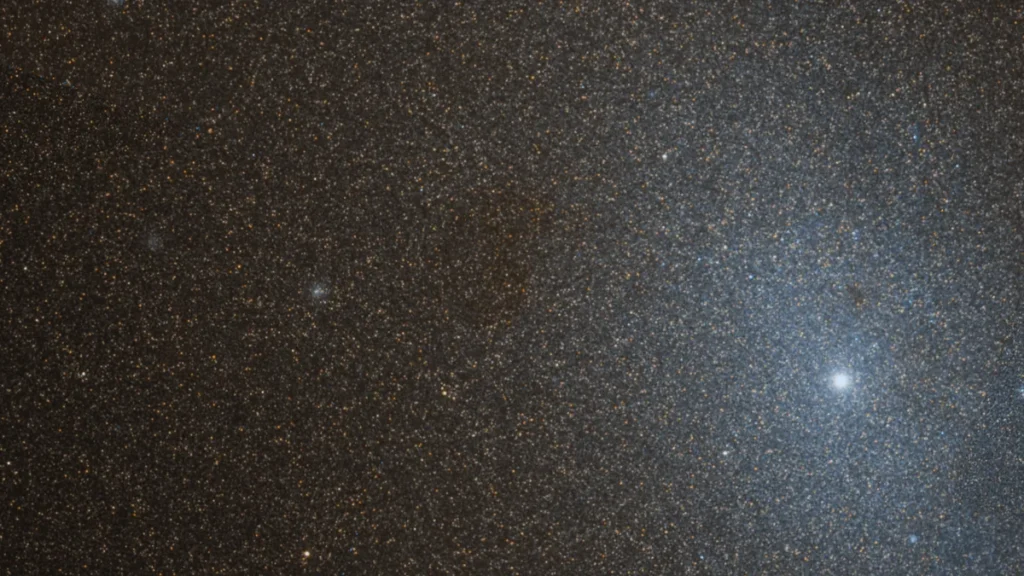
Phys.org reported that a team of astronomers had combined optical observations from the MUSE instrument with radio measurements from the MeerKAT array and found that the nearby dwarf galaxy UGCA 320 hosts an unusually large dark matter core. The finding challenges predictions of the Lambda Cold Dark Matter cosmological model. It is presented as new evidence that a nearby dwarf galaxy may challenge predictions of the widely accepted cosmological model. The paper was posted to the arXiv preprint server on Nov. 11, 2026.
A research team led by Qinwei Yuan of Nanjing University in China studied the gas-rich dwarf galaxy UGCA 320 to measure how mass is distributed within it and check whether its center is cuspy or cored. The study is positioned within the cusp-core problem, where Lambda Cold Dark Matter predicts a sharp central cusp but small-galaxy observations point to a flat core. Qinwei Yuan et al. posted the paper titled “A giant dark matter core extending far beyond the stars of a dwarf galaxy” to the arXiv preprint server on Nov. 11, 2026, listing DOI 10.48550/arxiv.2611.15528.
Lambda Cold Dark Matter expects a dense central cusp where density climbs steeply inward. Observations of small galaxies reveal a flat, smooth core, a conflict known as the cusp-core problem. Cold dark matter moves slowly and interacts through gravity, a definition Phys.org introduces when contrasting cold dark matter with alternative candidates such as warm, self-interacting and fuzzy dark matter. Alternative dark matter candidates such as warm, self-interacting and fuzzy dark matter have been proposed to address this mismatch, alongside an ordinary-matter explanation involving repeated star formation and supernovae.
Researchers combined MeerKAT radio data tracing UGCA 320’s neutral hydrogen distribution with MUSE and WiFeS optical data tracing hydrogen-alpha glow from gas near star-forming regions. They also used Spitzer infrared images showing the locations of the stars. These observations were fed into a three-dimensional tilted-ring model that treats the galaxy as concentric rings with individual tilt and speed to derive the rotation curve.
The tilted-ring approach measures rotation speed at different distances from the galactic center. It treats the galaxy as a stack of concentric rings, each with its own tilt and rotation speed. After deriving the rotation curve, researchers estimated the gas and stellar contributions, subtracted normal matter, and fit the residual to dark matter models. Phys.org explains that subtracting the contribution of gas and stars isolates the residual rotation that astronomers attribute to dark matter before comparing it to halo models.
The team fit the residual rotation curve to four dark matter models. These were cuspy Navarro-Frenk-White, cored pseudo-isothermal and Burkert, and flexible generalized Navarro-Frenk-White. The observations fit cored distributions better than the cuspy Navarro-Frenk-White profile. This outcome motivated the comparison among these four models.
Two best-fit models yielded core radii for UGCA 320’s dark matter: 7.62 kiloparsecs (24,850 light-years) and 11.97 kiloparsecs (39,000 light-years). The UGCA 320 observations are poorly described by the cuspy Navarro-Frenk-White halo. Models with a flatter core distribution, including pseudo-isothermal and Burkert models, provide a better fit.
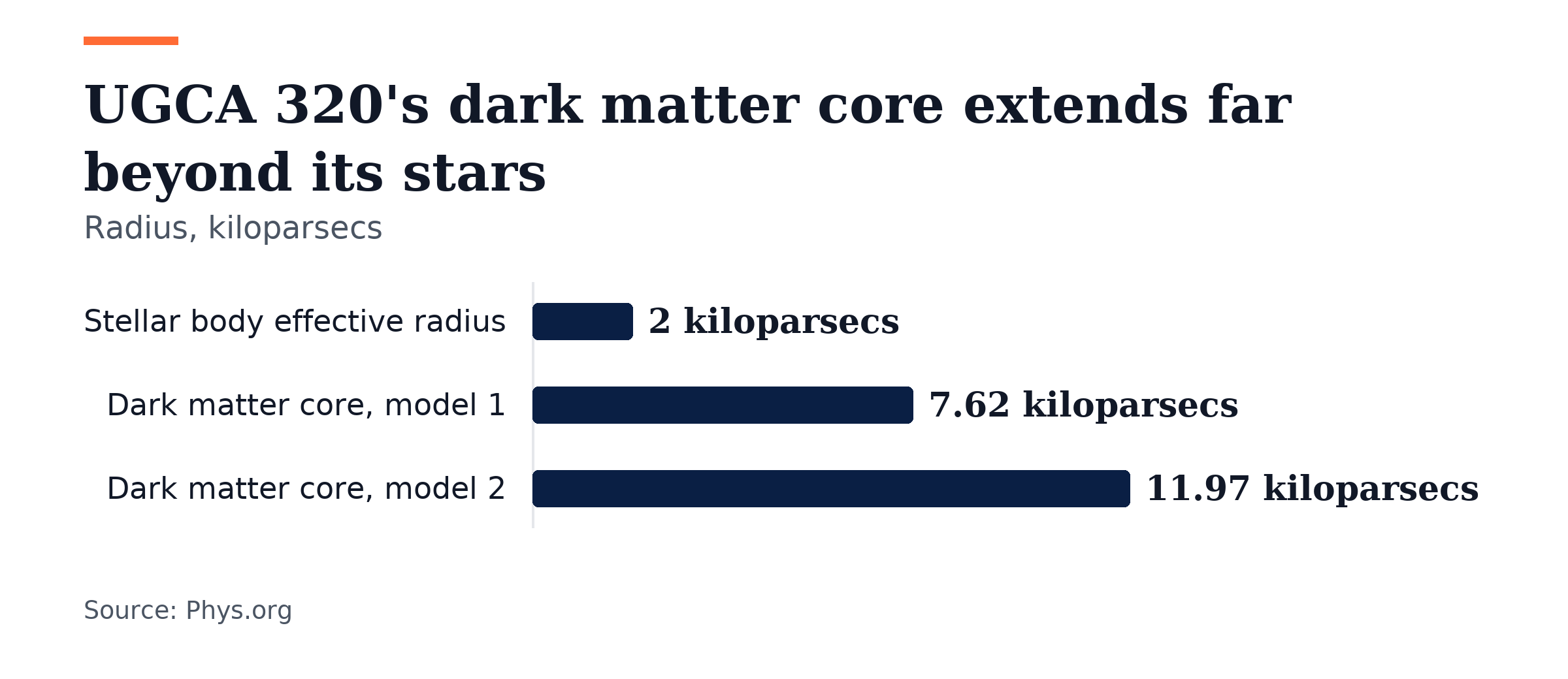
UGCA 320’s stellar body has an effective radius of about 2 kiloparsecs (6,600 light-years). This is the region containing half of the galaxy’s starlight. Models show the dark matter core extends far beyond it. The authors state in their paper that a dark matter core this large is rare for dwarf galaxies.
Self-interacting dark matter fits the UGCA 320 data best because its particles transfer kinetic energy inward and spread the center out. The needed interaction strength matches ranges found for galaxies of this size. The team concluded that its results are broadly consistent with the self-interacting dark matter scenario and appear to be in tension with warm dark matter and fuzzy dark matter predictions.
Warm dark matter fits UGCA 320 only if the particle mass is about 0.003 keV. Other observations rule out warm dark matter particles lighter than roughly 3 to 6.6 keV, so it fits poorly. Fuzzy dark matter, made of ultralight particles with wavelike behavior, fits the shape of UGCA 320’s core but not the required particle mass range. Phys.org groups fuzzy dark matter with warm dark matter as alternatives the team tested against the UGCA 320 observations, finding both constrained by particle mass limits.
Simulations indicate that star-formation bursts and falling clumps may smooth a cusp yet produce cores only around 0.1 to 2 kiloparsecs. This is far smaller than UGCA 320’s 7 to 12 kiloparsecs core. No prior study has demonstrated that supernovae can generate dark matter cores spanning 7 to 12 kiloparsecs in a galaxy similar to UGCA 320. “Such a large dark matter core radius is uncommon among dwarf galaxies,” the team writes in the paper.

Join the discussion